Department of Community Health and Family Medicine, University of Zambia, Lusaka, Zambia.
Health Economics and Policy Unit, Department of Health Systems and Policy, Kamuzu University of Health Sciences, Lilongwe, Malawi.
PLoS One. 2024 Oct 9;19(10):e0301735. doi: 10.1371/journal.pone.0301735. eCollection 2024.
Harmful alcohol use is associated with significant risks to public health outcomes worldwide. Although data on harmful alcohol use have been collected by population-based HIV Impact Assessment (PHIA), there is a dearth of analysis on the effect of HIV/ART status on harmful alcohol use in the Sub-Saharan Africa (SSA) countries with PHIA surveys.
A secondary analysis of the PHIA surveys: Namibia (n = 27,382), Tanzania (n = 1807), Zambia (n = 2268), Zimbabwe (n = 3418), Malawi (n = 2098), Namibia (n = 27,382), and Eswatini (n = 2762). Using R version 4.2, we analysed the uptake and correlates of harmful alcohol consumption in SSA. The cutoff point for statistically significant was P<0.05.
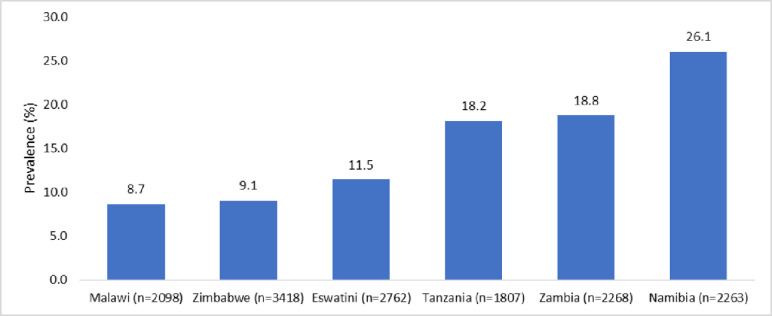
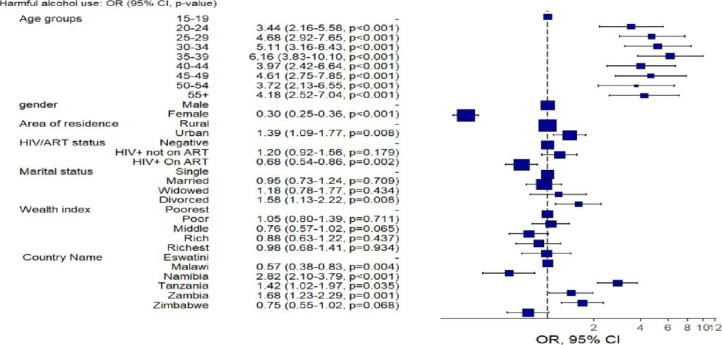
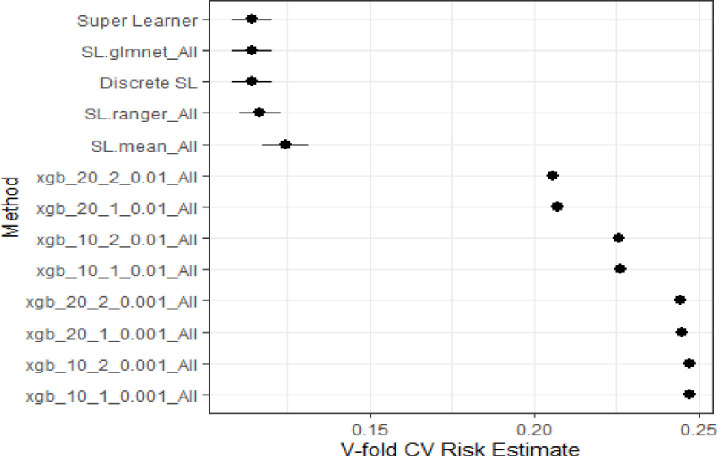
Of the 12,460 persons, 15% used alcohol harmfully. Harmful alcohol use varied by countries and ranged from 8.7% in Malawi to 26.1% in Namibia (P<0.001). Being female or HIV-positive and on ART were associated with less-likelihood of harmful alcohol consumption however persons that were HIV-positive and not on ART was associated with higher likelihood of harmful alcohol use (OR = 1.49, 95% CI: 1.32-1.69, P<0.001). The best performing models were Lasso or Super Learner or Random Forest were the best performing models while gradient boosting models or sample mean did not perform well.
Harmful alcohol use was high. Harmful alcohol use varied by countries, sex, age, HIV/ART status and marital status. Therefore, there is a need to introduce or enforce harmful alcohol use control policies in SSA through taking into account these characteristics.
有害饮酒在全球范围内与重大公共健康问题息息相关。尽管基于人群的艾滋病毒影响评估(PHIA)已经收集了有害饮酒的数据,但在进行 PHIA 调查的撒哈拉以南非洲(SSA)国家中,关于艾滋病毒/抗逆转录病毒治疗(ART)状况对有害饮酒影响的分析却很少。
对 PHIA 调查进行二次分析:纳米比亚(n=27382)、坦桑尼亚(n=1807)、赞比亚(n=2268)、津巴布韦(n=3418)、马拉维(n=2098)、纳米比亚(n=27382)和斯威士兰(n=2762)。使用 R 版本 4.2,我们分析了 SSA 中有害饮酒的采用率和相关因素。具有统计学意义的截断点为 P<0.05。
在 12460 人中,有 15%的人有害饮酒。有害饮酒的使用因国家而异,范围从马拉维的 8.7%到纳米比亚的 26.1%(P<0.001)。女性或艾滋病毒阳性且正在接受抗逆转录病毒治疗与较低的有害饮酒可能性相关,但艾滋病毒阳性且未接受抗逆转录病毒治疗的人更有可能有害饮酒(OR=1.49,95%CI:1.32-1.69,P<0.001)。表现最好的模型是 Lasso 或 Super Learner 或随机森林,而梯度提升模型或样本均值表现不佳。
有害饮酒率很高。有害饮酒的使用因国家、性别、年龄、艾滋病毒/ART 状况和婚姻状况而异。因此,需要考虑到这些特征,在 SSA 引入或执行有害饮酒控制政策。