Quintini Dario, Rizzo Giacomo Emanuele Maria, Tarantino Ilaria, Sarzo Giacomo, Fantin Alberto, Miraglia Roberto, Maruzzelli Luigi, Ligresti Dario, Carrozza Lucio, Rancatore Gabriele, Gruttadauria Salvatore, Cillo Umberto, Ferrara Francesco, Traina Mario
Endoscopy Service, Department of Diagnostic and Therapeutic Services, IRCCS - ISMETT, Palermo, Italy.
Department of Surgical, Oncological and Gastroenterological Sciences, University of Padua, Padua, Italy.
Surg Endosc. 2024 Dec;38(12):7233-7242. doi: 10.1007/s00464-024-11243-6. Epub 2024 Oct 9.
Post-surgical biliary leaks (PSBL) are one of the most prevalent and significant adverse events emerging after liver or biliary tract surgeries. Endoscopic retrograde cholangiopancreatography (ERCP) alone or combined with another approach (Rendez Vous) as treatment of PSBL obtains optimal outcomes due to the possibility of modifying the resistances in the biliary tree.
A retrospective double-center study was conducted in two tertiary centers. Consecutive patients who underwent at least one attempt of PSBL correction by ERCP or Rendez Vous procedure between January 2018 and August 2023 were included. The primary outcome was overall endoscopic clinical success. In contrast, the secondary outcomes were hospital stay exceeding five days and endoscopic clinical success with the first endoscopic procedure at the tertiary center. Both univariate and multivariate analyses were used to assess outcomes.
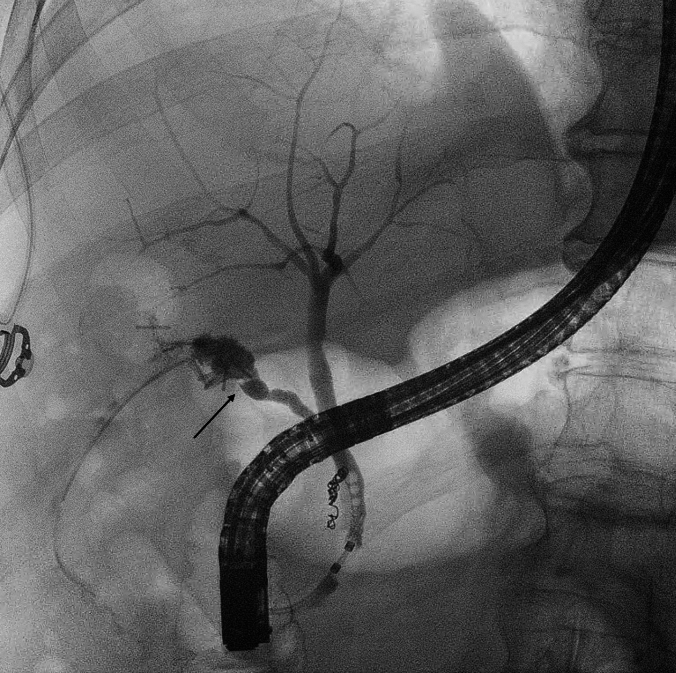
65 patients were included. Patients with one or multiple) leaks had more possibility to achieve the endoscopic clinical success compared to those affected by the association of leaks and stricture (96% vs 67%, p value 0.005). Leaks occurring in the main biliary duct had less probability (67%) to achieve the overall endoscopic clinical success compared to those in the end-to-end anastomosis (90%), in the resection plane or biliary stump (96%) or first or secondary order biliary branches (100%, p value 0.038). A leak-bridging stent positioning had more probability of achieving the endoscopic clinical success than a not leak-bridging stent (91% vs 53%, p value 0.005).
ERCP and Rendez Vous procedures are safe and effective for treating PSBL, regardless of the type of preceding surgery, even if technical or clinical success was not achieved on the first attempt. A stent should be placed, if feasible, leak-bridging to enhance treatment efficacy.
术后胆漏(PSBL)是肝脏或胆道手术后最常见且严重的不良事件之一。由于能够改变胆管树中的阻力,单独使用内镜逆行胰胆管造影术(ERCP)或联合另一种方法(会师法)治疗PSBL可取得最佳效果。
在两家三级中心进行了一项回顾性双中心研究。纳入2018年1月至2023年8月期间至少接受过一次ERCP或会师法纠正PSBL尝试的连续患者。主要结局是内镜总体临床成功率。相比之下,次要结局是住院时间超过5天以及在三级中心首次内镜手术时的内镜临床成功率。采用单因素和多因素分析来评估结局。
共纳入65例患者。与合并胆漏和狭窄的患者相比,发生一处或多处胆漏的患者更有可能实现内镜临床成功(96%对67%,p值0.005)。与端端吻合处(90%)、切除平面或胆管残端(96%)或一级或二级胆管分支处(100%)的胆漏相比,主胆管发生的胆漏实现内镜总体临床成功的概率较低(67%,p值0.038)。放置漏桥支架比未放置漏桥支架更有可能实现内镜临床成功(91%对�3%,p值0.005)。
ERCP和会师法治疗PSBL安全有效,无论之前的手术类型如何,即使首次尝试未取得技术或临床成功。如果可行,应放置漏桥支架以提高治疗效果。