Norwegian Veterinary Institute, Oslo, Norway.
BMC Microbiol. 2024 Oct 9;24(1):399. doi: 10.1186/s12866-024-03563-3.
Foodborne pathogens such as Campylobacter jejuni are responsible for a large proportion of the gastrointestinal infections worldwide associated with poultry meat. Campylobacter spp. can be found in the chicken fecal microbiome and can contaminate poultry meat during the slaughter process. Commonly used sampling methods to detect Campylobacter spp. at poultry farms use fecal droppings or boot swabs in combination with conventional culture techniques or PCR. In this pilot study, we have used air filtering and filters spiked with mock communities in combination with shotgun metagenomics to detect Campylobacter and test the applicability of this approach for the detection and characterization of foodborne pathogens. To the best of our knowledge is this the first study that combines air filtering with shotgun metagenomic sequencing for detection and characterization of Campylobacter.
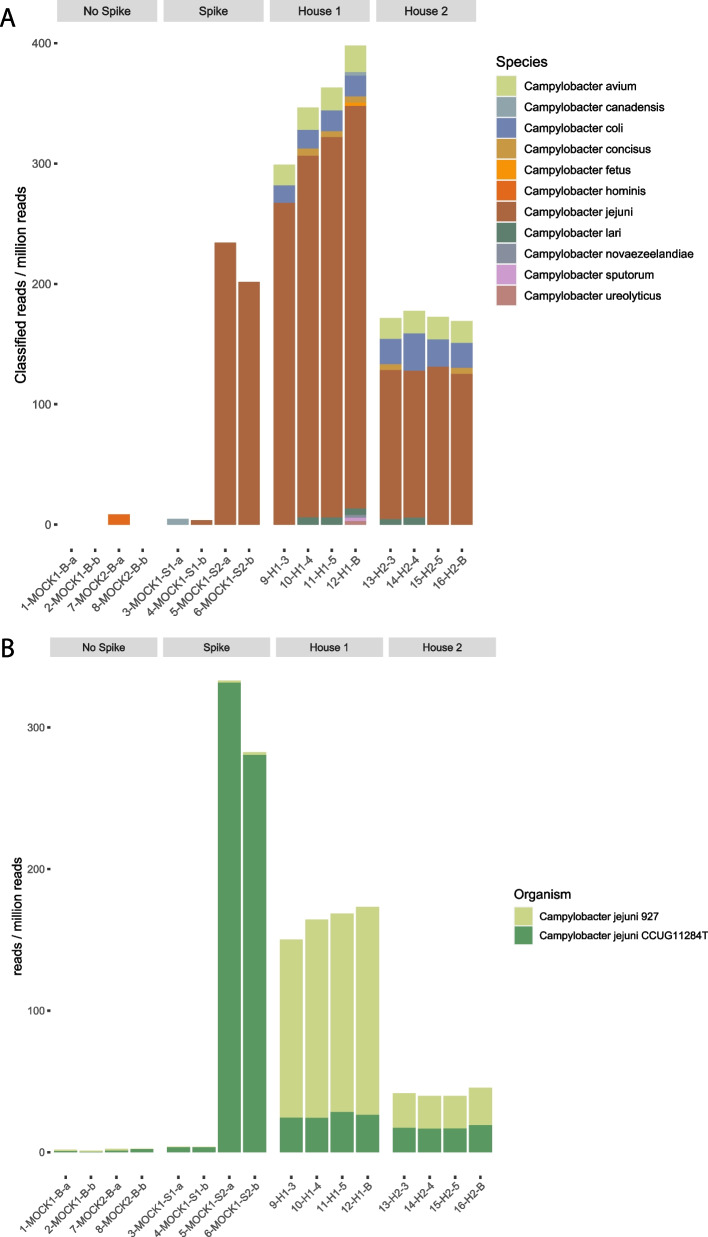
Analysis of air filters spiked with different levels of Campylobacter, into a background of mock or poultry house communities, indicated that we could detect as little as 200 colony forming units (CFU) Campylobacter per sample using our protocols. The results indicate that even with limited sequencing effort we could detect Campylobacter in the samples analysed in this study. We observed significant amounts of Campylobacter in real-life samples from poultry houses using both real-time PCR as well as shotgun metagenomics, suggesting that the flocks in both houses were infected with Campylobacter spp. Interestingly, in both houses we find diverse microbial communities present in the indoor air which reflect the fecal microbiome of poultry. Some of the identified genera such as Staphylococcus, Escherichia and Pseudomonas are known to contain opportunistic pathogenic species.
These results show that air sampling of poultry houses in combination with shotgun metagenomics can detect and identify Campylobacter spp. present at low levels. This is important since early detection of Campylobacter enables measures to be put in place to ensure the safety of broiler products, animal health and public health. This approach has the potential to detect any pathogen present in poultry house air.
空肠弯曲菌等食源性病原体是导致全球与禽肉相关的胃肠道感染的主要原因之一。弯曲菌可存在于鸡的粪便微生物群中,并可在屠宰过程中污染禽肉。在禽场中常用的采样方法来检测弯曲菌,采用粪便或靴子拭子与常规培养技术或 PCR 相结合。在本初步研究中,我们使用空气过滤和接种模拟群落的过滤器与鸟枪法宏基因组学相结合,来检测空肠弯曲菌并测试该方法用于检测和鉴定食源性病原体的适用性。据我们所知,这是首次将空气过滤与鸟枪法宏基因组测序相结合来检测和鉴定空肠弯曲菌的研究。
对用不同水平的空肠弯曲菌接种的空气过滤器进行分析,结果表明,我们可以用我们的方案检测到每个样本低至 200 个菌落形成单位(CFU)的空肠弯曲菌。结果表明,即使测序工作有限,我们仍可以检测到本研究中分析的样本中的空肠弯曲菌。我们使用实时 PCR 和鸟枪法宏基因组学在禽舍的实际样本中都观察到了大量的空肠弯曲菌,这表明两个禽舍的禽类都感染了空肠弯曲菌属。有趣的是,我们在两个禽舍的室内空气中都发现了大量反映禽粪便微生物群的多样化微生物群落。一些鉴定出的属,如葡萄球菌、大肠杆菌和假单胞菌,都含有机会性致病种。
这些结果表明,对禽舍进行空气采样并结合鸟枪法宏基因组学可以检测和鉴定低水平存在的空肠弯曲菌。这一点很重要,因为早期检测空肠弯曲菌可以采取措施确保肉鸡产品、动物健康和公共卫生的安全。该方法有潜力检测到禽舍空气中存在的任何病原体。