The First Hospital of Jilin University, No.1 Xinmin Street, Changchun, 130012, China.
BMC Public Health. 2024 Oct 9;24(1):2760. doi: 10.1186/s12889-024-20268-4.
BACKGROUND&AIMS: Gastrointestinal (GI) cancers, including gastric, liver, esophageal, pancreatic, and colorectal cancers, represent significant global health burdens. Emerging evidence suggests that dietary patterns, particularly their inflammatory and oxidative properties, may influence cancer risk. The Dietary Inflammatory Index (DII) and Dietary Oxidative Balance Score (DOBS) assess the inflammatory and oxidative effects of diets, respectively. This study aims to explore the association between DII, DOBS, and the combined risk of GI cancers, and investigates the potential mediating roles of serum albumin and red cell distribution width (RDW).
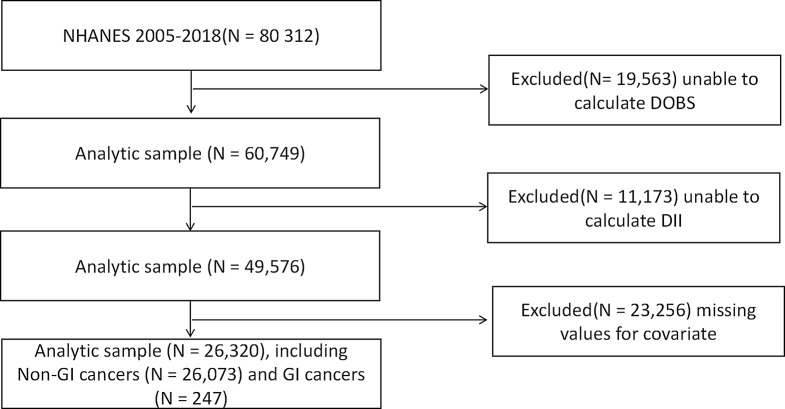
Data from 26,320 participants in the NHANES 2005-2018 cycles were analyzed. DII was calculated based on 28 dietary components, and DOBS included 17 nutrients (3 pro-oxidants and 14 antioxidants). Logistic regression models assessed the associations between DII, DOBS, and GI cancers. Restricted cubic spline (RCS) models examined dose-response relationships. Mediation analysis evaluated the roles of serum albumin and RDW. Subgroup analyses explored interactions with demographic and health-related factors.
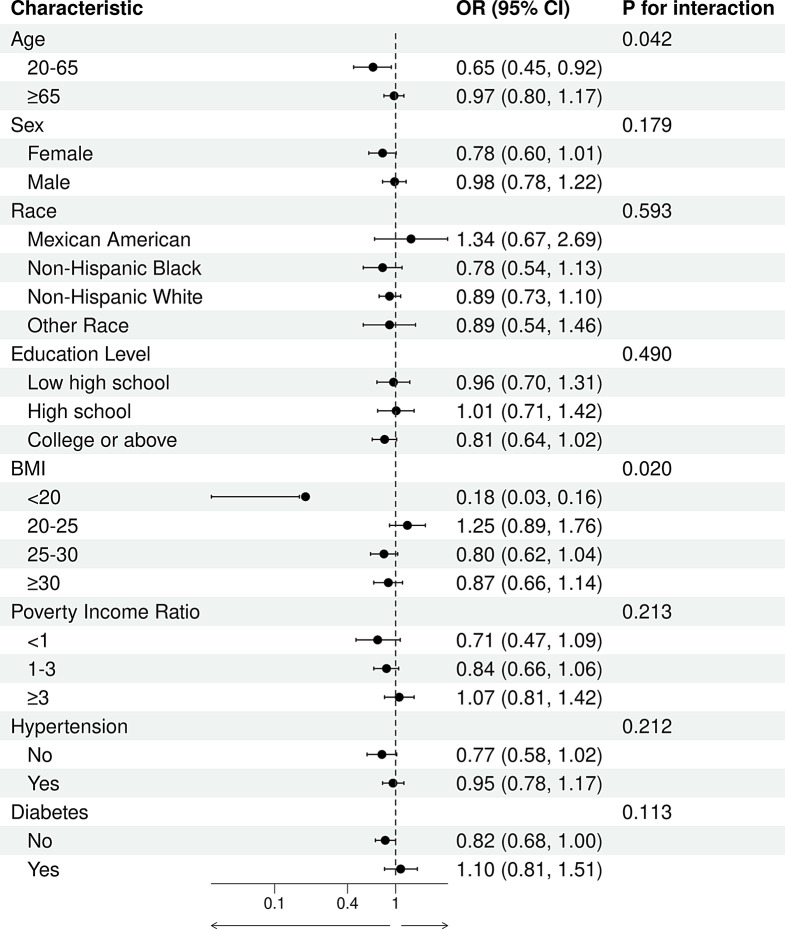
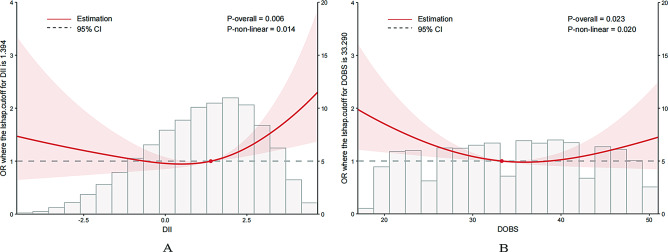
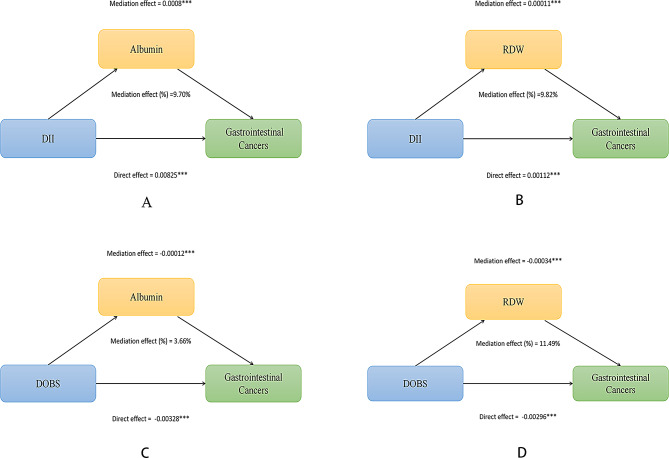
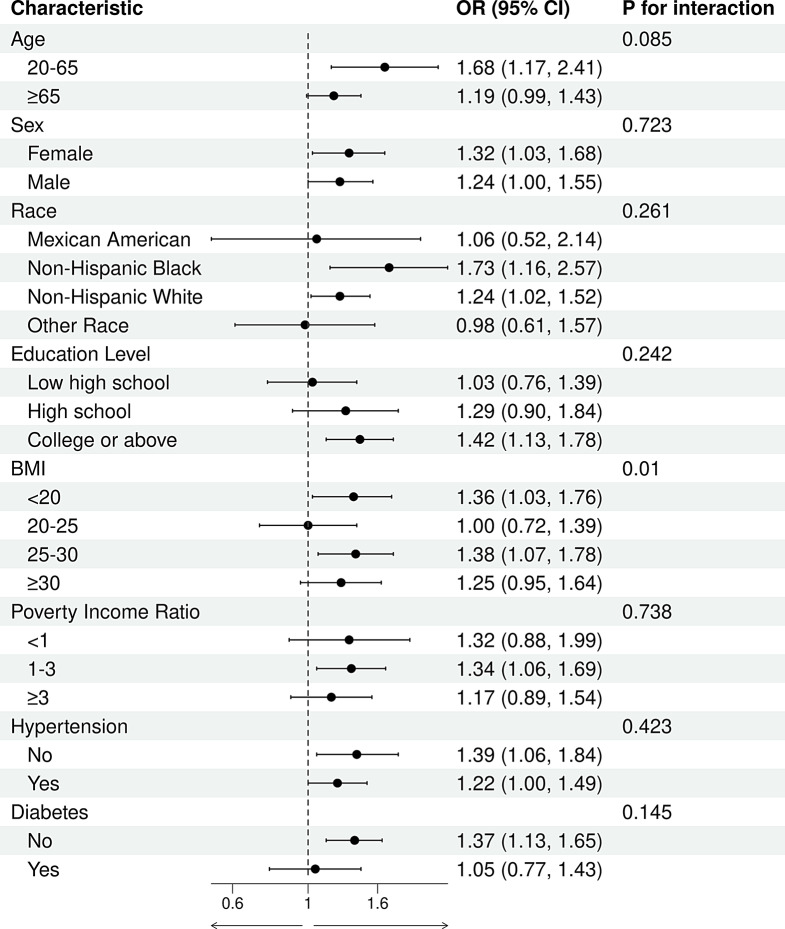
Higher DII was associated with increased GI cancer risk (OR: 1.26, 95% CI: 1.07-1.49 per unit increase), while higher DOBS was associated with reduced risk (OR: 0.90, 95% CI: 0.76-0.99 per unit increase). RCS analysis indicated a significant nonlinear relationship between DII and GI cancer risk. Serum albumin and RDW partially mediated the associations between DII, DOBS, and GI cancers. Subgroup analyses showed stronger associations for DII among certain demographics, and significant interactions were found between DII and BMI. For DOBS, significant interactions were observed with age and BMI.
This study reveals significant associations between dietary inflammatory and oxidative balance scores and GI cancer risk. Higher DII is linked to increased risk, while higher DOBS is protective. The mediating roles of serum albumin and RDW provide insights into underlying mechanisms. These findings underscore the potential of dietary modifications in GI cancer prevention and management, emphasizing the importance of anti-inflammatory and antioxidant-rich diets.
胃肠道(GI)癌症,包括胃癌、肝癌、食管癌、胰腺癌和结直肠癌,是全球重大的健康负担。新出现的证据表明,饮食模式,尤其是其炎症和氧化特性,可能会影响癌症风险。膳食炎症指数(DII)和膳食氧化平衡评分(DOBS)分别评估饮食的炎症和氧化作用。本研究旨在探讨 DII、DOBS 与 GI 癌症的综合风险之间的关联,并研究血清白蛋白和红细胞分布宽度(RDW)的潜在中介作用。
分析了 2005-2018 年 NHANES 周期中 26320 名参与者的数据。根据 28 种饮食成分计算 DII,DOBS 包括 17 种营养素(3 种促氧化剂和 14 种抗氧化剂)。使用逻辑回归模型评估 DII、DOBS 与 GI 癌症之间的关联。受限三次样条(RCS)模型用于检查剂量-反应关系。中介分析评估了血清白蛋白和 RDW 的作用。亚组分析探讨了与人口统计学和健康相关因素的相互作用。
DII 越高,GI 癌症风险越高(OR:1.26,95%CI:1.07-1.49,每单位增加),而 DOBS 越高,风险越低(OR:0.90,95%CI:0.76-0.99,每单位增加)。RCS 分析表明,DII 与 GI 癌症风险之间存在显著的非线性关系。血清白蛋白和 RDW 部分介导了 DII、DOBS 与 GI 癌症之间的关联。亚组分析表明,DII 在某些人群中具有更强的相关性,并且在 DII 和 BMI 之间发现了显著的相互作用。对于 DOBS,发现与年龄和 BMI 之间存在显著的相互作用。
本研究揭示了膳食炎症和氧化平衡评分与 GI 癌症风险之间的显著关联。DII 越高,风险越高,而 DOBS 越高,则具有保护作用。血清白蛋白和 RDW 的中介作用提供了潜在机制的见解。这些发现强调了饮食改变在 GI 癌症预防和管理中的潜力,强调了抗炎和富含抗氧化剂的饮食的重要性。