Institute for Molecular Bioscience, The University of Queensland, 306 Carmody Road, St Lucia QLD 4067, Australia.
Australian Institute for Bioengineering and Nanotechnology, The University of Queensland, Corner College Road and Cooper Road, St Lucia QLD 4067, Australia.
Cereb Cortex. 2024 Oct 3;34(10). doi: 10.1093/cercor/bhae401.
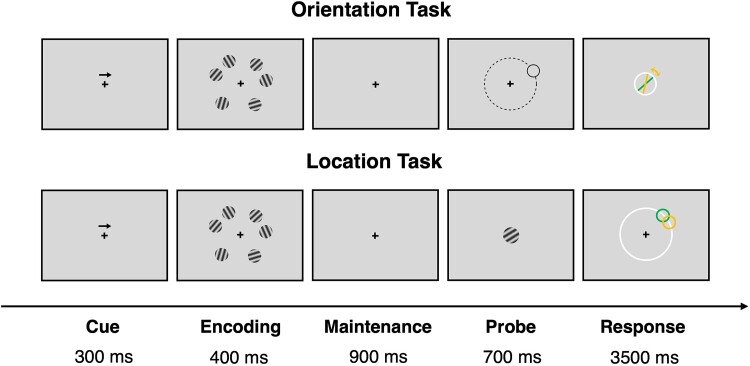
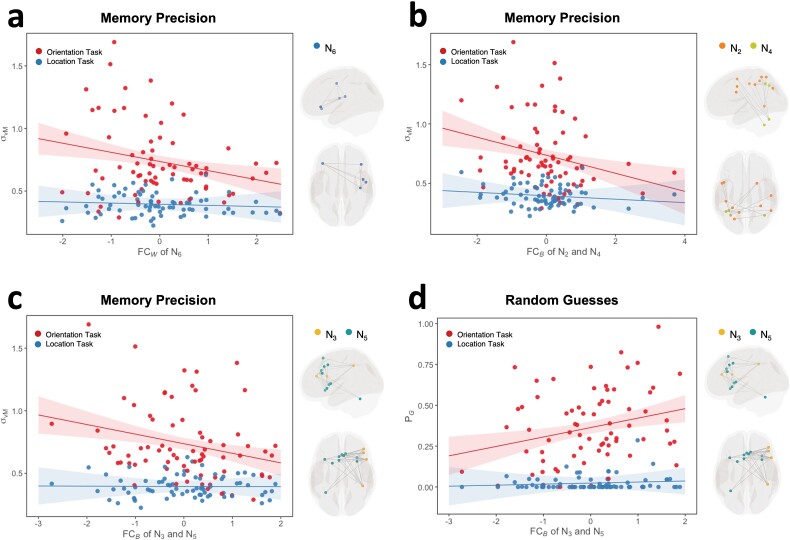
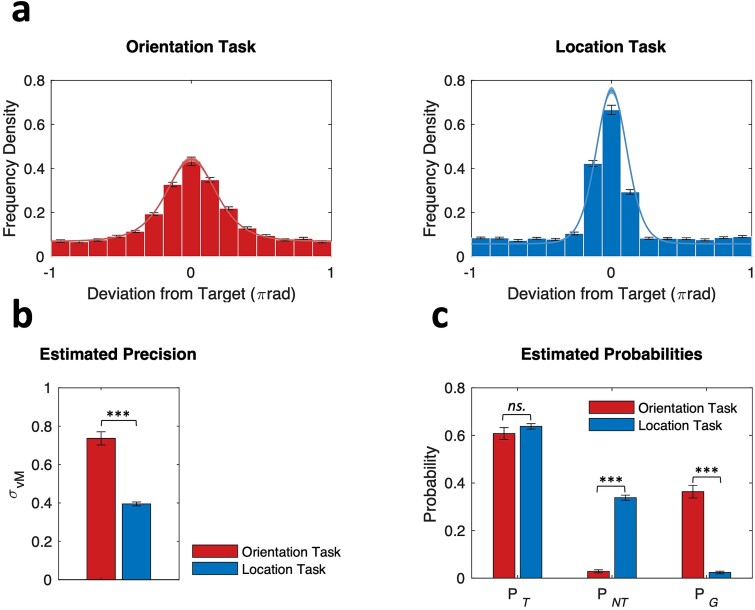
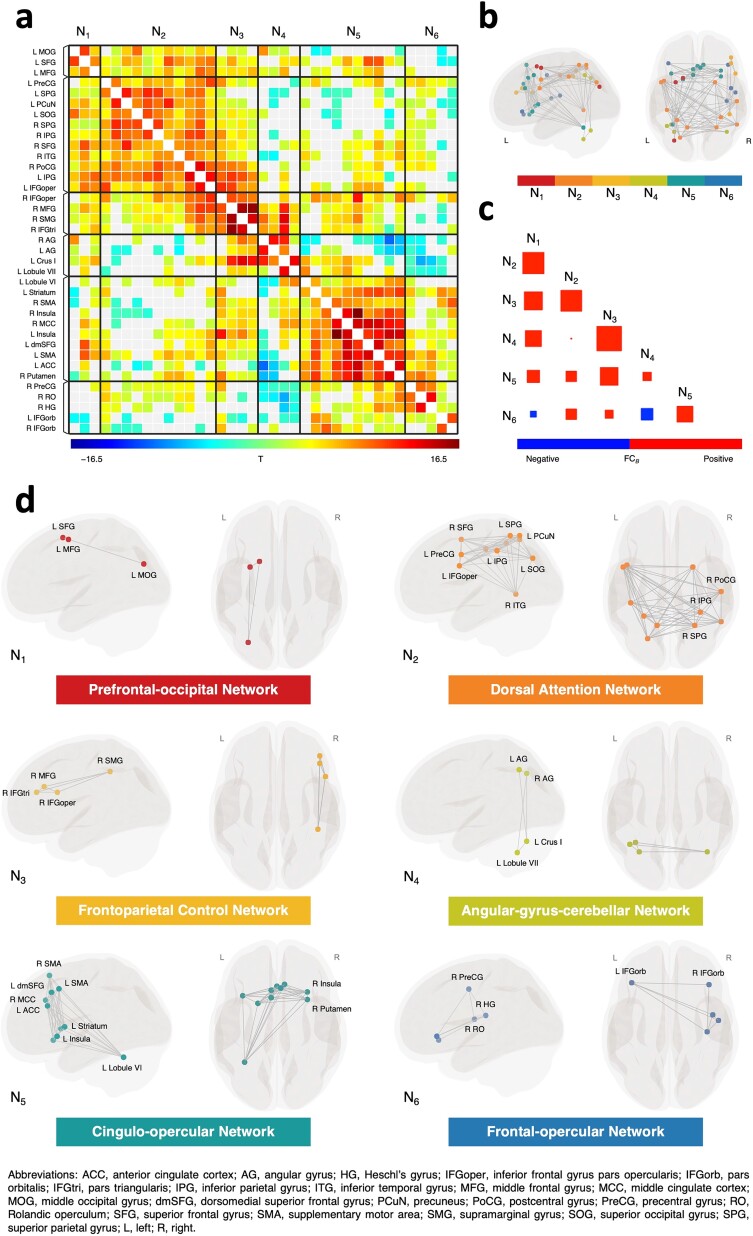
Visual working memory (VWM) is a core cognitive function wherein visual information is stored and manipulated over short periods. Response errors in VWM tasks arise from the imprecise memory of target items, swaps between targets and nontargets, and random guesses. However, it remains unclear whether these types of errors are underpinned by distinct neural networks. To answer this question, we recruited 80 healthy adults to perform delayed estimation tasks and acquired their resting-state functional magnetic resonance imaging scans. The tasks required participants to reproduce the memorized visual feature along continuous scales, which, combined with mixture distribution modeling, allowed us to estimate the measures of memory precision, swap errors, and random guesses. Intrinsic functional connectivity within and between different networks, identified using a hierarchical clustering approach, was estimated for each participant. Our analyses revealed that higher memory precision was associated with increased connectivity within a frontal-opercular network, as well as between the dorsal attention network and an angular-gyrus-cerebellar network. We also found that coupling between the frontoparietal control network and the cingulo-opercular network contributes to both memory precision and random guesses. Our findings demonstrate that distinct sources of variability in VWM performance are underpinned by different yet partially overlapping intrinsic functional networks.
视觉工作记忆(VWM)是一种核心认知功能,其中视觉信息在短时间内被存储和操作。VWM 任务中的反应错误源于目标项目的不精确记忆、目标与非目标之间的交换以及随机猜测。然而,这些类型的错误是否由不同的神经网络支持仍不清楚。为了回答这个问题,我们招募了 80 名健康成年人来执行延迟估计任务,并获取了他们的静息态功能磁共振成像扫描。任务要求参与者沿着连续的刻度重现记忆中的视觉特征,这与混合分布建模相结合,使我们能够估计记忆精度、交换错误和随机猜测的度量。使用分层聚类方法对每个参与者的不同网络内和网络间的内在功能连接进行了估计。我们的分析表明,较高的记忆精度与额眶网络内以及背侧注意网络和角回-小脑网络之间的连接增加有关。我们还发现,顶-顶间控制网络和扣带回-脑岛网络之间的耦合有助于记忆精度和随机猜测。我们的研究结果表明,VWM 表现中不同的可变性来源由不同但部分重叠的内在功能网络支持。