Roßmann Kilian, Sun Siqi, Olesen Christina Holmboe, Kowald Maria, Tapp Eleni, Pabst Ulrich, Bieck Marie, Birke Ramona, Shields Brenda C, Jeong PyeongHwa, Hong Jiyong, Tadross Michael R, Levitz Joshua, Lehmann Martin, Lipstein Noa, Broichhagen Johannes
Leibniz-Forschungsinstitut für Molekulare Pharmakologie (FMP), 13125 Berlin, Germany.
Duke University, Department of Biomedical Engineering, Durham, North Carolina 27708, USA.
bioRxiv. 2024 Sep 23:2024.09.20.614087. doi: 10.1101/2024.09.20.614087.
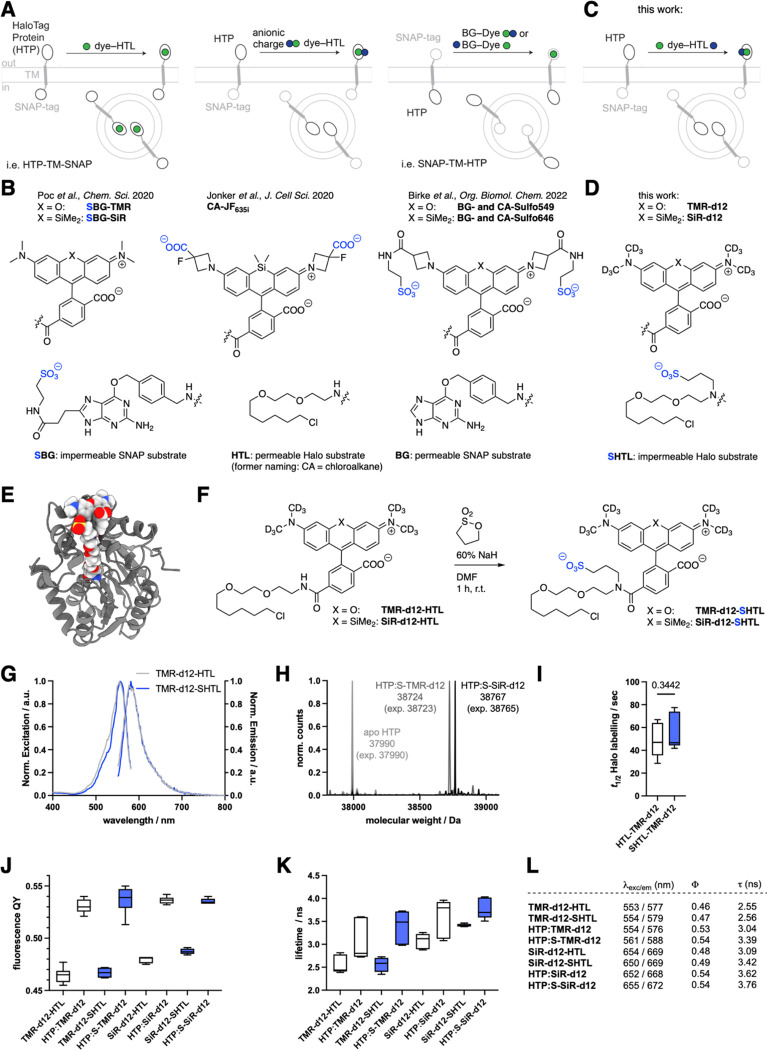
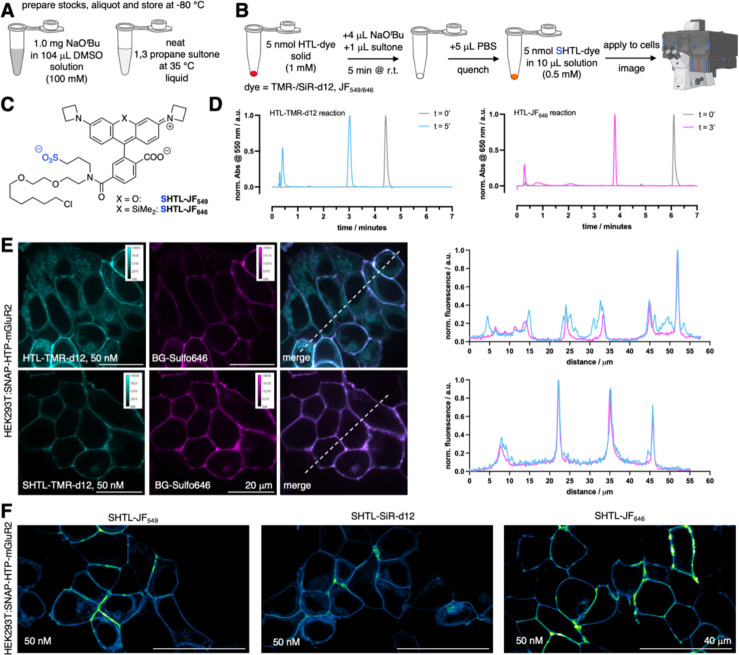
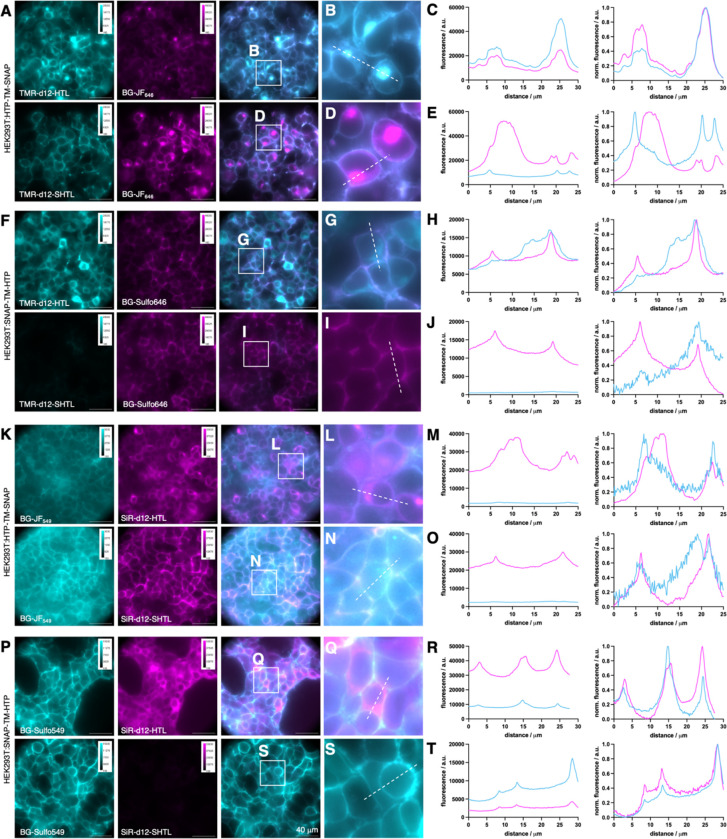
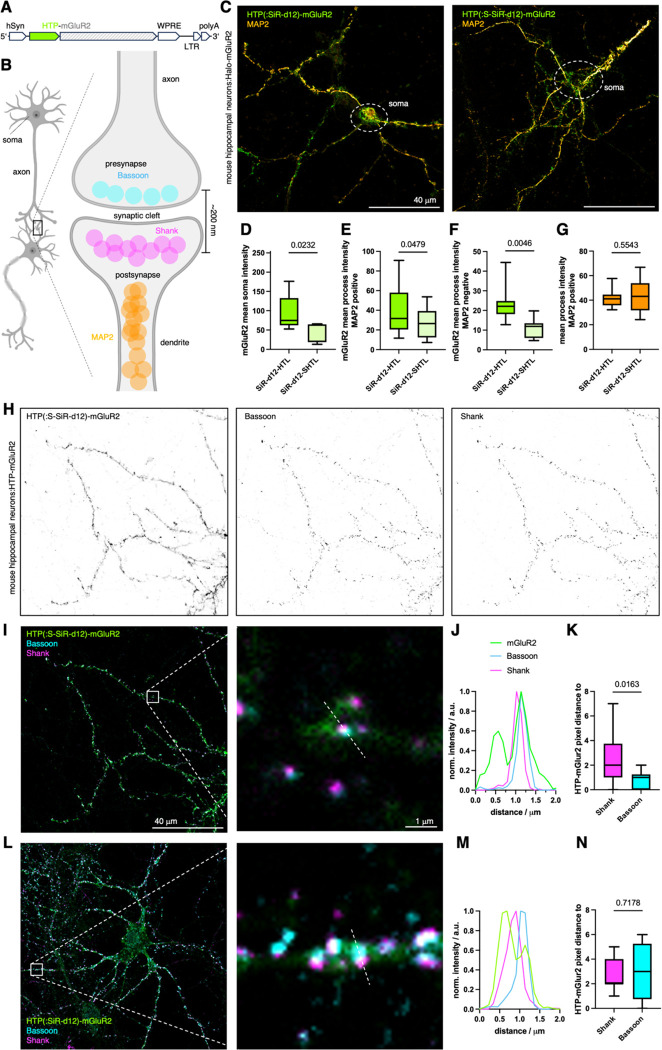
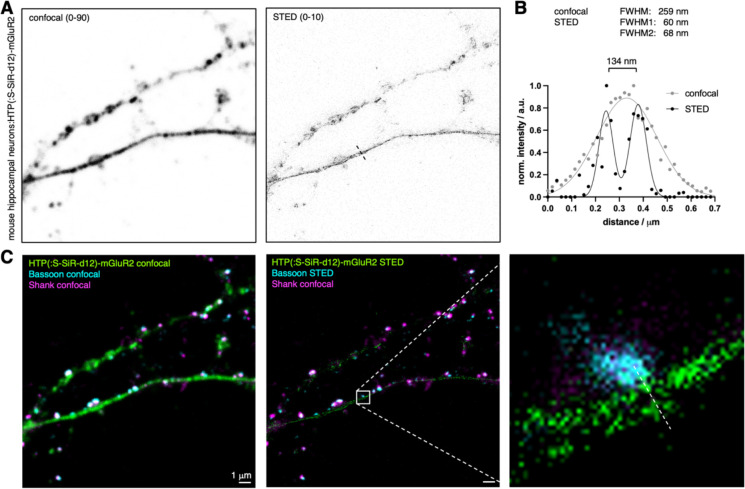
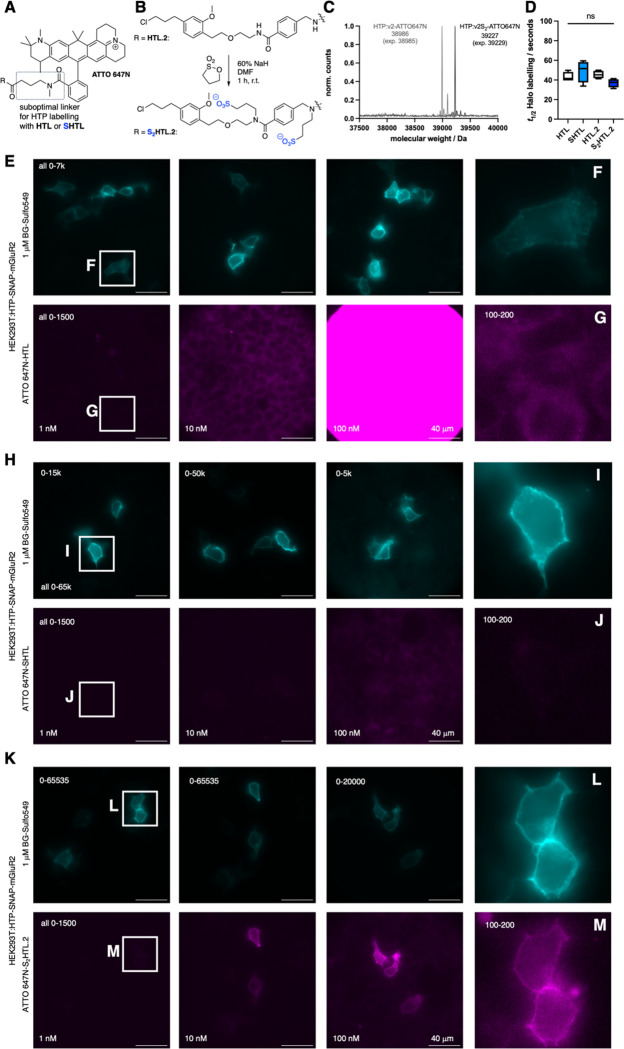
Communication between cells is largely orchestrated by proteins on the cell surface, which allow information transfer across the cell membrane. Super-resolution and single-molecule visualization of these proteins can be achieved by genetically grafting HTP (HaloTag Protein) into the protein of interest followed by brief incubation of cells with a dye-HTL (dye-linked HaloTag Ligand). This approach allows for use of cutting-edge fluorophores optimized for specific optical techniques or a cell-impermeable dye-HTL to selectively label surface proteins without labeling intracellular copies. However, these two goals often conflict, as many high-performing dyes exhibit membrane permeability. Traditional methods to eliminate cell permeability face synthetic bottlenecks and risk altering photophysical properties. Here we report that dye-HTL reagents can be made cell-impermeable by inserting a charged sulfonate directly into the HTL, leaving the dye moiety unperturbed. This simple, one-step method requires no purification and is compatible with both the original HTL and second-generation HTL.2, the latter offering accelerated labeling. We validate such compounds, termed dye-SHTL ('dye shuttle') conjugates, in live cells via widefield microscopy, demonstrating exclusive membrane staining of extracellular HTP fusion proteins. In transduced primary hippocampal neurons, we label mGluR2, a neuromodulatory G protein-coupled receptor (GPCR), with dyes optimized for stimulated emission by depletion (STED) super-resolution microscopy, allowing unprecedented accuracy in distinguishing surface and receptors from those in internal compartments of the presynaptic terminal, important in neural communication. This approach offers broad utility for surface-specific protein labelling.
细胞间的通讯很大程度上由细胞表面的蛋白质协调完成,这些蛋白质能够实现跨细胞膜的信息传递。通过将HTP(卤代标签蛋白)基因嫁接到目标蛋白中,然后用染料-HTL(染料连接的卤代标签配体)对细胞进行短暂孵育,可实现这些蛋白质的超分辨率和单分子可视化。这种方法允许使用针对特定光学技术优化的前沿荧光团或细胞不可渗透的染料-HTL来选择性标记表面蛋白,而不标记细胞内的拷贝。然而,这两个目标常常相互冲突,因为许多高性能染料具有膜通透性。消除细胞通透性的传统方法面临合成瓶颈,并且有改变光物理性质的风险。在此,我们报告通过直接在HTL中插入带电荷的磺酸盐可使染料-HTL试剂具有细胞不可渗透性,而染料部分不受影响。这种简单的一步法无需纯化,并且与原始HTL和第二代HTL.2均兼容,后者具有加速标记的作用。我们通过宽场显微镜在活细胞中验证了此类化合物,即染料-SHTL(“染料穿梭体”)缀合物,证明了细胞外HTP融合蛋白的专属膜染色。在转导的原代海马神经元中,我们用针对受激发射损耗(STED)超分辨率显微镜优化的染料标记mGluR2,这是一种神经调节性G蛋白偶联受体(GPCR),能够以前所未有的精度区分突触前终末内部区域的表面受体和内部受体,这在神经通讯中很重要。这种方法为表面特异性蛋白标记提供了广泛的应用。