Center for Tropical and Emerging Global Diseases, University of Georgia, Athens, Georgia, USA.
Department of Cellular Biology, University of Georgia, Athens, Georgia, USA.
mBio. 2024 Nov 13;15(11):e0175624. doi: 10.1128/mbio.01756-24. Epub 2024 Oct 10.
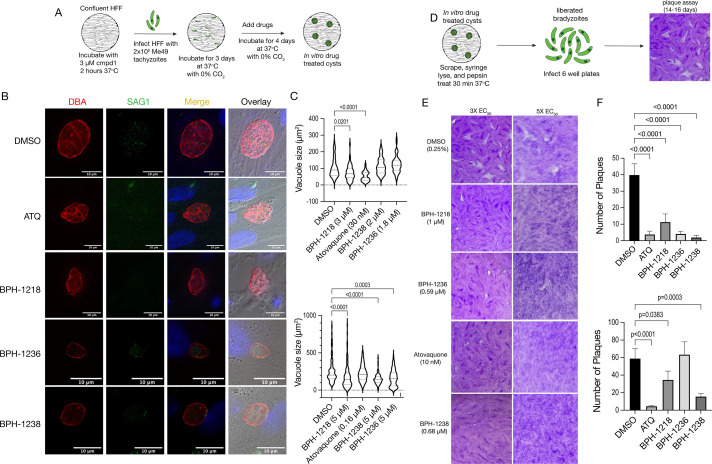
The current treatments for toxoplasmosis are only active against fast-growing tachyzoites, present in acute infections, with little effect on slow-growing bradyzoites within tissue cysts, present in latent chronic infections. The mitochondrion of is essential for its survival, and one of the major anti-parasitic drugs, atovaquone, inhibits the mitochondrial electron transport chain at the coenzyme Q:cytochrome c oxidoreductase site. Coenzyme Q (also known as ubiquinone [UQ]) consists of a quinone head and a lipophilic, isoprenoid tail that anchors UQ to membranes. The synthesis of the isoprenoid unit is essential for cell growth and is inhibited by lipophilic bisphosphonates, which inhibit the parasite growth. In this work, we investigated the effect of lipophilic bisphosphonates on the chronic stages of . We discovered that three lipophilic bisphosphonates (BPH-1218, BPH-1236, and BPH-1238), effective for the acute infection, were also effective in controlling the development of chronic stages. We showed effectiveness by testing them against cysts and derived tissue cysts and, most importantly, these compounds reduced the cyst burden in the brains of chronically infected mice. We monitored the activity of infected mice non-invasively and continuously with a novel device termed the CageDot. A decrease in activity accompanied the acute phase, but mice recovered to normal activity and showed signs of hyperactivity when the chronic infection was established. Moreover, treatment with atovaquone or BPH-1218 ameliorated the hyperactivity observed during the chronic infection.IMPORTANCETreatment for toxoplasmosis is challenged by a lack of effective drugs to eradicate the chronic stages. Most of the drugs currently used are poorly distributed to the central nervous system, and they trigger allergic reactions in a large number of patients. There is a compelling need for safe and effective treatments for toxoplasmosis. Bisphosphonates (BPs) are analogs of inorganic pyrophosphate and are used for the treatment of bone disorders. BPs target the isoprenoid pathway and are effective against several experimental parasitic infections. Some lipophilic BPs can specifically inhibit the mitochondrial activity of by interfering with the mechanism by which ubiquinone is inserted into the inner mitochondrial membrane. In this work, we present the effect of three lipophilic BPs against chronic stages. We also present a new strategy for the monitoring of animal activity during disease and treatment that is non-invasive and continuous.
目前针对弓形虫病的治疗方法仅对急性感染期快速生长的速殖子有效,而对组织囊肿内缓慢生长的缓殖子几乎没有作用,缓殖子存在于潜伏性慢性感染中。的线粒体对于其生存至关重要,而主要的抗寄生虫药物之一阿托伐醌抑制辅酶 Q:细胞色素 c 氧化还原酶位点的线粒体电子传递链。辅酶 Q(也称为泛醌 [UQ])由醌头和亲脂性异戊烯尾组成,将 UQ 锚定在膜上。异戊烯单位的合成对于细胞生长至关重要,并且被亲脂性双膦酸盐抑制,双膦酸盐抑制寄生虫的生长。在这项工作中,我们研究了亲脂性双膦酸盐对弓形虫慢性阶段的影响。我们发现三种亲脂性双膦酸盐(BPH-1218、BPH-1236 和 BPH-1238),对急性感染有效,也能有效控制慢性阶段的发展。我们通过测试它们对 包囊和 衍生的组织包囊的效果证明了它们的有效性,最重要的是,这些化合物减少了慢性感染小鼠大脑中的包囊负担。我们使用一种称为 CageDot 的新型设备非侵入性和连续地监测感染小鼠的活动。活性的下降伴随着急性阶段,但当慢性感染建立时,小鼠恢复到正常活动并表现出过度活跃的迹象。此外,用阿托伐醌或 BPH-1218 治疗可改善慢性感染期间观察到的过度活跃。
重要性
弓形虫病的治疗受到缺乏有效药物来根除慢性阶段的挑战。目前使用的大多数药物都不能很好地分布到中枢神经系统,并且会引发大量患者的过敏反应。迫切需要针对弓形虫病的安全有效治疗方法。双膦酸盐(BPs)是无机焦磷酸盐的类似物,用于治疗骨骼疾病。BPs 靶向异戊烯途径,对几种实验性寄生虫感染有效。一些亲脂性 BPs 可以通过干扰泛醌插入线粒体内膜的机制,特异性抑制 线粒体活性。在这项工作中,我们展示了三种亲脂性 BPs 对弓形虫慢性阶段的作用。我们还提出了一种新的策略,用于在非侵入性和连续的情况下监测疾病和治疗期间的动物活动。