Global Health Research Center, Guangdong Provincial People's Hospital, Guangdong Academy of Medical Sciences, Southern Medical University, Guangzhou, Guangdong, China.
Guangdong Cardiovascular Institute, Guangdong Provincial People's Hospital, Guangdong Academy of Medical Sciences, Southern Medical University, Guangzhou, Guangdong, China.
JAMA Netw Open. 2024 Oct 1;7(10):e2438747. doi: 10.1001/jamanetworkopen.2024.38747.
The association of folate supplementation with congenital heart disease (CHD) prevention is controversial.
To examine the association of maternal serum folate levels at early to midpregnancy with CHD risk in offspring.
DESIGN, SETTING, AND PARTICIPANTS: This case-control study recruited participants from one of China's largest cardiac referral centers between 2015 and 2018. CHD cases and non-CHD controls were matched according to maternal age at a ratio of 1:4. Data were analyzed from May to August 2023.
Maternal serum levels of folate, vitamin B12, and homocysteine were measured around the gestational age of 16 weeks.
The primary outcome was CHD, which was confirmed using echocardiography. The association between CHD risk in offspring with maternal folate levels was measured using adjusted odds ratios (aORs) with 95% CIs in conditional logistic regression analyses. Interactions between folate, vitamin B12, and homocysteine and CHD were estimated on a multiplicative scale.
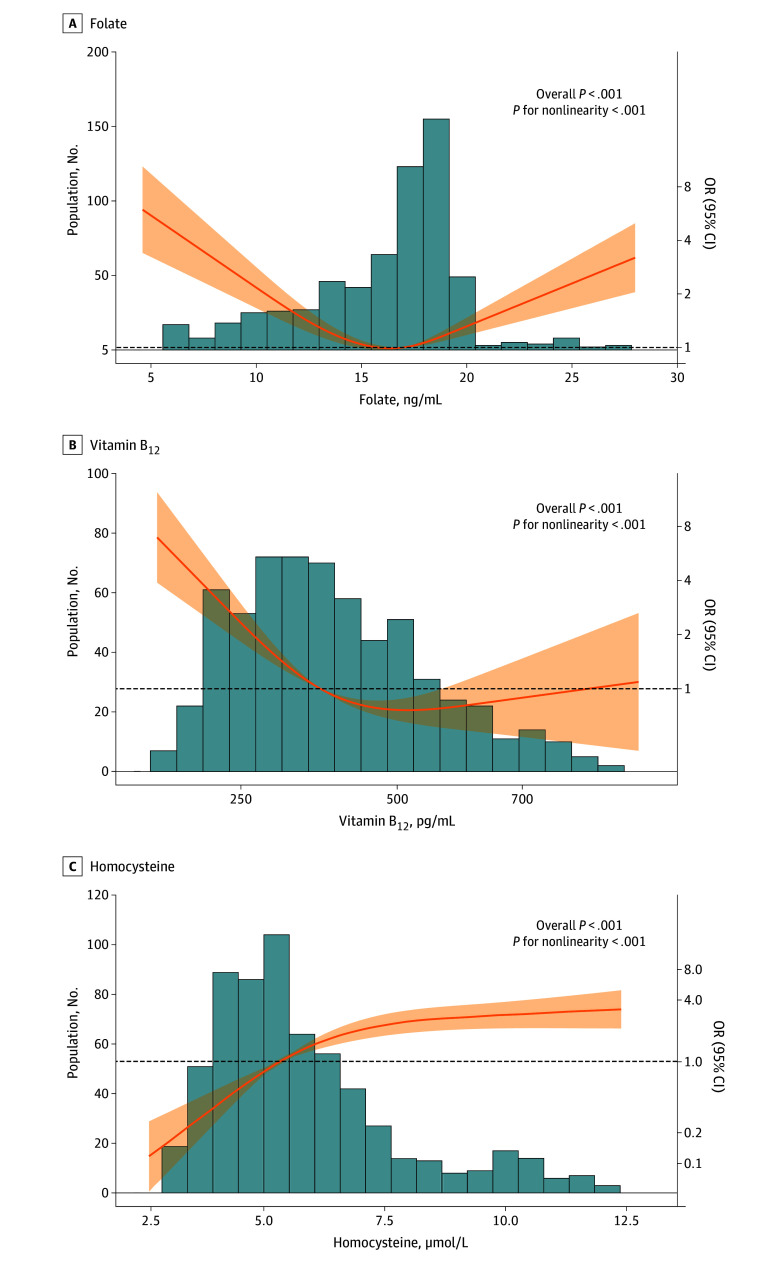
A total of 129 CHD cases with ventricular septal defect as the most common phenotype and 516 matched controls were included. The mean (SD) maternal age at pregnancy was 31.6 (5.3) years. There was a U-shaped association between maternal serum folate levels at early to midpregnancy and CHD risk in offspring. Compared with the offspring in the second and third quartiles of maternal folate, those in the lowest (aOR, 3.09; 95% CI, 1.88-5.08) and highest quartiles (OR, 1.81; 95% CI, 1.07-3.06) had increased odds of CHD. The ORs were higher when applying the World Health Organization criteria to determine the normal range for serum folate levels. Interaction analyses suggested that the adverse associations between low and high maternal folate and CHD risk might be further magnified by vitamin B12 deficiency or elevated homocysteine.
In this case-control study of CHD, low maternal serum folate levels in early to midpregnancy were associated with an increased CHD risk in offspring, and excessively high folate levels were also associated with an elevated CHD risk. Further investigation is needed to make causal inferences for the observed associations and elucidate the underlying mechanisms.
叶酸补充与先天性心脏病(CHD)预防之间的关联存在争议。
研究孕早期至中期母体血清叶酸水平与后代 CHD 风险之间的关系。
设计、地点和参与者:本病例对照研究于 2015 年至 2018 年期间在中国最大的心脏转诊中心之一招募参与者。CHD 病例和非 CHD 对照组按照母亲年龄以 1:4 的比例进行匹配。数据于 2023 年 5 月至 8 月进行分析。
在妊娠 16 周左右测量母体血清叶酸、维生素 B12 和同型半胱氨酸水平。
主要结局是使用超声心动图确认的 CHD。使用条件逻辑回归分析中调整后的优势比(aOR)及其 95%置信区间(CI)来衡量后代 CHD 风险与母体叶酸水平之间的关系。在乘法尺度上估计了叶酸、维生素 B12 和同型半胱氨酸与 CHD 之间的相互作用。
共纳入 129 例 CHD 病例(室间隔缺损为最常见表型)和 516 例匹配对照组。妊娠时母亲的平均(SD)年龄为 31.6(5.3)岁。孕早期至中期母体血清叶酸水平与后代 CHD 风险呈 U 型关联。与处于第二和第三四分位的母体叶酸相比,处于最低(aOR,3.09;95%CI,1.88-5.08)和最高四分位(OR,1.81;95%CI,1.07-3.06)的后代发生 CHD 的几率增加。当应用世界卫生组织标准来确定血清叶酸水平的正常范围时,OR 值更高。交互分析表明,母体叶酸水平低和高与 CHD 风险之间的不良关联可能会因维生素 B12 缺乏或同型半胱氨酸升高而进一步放大。
在这项 CHD 的病例对照研究中,孕早期至中期母体血清叶酸水平较低与后代 CHD 风险增加相关,而叶酸水平过高也与 CHD 风险增加相关。需要进一步研究以对观察到的关联进行因果推断并阐明潜在机制。