Orsi Markus, Reymond Jean-Louis
Department of Chemistry, Biochemistry and Pharmaceutical Sciences, University of Bern, Freiestrasse 3, 3012, Bern, Switzerland.
Mol Inform. 2025 Jan;44(1):e202400186. doi: 10.1002/minf.202400186. Epub 2024 Oct 10.
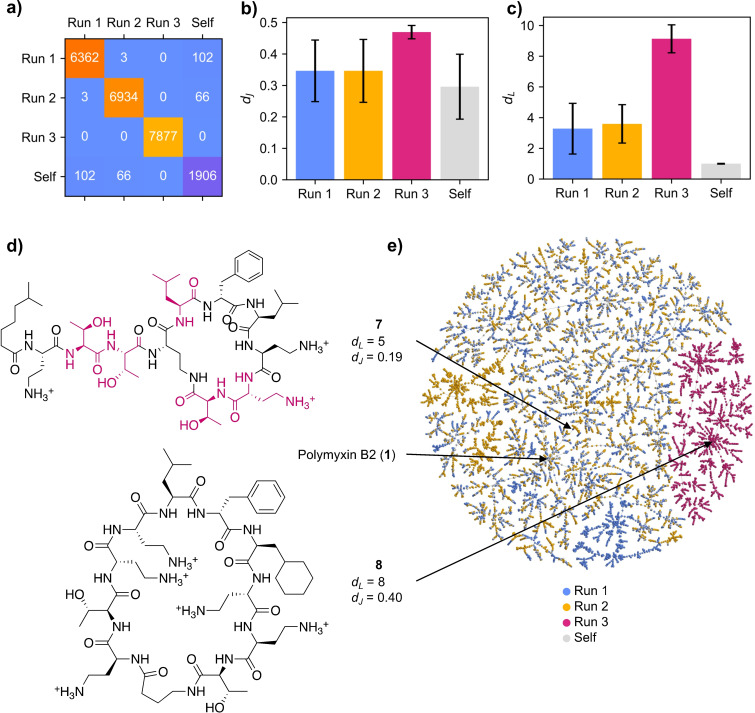
Herein we report a virtual library of 1E+60 members, a common estimate for the total size of the drug-like chemical space. The library is obtained from 100 commercially available peptide and peptoid building blocks assembled into linear or cyclic oligomers of up to 30 units, forming molecules within the size range of peptide drugs and potentially accessible by solid-phase synthesis. We demonstrate ligand-based virtual screening (LBVS) using the peptide design genetic algorithm (PDGA), which evolves a population of 50 members to resemble a given target molecule using molecular fingerprint similarity as fitness function. Target molecules are reached in less than 10,000 generations. Like in many journeys, the value of the chemical space journey using PDGA lies not in reaching the target but in the journey itself, here by encountering non-obvious analogs. We also show that PDGA can be used to generate median molecules and analogs of non-peptide target molecules.
在此,我们报告了一个包含10^60个成员的虚拟库,这是对类药化学空间总大小的一个常见估计。该库由100种市售的肽和类肽构建模块组装成最多30个单元的线性或环状低聚物而得,形成了肽类药物大小范围内且可能通过固相合成获得的分子。我们展示了使用肽设计遗传算法(PDGA)的基于配体的虚拟筛选(LBVS),该算法以分子指纹相似性作为适应度函数,使50个成员的群体进化以类似于给定的目标分子。在不到10000代的时间内就能达到目标分子。就像在许多旅程中一样,使用PDGA进行化学空间之旅的价值不在于到达目标,而在于旅程本身,在这里是通过遇到不明显的类似物。我们还表明,PDGA可用于生成非肽类目标分子的中位分子和类似物。