• 文献检索
  • 文档翻译
  • 深度研究
  • 学术资讯
  • Suppr Zotero 插件Zotero 插件
  • 邀请有礼
  • 套餐&价格
  • 历史记录
应用&插件
Suppr Zotero 插件Zotero 插件浏览器插件Mac 客户端Windows 客户端微信小程序
定价
高级版会员购买积分包购买API积分包
服务
文献检索文档翻译深度研究API 文档MCP 服务
关于我们
关于 Suppr公司介绍联系我们用户协议隐私条款
关注我们

Suppr 超能文献

核心技术专利:CN118964589B侵权必究
粤ICP备2023148730 号-1Suppr @ 2026

文献检索

告别复杂PubMed语法,用中文像聊天一样搜索,搜遍4000万医学文献。AI智能推荐,让科研检索更轻松。

立即免费搜索

文件翻译

保留排版,准确专业,支持PDF/Word/PPT等文件格式,支持 12+语言互译。

免费翻译文档

深度研究

AI帮你快速写综述,25分钟生成高质量综述,智能提取关键信息,辅助科研写作。

立即免费体验

智能手机使用时间特征与自杀意念的关系:回顾性观察数据分析研究

Smartphone Screen Time Characteristics in People With Suicidal Thoughts: Retrospective Observational Data Analysis Study.

机构信息

Department of Biostatistics, Harvard T.H. Chan School of Public Health, Harvard University, Boston, MA, United States.

Department of Psychology, Harvard University, Cambridge, MA, United States.

出版信息

JMIR Mhealth Uhealth. 2024 Oct 11;12:e57439. doi: 10.2196/57439.

DOI:10.2196/57439
PMID:39392706
原文链接:https://pmc.ncbi.nlm.nih.gov/articles/PMC11488461/
Abstract

BACKGROUND

Smartphone-based monitoring in natural settings provides opportunities to monitor mental health behaviors, including suicidal thoughts and behaviors. To date, most suicidal thoughts and behaviors research using smartphones has primarily relied on collecting so-called "active" data, requiring participants to engage by completing surveys. Data collected passively from smartphone sensors and logs may offer an objectively measured representation of an individual's behavior, including smartphone screen time.

OBJECTIVE

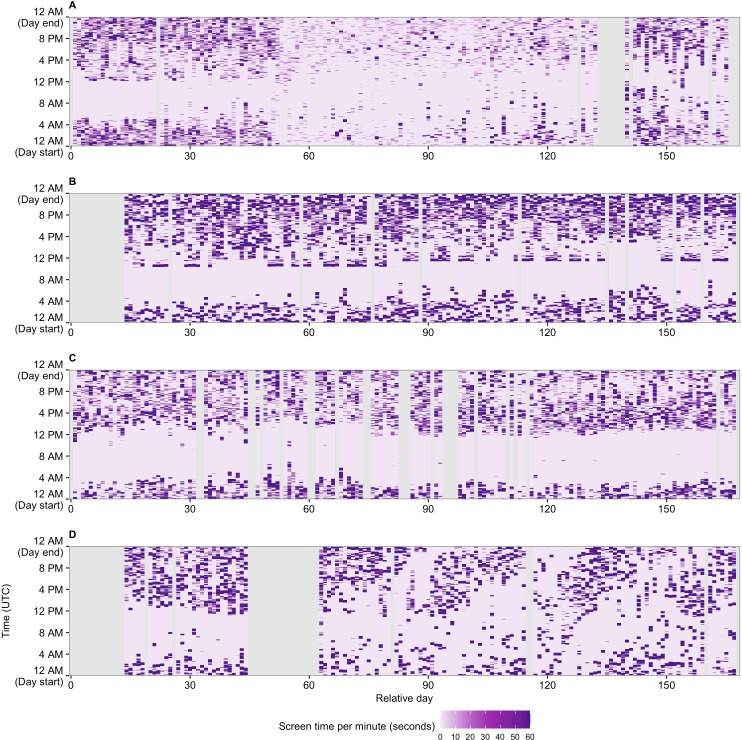
This study aims to present methods for identifying screen-on bouts and deriving screen time characteristics from passively collected smartphone state logs and to estimate daily smartphone screen time in people with suicidal thinking, providing a more reliable alternative to traditional self-report.

METHODS

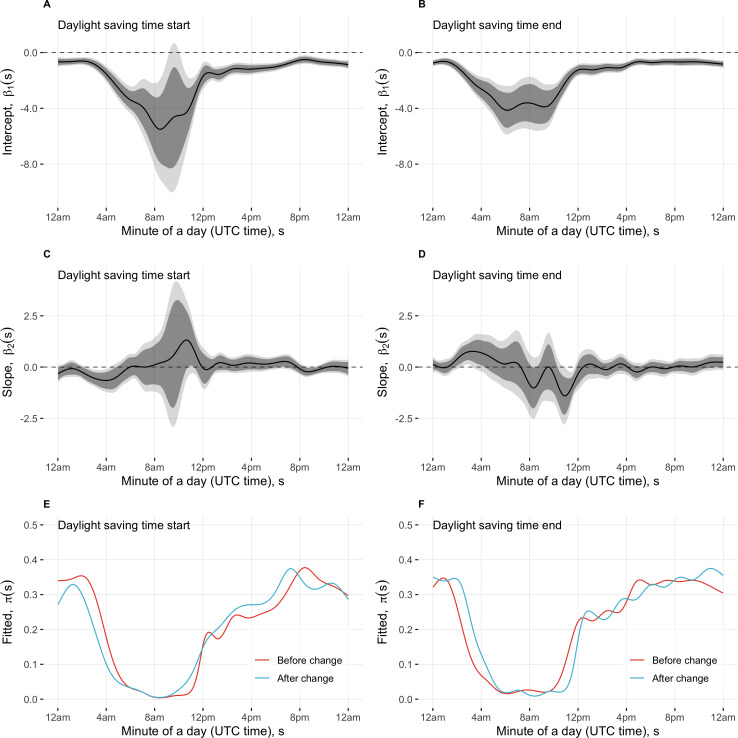
Participants (N=126; median age 22, IQR 16-33 years) installed the Beiwe app (Harvard University) on their smartphones, which passively collected phone state logs for up to 6 months after discharge from an inpatient psychiatric unit (adolescents) or emergency department visit (adults). We derived daily screen time measures from these logs, including screen-on time, screen-on bout duration, screen-off bout duration, and screen-on bout count. We estimated the mean of these measures across age subgroups (adults and adolescents), phone operating systems (Android and iOS), and monitoring stages after the discharge (first 4 weeks vs subsequent weeks). We evaluated the sensitivity of daily screen time measures to changes in the parameters of the screen-on bout identification method. Additionally, we estimated the impact of a daylight time change on minute-level screen time using function-on-scalar generalized linear mixed-effects regression.

RESULTS

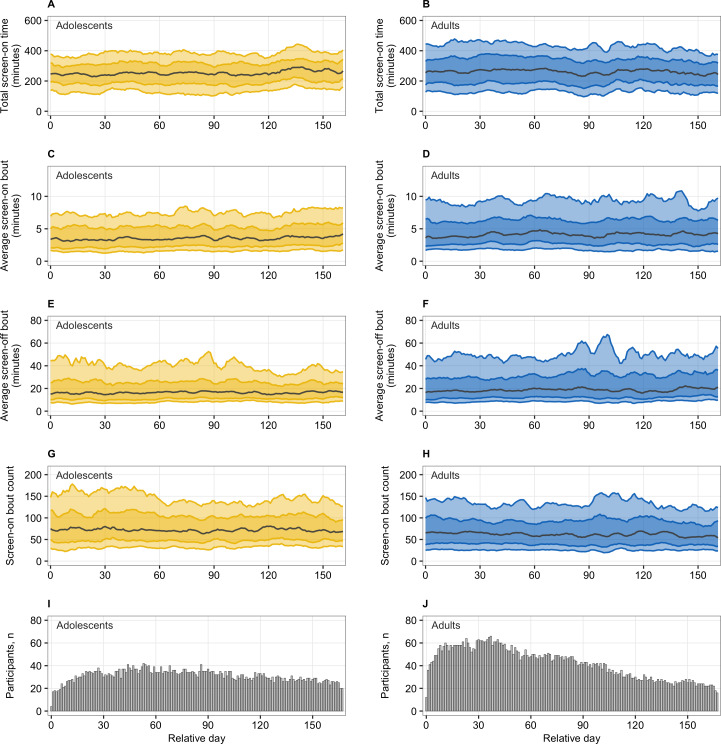
The median monitoring period was 169 (IQR 42-169) days. For adolescents and adults, mean daily screen-on time was 254.6 (95% CI 231.4-277.7) and 271.0 (95% CI 252.2-289.8) minutes, mean daily screen-on bout duration was 4.233 (95% CI 3.565-4.902) and 4.998 (95% CI 4.455-5.541) minutes, mean daily screen-off bout duration was 25.90 (95% CI 20.09-31.71) and 26.90 (95% CI 22.18-31.66) minutes, and mean daily screen-on bout count (natural logarithm transformed) was 4.192 (95% CI 4.041-4.343) and 4.090 (95% CI 3.968-4.213), respectively; there were no significant differences between smartphone operating systems (all P values were >.05). The daily measures were not significantly different for the first 4 weeks compared to the fifth week onward (all P values were >.05), except average screen-on bout in adults (P value = .018). Our sensitivity analysis indicated that in the screen-on bout identification method, the cap on an individual screen-on bout duration has a substantial effect on the resulting daily screen time measures. We observed time windows with a statistically significant effect of daylight time change on screen-on time (based on 95% joint confidence intervals bands), plausibly attributable to sleep time adjustments related to clock changes.

CONCLUSIONS

Passively collected phone logs offer an alternative to self-report measures for studying smartphone screen time characteristics in people with suicidal thinking. Our work demonstrates the feasibility of this approach, opening doors for further research on the associations between daily screen time, mental health, and other factors.

摘要

背景

智能手机在自然环境中的监测为监测心理健康行为(包括自杀意念和行为)提供了机会。迄今为止,使用智能手机进行的大多数自杀意念和行为研究主要依赖于收集所谓的“主动”数据,要求参与者通过完成调查来参与。从智能手机传感器和日志中被动收集的数据可能会提供对个人行为的客观测量,包括智能手机屏幕时间。

目的

本研究旨在介绍从被动收集的智能手机状态日志中识别屏幕开启时段并得出屏幕时间特征的方法,并估计有自杀意念的人的日常智能手机屏幕时间,为传统的自我报告提供更可靠的替代方法。

方法

参与者(N=126;中位数年龄 22 岁,IQR 16-33 岁)在智能手机上安装了 Beiwe 应用程序(哈佛大学),在从住院精神病病房(青少年)或急诊部出院后(成年人)最多可被动收集 6 个月的手机状态日志。我们从这些日志中得出了每日屏幕时间测量值,包括屏幕开启时间、屏幕开启时段持续时间、屏幕关闭时段持续时间和屏幕开启时段计数。我们估计了这些措施在年龄亚组(成年人和青少年)、手机操作系统(Android 和 iOS)和出院后监测阶段(前 4 周与随后几周)中的平均值。我们评估了每日屏幕时间测量值对屏幕开启时段识别方法参数变化的敏感性。此外,我们使用函数对标量广义线性混合效应回归来估计夏令时变化对分钟级屏幕时间的影响。

结果

中位监测期为 169 天(IQR 42-169)。对于青少年和成年人,平均每日屏幕开启时间分别为 254.6(95%CI 231.4-277.7)和 271.0(95%CI 252.2-289.8)分钟,平均每日屏幕开启时段持续时间分别为 4.233(95%CI 3.565-4.902)和 4.998(95%CI 4.455-5.541)分钟,平均每日屏幕关闭时段持续时间分别为 25.90(95%CI 20.09-31.71)和 26.90(95%CI 22.18-31.66)分钟,平均每日屏幕开启时段计数(自然对数转换)分别为 4.192(95%CI 4.041-4.343)和 4.090(95%CI 3.968-4.213);智能手机操作系统之间没有显著差异(所有 P 值均>.05)。与前五周相比,前四周与第五周相比,每日测量值没有显著差异(所有 P 值均>.05),但成年人的平均屏幕开启时段除外(P 值=.018)。我们的敏感性分析表明,在屏幕开启时段识别方法中,个人屏幕开启时段持续时间的上限对最终的每日屏幕时间测量值有很大影响。我们观察到有统计学意义的夏令时变化对屏幕开启时间的时间窗口(基于 95%联合置信区间带),可能归因于与时钟变化相关的睡眠时间调整。

结论

被动收集的手机日志为研究有自杀意念的人的智能手机屏幕时间特征提供了自我报告措施的替代方法。我们的工作证明了这种方法的可行性,为进一步研究日常屏幕时间、心理健康和其他因素之间的关联打开了大门。
https://cdn.ncbi.nlm.nih.gov/pmc/blobs/860e/11488461/ec094763c399/mhealth-v12-e57439-g003.jpg
https://cdn.ncbi.nlm.nih.gov/pmc/blobs/860e/11488461/ed6276813eb9/mhealth-v12-e57439-g001.jpg
https://cdn.ncbi.nlm.nih.gov/pmc/blobs/860e/11488461/13c70ee089e3/mhealth-v12-e57439-g002.jpg
https://cdn.ncbi.nlm.nih.gov/pmc/blobs/860e/11488461/ec094763c399/mhealth-v12-e57439-g003.jpg
https://cdn.ncbi.nlm.nih.gov/pmc/blobs/860e/11488461/ed6276813eb9/mhealth-v12-e57439-g001.jpg
https://cdn.ncbi.nlm.nih.gov/pmc/blobs/860e/11488461/13c70ee089e3/mhealth-v12-e57439-g002.jpg
https://cdn.ncbi.nlm.nih.gov/pmc/blobs/860e/11488461/ec094763c399/mhealth-v12-e57439-g003.jpg

相似文献

1
Smartphone Screen Time Characteristics in People With Suicidal Thoughts: Retrospective Observational Data Analysis Study.智能手机使用时间特征与自杀意念的关系:回顾性观察数据分析研究
JMIR Mhealth Uhealth. 2024 Oct 11;12:e57439. doi: 10.2196/57439.
2
Development of a Smartphone App to Predict and Improve the Rates of Suicidal Ideation Among Transgender Persons (TransLife): Qualitative Study.开发一款智能手机应用程序,预测和改善跨性别者(TransLife)自杀意念的发生率:定性研究。
J Med Internet Res. 2021 Mar 24;23(3):e24023. doi: 10.2196/24023.
3
Identifying factors impacting missingness within smartphone-based research: Implications for intensive longitudinal studies of adolescent suicidal thoughts and behaviors.识别影响基于智能手机的研究中缺失数据的因素:对青少年自杀意念和行为的密集纵向研究的启示。
J Psychopathol Clin Sci. 2024 Oct;133(7):577-597. doi: 10.1037/abn0000930. Epub 2024 Jul 18.
4
A Mobile Health Intervention (LifeBuoy App) to Help Young People Manage Suicidal Thoughts: Protocol for a Mixed-Methods Randomized Controlled Trial.一种帮助年轻人管理自杀念头的移动健康干预措施(卫宝应用程序):一项混合方法随机对照试验的方案
JMIR Res Protoc. 2020 Oct 27;9(10):e23655. doi: 10.2196/23655.
5
A Pilot Study Using Frequent Inpatient Assessments of Suicidal Thinking to Predict Short-Term Postdischarge Suicidal Behavior.利用频繁的住院评估自杀思维预测短期出院后自杀行为的初步研究。
JAMA Netw Open. 2021 Mar 1;4(3):e210591. doi: 10.1001/jamanetworkopen.2021.0591.
6
Investigating Associations Between Screen Time and Symptomatology in Individuals With Serious Mental Illness: Longitudinal Observational Study.调查严重精神疾病个体的屏幕时间与症状之间的关联:纵向观察研究。
J Med Internet Res. 2021 Mar 10;23(3):e23144. doi: 10.2196/23144.
7
Measuring Environmental and Behavioral Drivers of Chronic Diseases Using Smartphone-Based Digital Phenotyping: Intensive Longitudinal Observational mHealth Substudy Embedded in 2 Prospective Cohorts of Adults.使用基于智能手机的数字表型测量慢性病的环境和行为驱动因素:嵌入在 2 项前瞻性成人队列中的密集纵向观察性移动健康子研究。
JMIR Public Health Surveill. 2024 Oct 11;10:e55170. doi: 10.2196/55170.
8
Folic acid supplementation and malaria susceptibility and severity among people taking antifolate antimalarial drugs in endemic areas.在流行地区,服用抗叶酸抗疟药物的人群中,叶酸补充剂与疟疾易感性和严重程度的关系。
Cochrane Database Syst Rev. 2022 Feb 1;2(2022):CD014217. doi: 10.1002/14651858.CD014217.
9
Mobile health (m-health) smartphone interventions for adolescents and adults with overweight or obesity.移动健康(m-health)智能手机干预措施用于超重或肥胖的青少年和成年人。
Cochrane Database Syst Rev. 2024 Feb 20;2(2):CD013591. doi: 10.1002/14651858.CD013591.pub2.
10
Passive sensing of smartphone use, physical activity and sedentary behavior among adolescents and young adults during the COVID-19 pandemic.青少年和年轻人在 COVID-19 大流行期间使用智能手机、身体活动和久坐行为的被动感知。
J Behav Med. 2024 Oct;47(5):770-781. doi: 10.1007/s10865-024-00499-x. Epub 2024 Jun 2.

本文引用的文献

1
Digital Phenotyping for Stress, Anxiety, and Mild Depression: Systematic Literature Review.数字化表型用于压力、焦虑和轻度抑郁的评估:系统文献综述。
JMIR Mhealth Uhealth. 2024 May 23;12:e40689. doi: 10.2196/40689.
2
Digital Phenotyping: Data-Driven Psychiatry to Redefine Mental Health.数字表型:以数据为驱动的精神病学重新定义精神健康。
J Med Internet Res. 2023 Oct 4;25:e44502. doi: 10.2196/44502.
3
Digital Phenotyping for Differential Diagnosis of Major Depressive Episode: Narrative Review.用于重度抑郁发作鉴别诊断的数字表型分析:叙述性综述
JMIR Ment Health. 2023 Jan 23;10:e37225. doi: 10.2196/37225.
4
Fast Univariate Inference for Longitudinal Functional Models.纵向功能模型的快速单变量推断
J Comput Graph Stat. 2022;31(1):219-230. doi: 10.1080/10618600.2021.1950006. Epub 2021 Aug 4.
5
Considerations to address missing data when deriving clinical trial endpoints from digital health technologies.从数字健康技术推导临床试验终点时处理缺失数据的注意事项。
Contemp Clin Trials. 2022 Feb;113:106661. doi: 10.1016/j.cct.2021.106661. Epub 2021 Dec 22.
6
Consensus Statement on Ethical & Safety Practices for Conducting Digital Monitoring Studies with People at Risk of Suicide and Related Behaviors.关于对有自杀及相关行为风险的人群开展数字监测研究的伦理与安全实践的共识声明。
Psychiatr Res Clin Pract. 2021 Summer;3(2):57-66. doi: 10.1176/appi.prcp.20200029. Epub 2020 Dec 21.
7
Sociodemographic characteristics of missing data in digital phenotyping.数字表型中缺失数据的社会人口学特征。
Sci Rep. 2021 Jul 29;11(1):15408. doi: 10.1038/s41598-021-94516-7.
8
Use of Ecological Momentary Assessment to Study Suicidal Thoughts and Behavior: a Systematic Review.使用生态瞬时评估研究自杀意念和行为:系统评价。
Curr Psychiatry Rep. 2021 May 18;23(7):41. doi: 10.1007/s11920-021-01255-7.
9
Validation of Self-Reported Smartphone Usage Against Objectively-Measured Smartphone Usage in Hong Kong Chinese Adolescents and Young Adults.香港华裔青少年和青年中自我报告的智能手机使用情况与客观测量的智能手机使用情况的验证
Psychiatry Investig. 2021 Feb;18(2):95-100. doi: 10.30773/pi.2020.0197. Epub 2021 Feb 2.
10
Opportunities and challenges in the collection and analysis of digital phenotyping data.数字表型数据收集与分析中的机遇与挑战。
Neuropsychopharmacology. 2021 Jan;46(1):45-54. doi: 10.1038/s41386-020-0771-3. Epub 2020 Jul 17.