Joint International Research Laboratory of Environment and Health, Ministry of Education, Guangdong Provincial Engineering Technology Research Center of Environmental Pollution and Health Risk Assessment, Department of Occupational and Environmental Health, School of Public Health, Sun Yat-sen University, Guangzhou 510080, China.
Acacia Lab for Implementation Science, Institute for Global Health, Dermatology Hospital of Southern Medical University, Guangzhou 510515, China.
Environ Sci Technol. 2024 Oct 22;58(42):18928-18939. doi: 10.1021/acs.est.4c05405. Epub 2024 Oct 12.
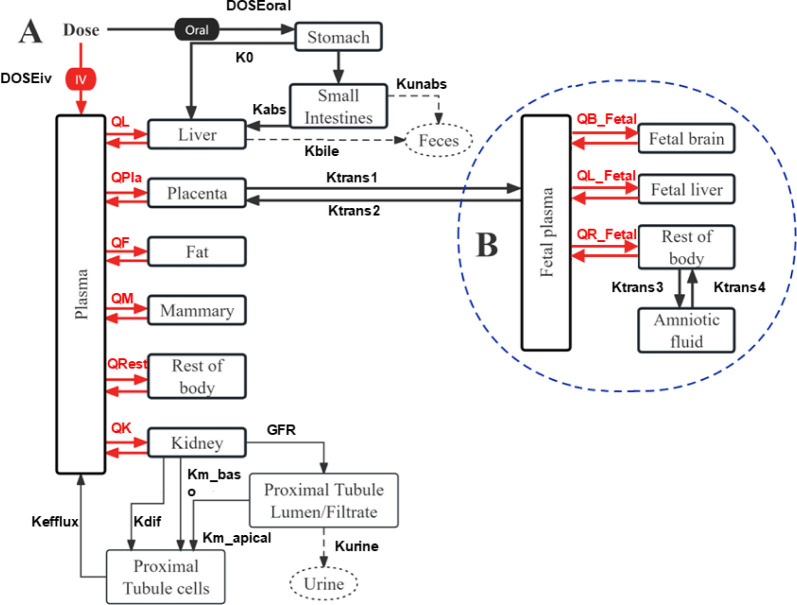
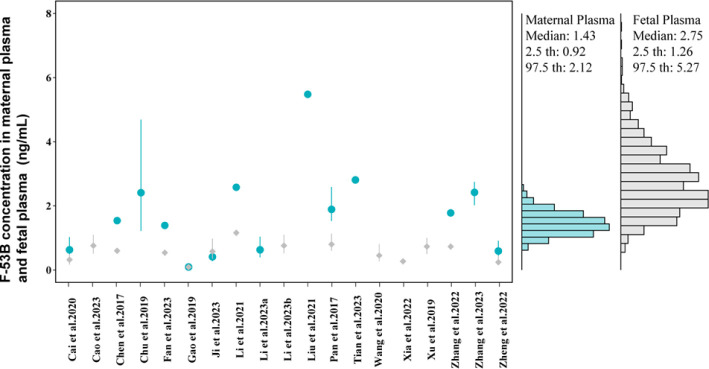
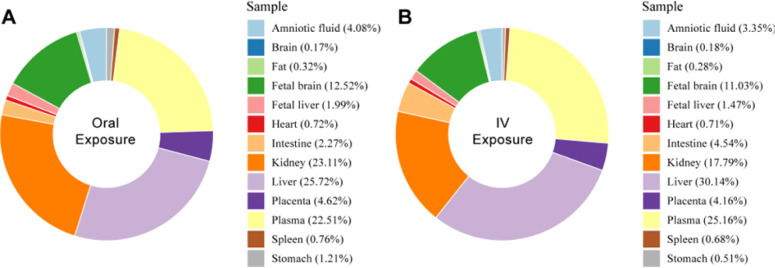
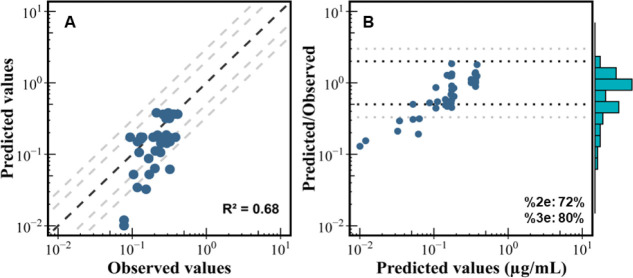
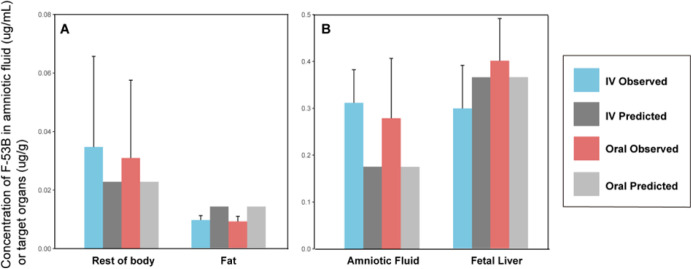
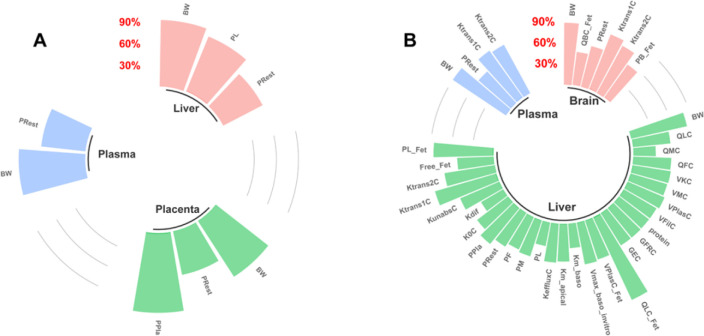
Chlorinated polyfluorinated ether sulfonic acid (F-53B), a commonly utilized alternative for perfluorooctane sulfonate, was detected in pregnant women and cord blood recently. However, the lack of detailed toxicokinetic information poses a significant challenge in assessing the human risk assessment for F-53B exposure. Our study aimed to develop a physiologically based pharmacokinetic (PBPK) model for pregnant mice, based on toxicokinetic experiments, and extrapolating it to humans. Pregnant mice were administered 80 μg/kg F-53B orally and intravenously on gestational day 13. F-53B concentrations in biological samples were analyzed via ultraperformance liquid chromatography-mass spectrometry. Results showed the highest F-53B accumulation in the brain, followed by the placenta, amniotic fluid, and liver in fetal mice. These toxicokinetic data were applied to F-53B PBPK model development and evaluation, and Monte Carlo simulations were used to characterize the variability and uncertainty in the human population. Most of the predictive values were within a 2-fold range of experimental data (>72%) and had a coefficient of determination (R) greater than 0.68. The developed mouse model was then extrapolated to the human and evaluated with human biomonitoring data. Our study provides an important step toward improving the understanding of toxicokinetics of F-53B and enhancing the quantitative risk assessments in sensitive populations, particularly in pregnant women and fetuses.
氯代全氟醚磺酸(F-53B)是一种常用的全氟辛烷磺酸替代品,最近在孕妇和脐带血中被检测到。然而,缺乏详细的毒代动力学信息给评估 F-53B 暴露对人类的风险评估带来了重大挑战。我们的研究旨在基于毒代动力学实验,为怀孕小鼠建立一个基于生理学的药代动力学(PBPK)模型,并将其外推至人类。在妊娠第 13 天,给怀孕小鼠口服和静脉注射 80μg/kg 的 F-53B。通过超高效液相色谱-质谱法分析生物样本中的 F-53B 浓度。结果表明,F-53B 在胎儿小鼠的大脑中积累最多,其次是胎盘、羊水和肝脏。这些毒代动力学数据被应用于 F-53B 的 PBPK 模型的开发和评估,蒙特卡罗模拟用于描述人群中的变异性和不确定性。大多数预测值在实验数据的 2 倍范围内(>72%),且决定系数(R)大于 0.68。然后,将建立的小鼠模型外推到人类,并使用人类生物监测数据进行评估。我们的研究为了解 F-53B 的毒代动力学和加强对敏感人群(特别是孕妇和胎儿)的定量风险评估提供了重要的一步。