School of Medicine, Makerere University, Kampala, Uganda.
Division of Biostatistics, School of Public Health, University of California, Berkeley, CA, USA.
Lancet HIV. 2024 Nov;11(11):e736-e745. doi: 10.1016/S2352-3018(24)00235-2. Epub 2024 Oct 9.
HIV infections are ongoing globally despite efficacious biomedical prevention options. We sought to determine whether an HIV prevention package providing choice of daily pills or long-acting injectable cabotegravir and opportunities to change prevention options could increase biomedical prevention coverage and reduce new HIV infections.
This study was an extension of three randomised trials that used SEARCH dynamic choice HIV prevention to recruit adults (aged ≥15 years) at risk for HIV from antenatal, outpatient, and community settings in rural Uganda and Kenya. In this 48-week open-label extension, participants maintained their original (1:1) randomisation group; the option to choose cabotegravir long-acting injectable was added for intervention participants. Inclusion criteria for the extension were previous enrolment in a SEARCH dynamic choice HIV prevention trial, negative HIV rapid test, and residence in study region. The intervention provided person-centred choice of oral pre-exposure prophylaxis (PrEP) or post-exposure HIV prophylaxis (PEP) or cabotegravir long-acting injectable, with the option to switch according to participant preference. The control provided standard-of-care access to oral PrEP and PEP, but not cabotegravir long-acting injectable. Biomedical prevention coverage (proportion of follow-up covered by oral PrEP, PEP, or cabotegravir long-acting injectable; primary outcome) and HIV incidence (secondary outcome) were compared between groups using targeted minimum loss-based estimation. The trial (NCT05549726) is closed to recruitment.
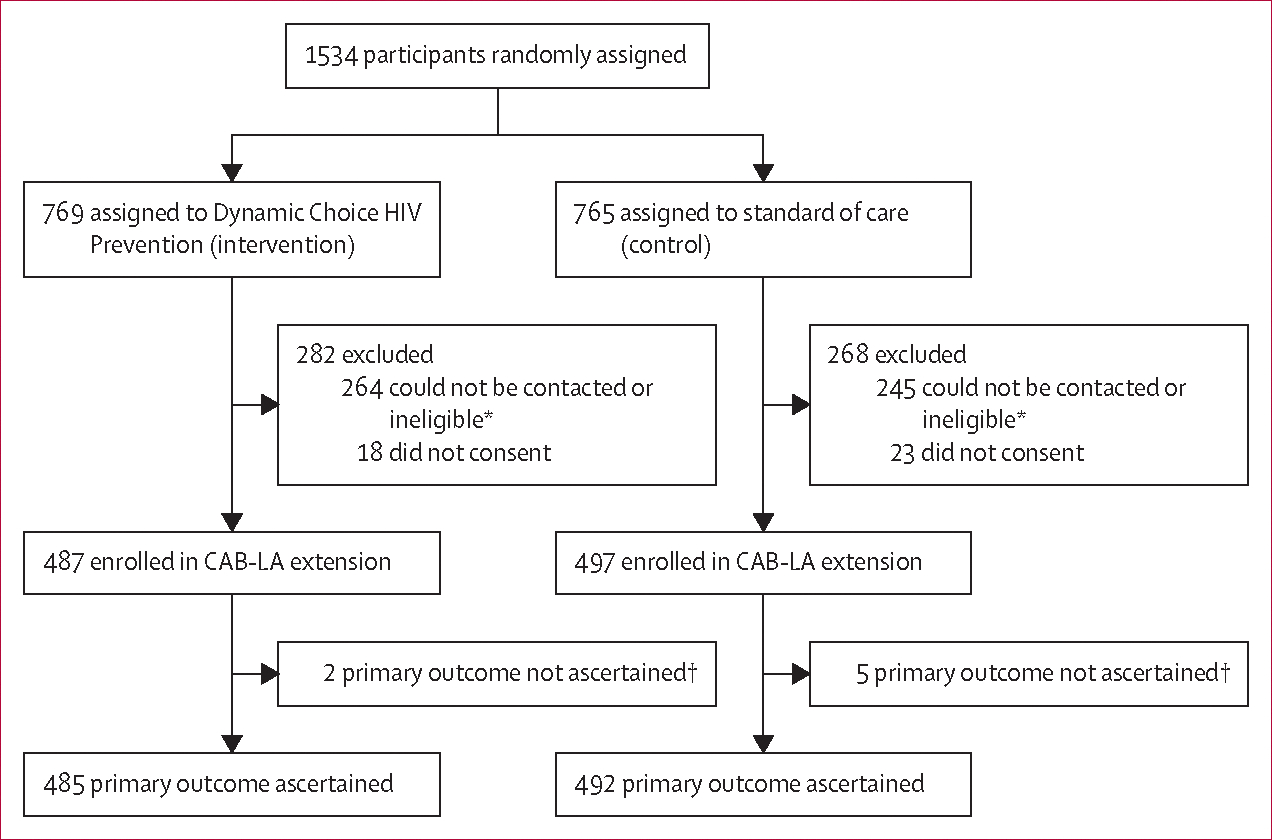
Of 1534 participants initially randomly assigned (from April 15, 2021 to Sept 29, 2022), 984 (487 in the intervention group and 497 in the standard-of-care group) reconsented to the extension (from Jan 2 to March 3, 2023). The mean proportion of follow-up covered by biomedical HIV prevention was 69·7% (95% CI 64·9-74·5) in the intervention group versus 13·3% (10·2-16·3) in the standard-of-care group, corresponding to an absolute difference of 56·4 percentage points (95% CI 50·8-62·1; p<0·0001). The intervention significantly improved coverage across prespecified subgroups (sex and age groups). During the study, 274 (56%) of 485 intervention participants used cabotegravir long-acting injectable, 255 (53%) used oral PrEP, and ten (2%) used PEP. Among cabotegravir long-acting injectable initiators, 118 (43%) of 274 were not previously using oral PrEP or PEP. There were seven incident HIV infections in 390 person-years of follow-up in the standard-of-care group and no infections in 400 person-years of follow-up in the intervention group (incidence rate difference per 100 person-years 1·8, 95% CI 0·4-3·2; p=0·014).
Offering people the choice of HIV biomedical prevention options including cabotegravir long-acting injectable in a flexible model can increase prevention coverage and reduce incident HIV infections. HIV programmes should support dynamic choice HIV prevention programmes that include effective oral and injectable long-acting products.
National Institutes of Health.
尽管有有效的生物医学预防措施,全球仍在发生艾滋病毒感染。我们旨在确定提供每日药丸或长效注射用卡替拉韦选择以及改变预防方案机会的艾滋病毒预防方案是否可以提高生物医学预防覆盖率并减少新的艾滋病毒感染。
本研究是三项随机试验的扩展,这些试验使用 SEARCH 动态选择艾滋病毒预防来招募来自乌干达和肯尼亚农村地区产前、门诊和社区环境的艾滋病毒高危成年人(年龄≥15 岁)。在这项 48 周的开放标签扩展中,参与者保留了他们原来的(1:1)随机分组;为干预参与者增加了选择卡替拉韦长效注射的选项。扩展的纳入标准是先前参加过 SEARCH 动态选择艾滋病毒预防试验、艾滋病毒快速检测阴性以及居住在研究区域。该干预措施提供了基于个体的口服暴露前预防(PrEP)或暴露后艾滋病毒预防(PEP)或卡替拉韦长效注射的选择,根据参与者的偏好可以选择切换。对照组提供了口服 PrEP 和 PEP 的标准护理,但不提供卡替拉韦长效注射。使用基于目标最小损失的估计,比较两组之间的生物医学预防覆盖率(口服 PrEP、PEP 或卡替拉韦长效注射随访的比例;主要结局)和艾滋病毒发病率(次要结局)。该试验(NCT05549726)已停止招募。
在最初随机分配的 1534 名参与者(从 2021 年 4 月 15 日至 2022 年 9 月 29 日)中,984 名(干预组 487 名,对照组 497 名)同意参加扩展研究(从 2023 年 1 月 2 日至 3 月 3 日)。干预组生物医学艾滋病毒预防的随访比例平均为 69.7%(95%CI 64.9-74.5),对照组为 13.3%(10.2-16.3),绝对差异为 56.4 个百分点(95%CI 50.8-62.1;p<0.0001)。该干预措施在预先指定的亚组(性别和年龄组)中显著提高了覆盖率。在研究期间,485 名干预参与者中有 274 名(56%)使用了卡替拉韦长效注射,255 名(53%)使用了口服 PrEP,10 名(2%)使用了 PEP。在卡替拉韦长效注射的启动者中,274 名(43%)人之前没有使用过口服 PrEP 或 PEP。在对照组中,390 人年随访中有 7 例发生艾滋病毒感染,而在干预组中 400 人年随访中无感染(每 100 人年的发病率差异为 1.8,95%CI 0.4-3.2;p=0.014)。
在灵活的模式下为人们提供艾滋病毒生物医学预防方案的选择,包括卡替拉韦长效注射,可以提高预防覆盖率并减少新的艾滋病毒感染。艾滋病毒规划应支持包括有效口服和注射长效产品在内的动态选择艾滋病毒预防方案。
美国国立卫生研究院。