Zhejiang Institute of Subtropical Crops, Zhejiang Academy of Agricultural Sciences, Wenzhou, 325005, China.
Sci Rep. 2024 Oct 12;14(1):23873. doi: 10.1038/s41598-024-74204-y.
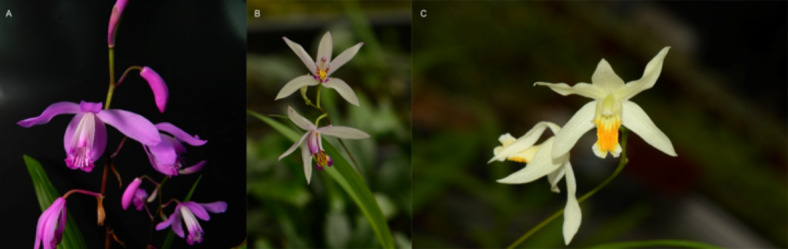
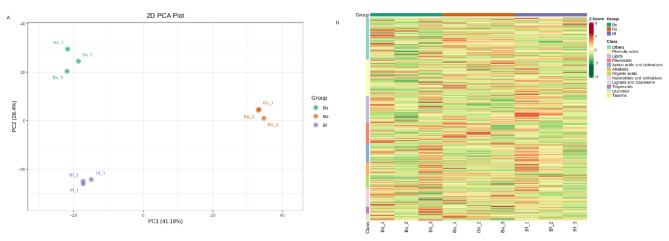
Bletilla striata has been used in traditional Chinese medicine for thousands of years to treat a variety of health diseases. Currently, metabolic causes of differences in medicinal values are unknown, due to the lack of a large-scale and comprehensive investigation of metabolites in Bletilla species. In order to gain a better understanding of the major chemical constituents responsible for the medicinal value, this study aimed to explore the metabolomic differences among three Bletilla species (Bletilla striata: Bs, Bletilla ochracea: Bo and Bletilla formosana: Bf). There were 258 different metabolites between 'Bo' and 'Bf', the contents of 109 metabolites had higher abundance, while 149 metabolites showed less accumulation. There were 165 different metabolites between the 'Bs' and 'Bf', content of 72 metabolites was increased and content of 93 metabolites was decreased. There were 239 different metabolites between the 'Bs' and 'Bo', content of 145 metabolites was increased and content of 94 metabolites was decreased. In the Bo_vs_Bf, Bs_vs_Bf and Bs_vs_Bo groups, the major differential categories were flavonoids, phenolic acids, organic acids and alkaloids. Moreover, the differential metabolites were clustered into clear and distinct profiles via K-means analysis. In addition, the major differential categories were flavonoids, phenolic acids, organic acids and alkaloids. The 'Flavonoid biosynthesis' (ko00941) and 'Phenylalanine metabolism' (ko00360) pathways were significantly enriched in Bo_vs_Bf, Bs_vs_Bf and Bs_vs_Bo comparisons. These results clarify the metabolomics in different Bletilla species, as well as providing basis for the phamaceutical value of novel species of Bletilla.
白及在中医药中已经使用了数千年,用于治疗各种健康疾病。目前,由于缺乏对白及属种中代谢物的大规模和全面调查,因此代谢物是造成药用价值差异的原因尚不清楚。为了更好地了解主要的化学成分,本研究旨在探索三种白及属种(白及:Bs、黄花白及:Bo 和白及:Bf)之间的代谢组学差异。“Bo”和“Bf”之间有 258 种不同的代谢物,其中 109 种代谢物的含量较高,而 149 种代谢物的含量较低。“Bs”和“Bf”之间有 165 种不同的代谢物,其中 72 种代谢物的含量增加,93 种代谢物的含量减少。“Bs”和“Bo”之间有 239 种不同的代谢物,其中 145 种代谢物的含量增加,94 种代谢物的含量减少。在 Bo_vs_Bf、Bs_vs_Bf 和 Bs_vs_Bo 组中,主要的差异类别为黄酮类、酚酸类、有机酸类和生物碱类。此外,通过 K-均值分析,差异代谢物聚类成清晰和独特的图谱。此外,主要的差异类别为黄酮类、酚酸类、有机酸类和生物碱类。在 Bo_vs_Bf、Bs_vs_Bf 和 Bs_vs_Bo 比较中,“黄酮类生物合成”(ko00941)和“苯丙氨酸代谢”(ko00360)途径显著富集。这些结果阐明了不同白及属种的代谢组学,并为白及属种的药用价值提供了依据。