Laboratory of Climate-Smart Food Crop Production, Institute of Tropical Agriculture and Food Security (ITAFoS), Universiti Putra Malaysia (UPM), 43400, Serdang, Selangor, Malaysia.
Bangladesh Agricultural Research Institute (BARI), Gazipur, 1701, Bangladesh.
Sci Rep. 2021 Nov 23;11(1):22791. doi: 10.1038/s41598-021-01411-2.
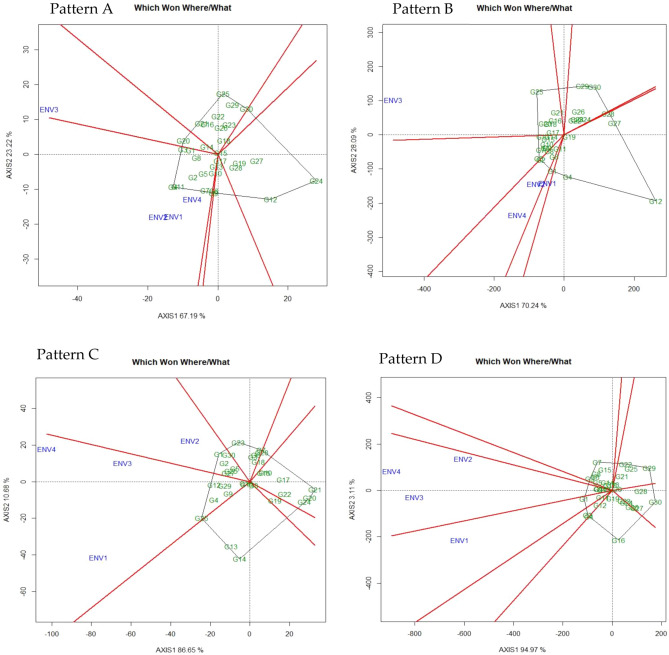
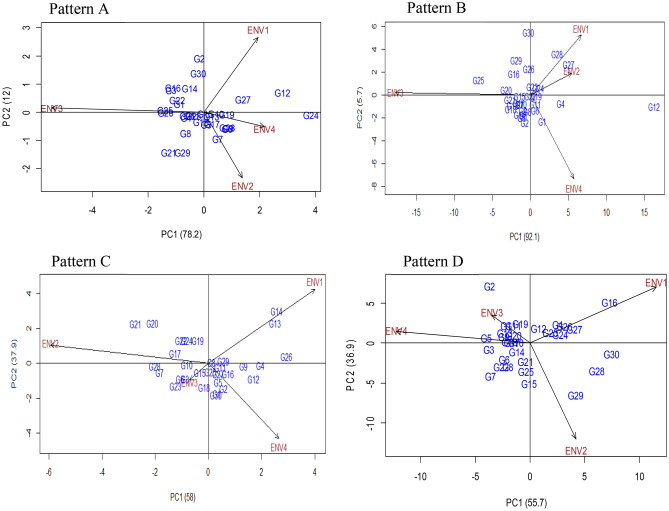
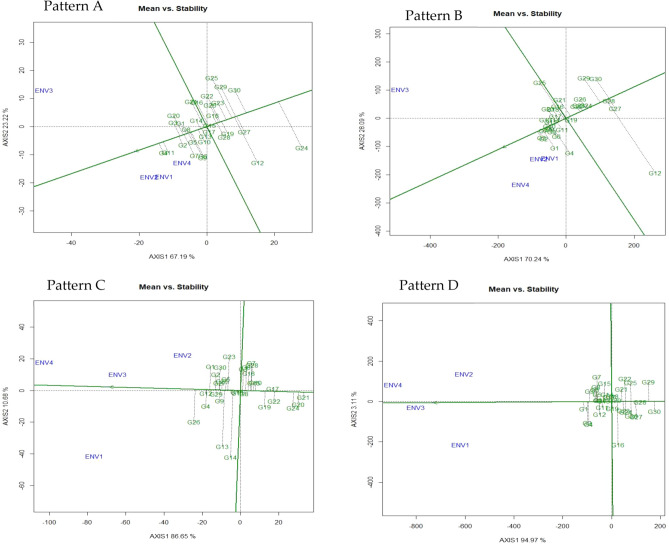
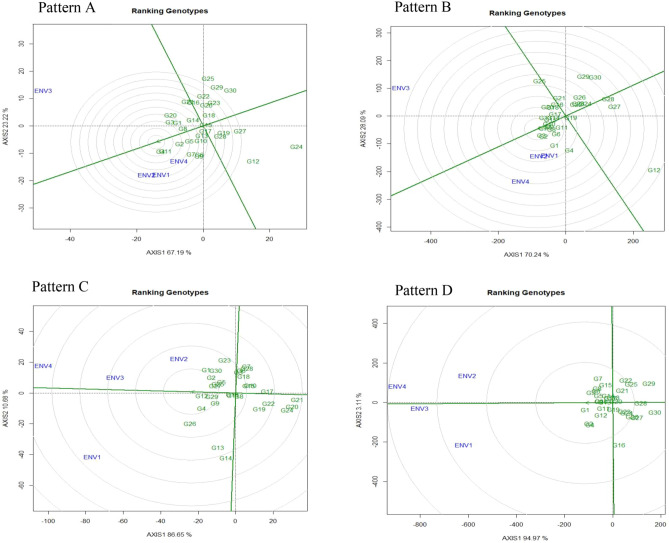
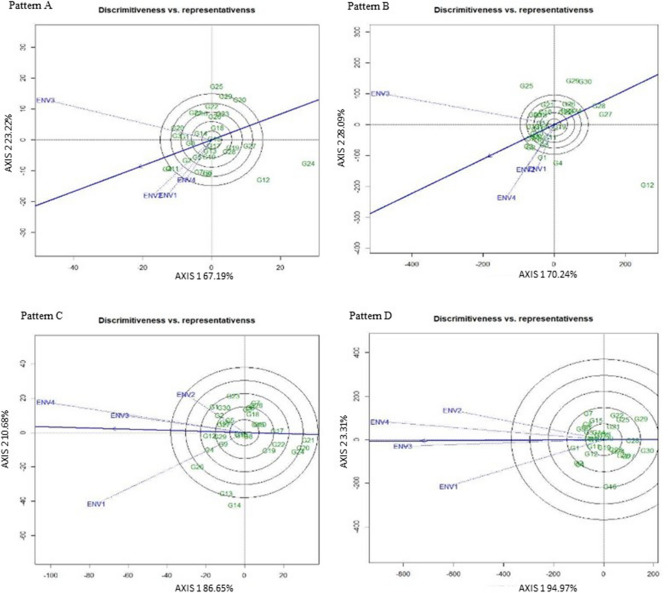
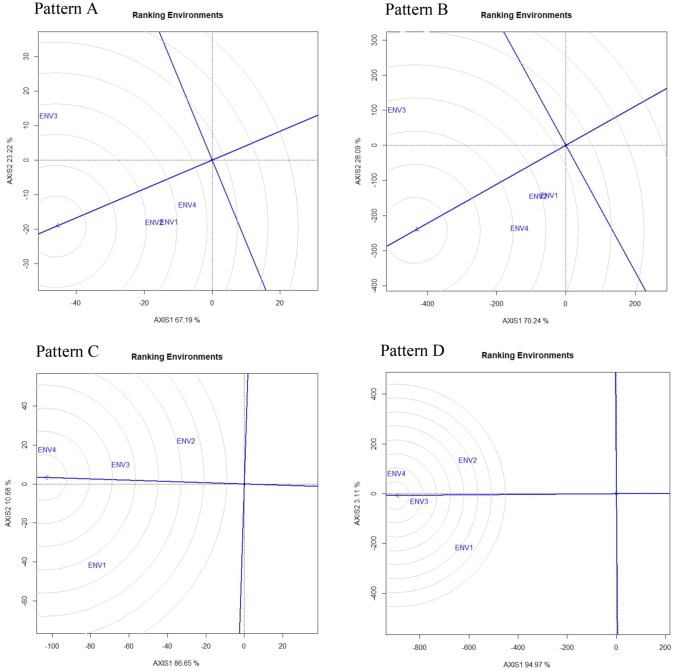
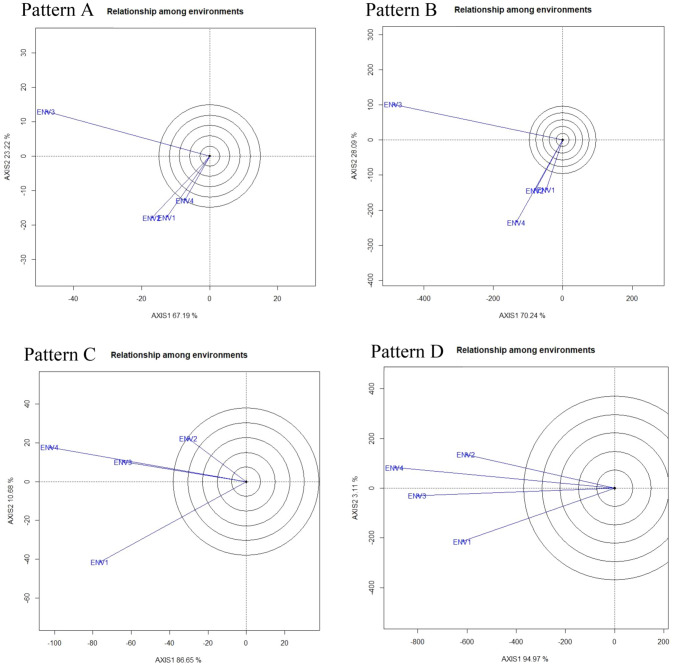
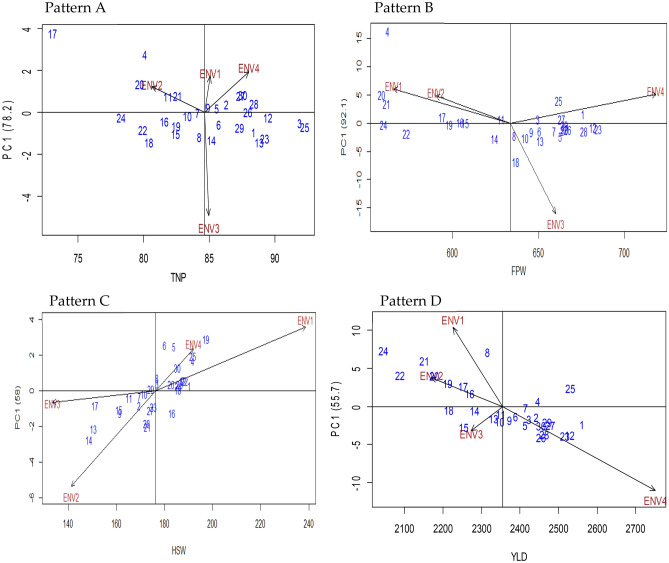
The stability and high yielding of Vigna subterranea L. Verdc. genotype is an important factor for long-term development and food security. The effects of G × E interaction on yield stability in 30 Bambara groundnut genotypes in four different Malaysian environments were investigated in this research. The experiment used a randomized complete block design with three replications in each environment. Over multiple harvests, yield component traits such as the total number of pods per plant, fresh pods weight (g), hundred seeds weight (g), and yield per hectare were evaluated in the main and off-season in 2020 and 2021. Stability tests for multivariate stability parameters were performed based on analyses of variance. For all the traits, the pooled analysis of variance revealed highly significant (p < 0.01) variations between genotypes, locations, seasons, and genotypes by environment (G × E interaction). A two-dimensional GGE biplot was generated using the first two principal components (axis 1 and axis 2), which accounted for 94.97% and 3.11% difference in GEI for yield per hectare, respectively. Season and location were found to be the most significant causes of yield heterogeneity, accounting for 31.13% and 14.02% of overall G + E + G × E variation, respectively, according to the combined study of variance. The GGE biplot revealed that the three winning genotypes G1, G3, and G5 appear across environments whereas AMMI model exposed genotypes viz G18, G14, G7, G3, G1, and G5 as best performer. Based on ideal genotype ranking genotype G1 was the best performer, with a high mean yield and high stability in the tested environment. According to the AEC line, genotypes G1 and G3 were extremely stable, while genotypes G2 and G4 were low stable, with a high average yielding per hectare. A GGE and AMMI biplot graphically showed the interrelationships between the tested environment and genotypes, classified genotypes into three categories as well as simplifying visual evaluations, according to this investigation. According to our results, breeding could improve yield production, and the genotypes discovered could be recommended for commercial cultivation.
菜豆属地下结实品种的稳定性和高产量是长期发展和粮食安全的重要因素。本研究调查了 30 个斑鸠花生基因型在马来西亚四个不同环境中 G×E 互作对产量稳定性的影响。该实验采用随机完全区组设计,每个环境重复三次。在 2020 年和 2021 年的主季和淡季,对每个植株的总荚数、鲜荚重(g)、百粒重(g)和每公顷产量等产量构成性状进行了多次收获评估。基于方差分析,对多元稳定性参数进行了稳定性测试。对于所有性状, pooled ANOVA 分析表明基因型、地点、季节和基因型与环境之间存在高度显著的差异(p<0.01)。使用前两个主成分(轴 1 和轴 2)生成二维 GGE 双标图,分别解释了每公顷产量的 GEI 差异的 94.97%和 3.11%。根据方差的综合研究,季节和地点被发现是产量异质性的最主要原因,分别占总 G+E+G×E 变异的 31.13%和 14.02%。GGE 双标图表明,三个优势基因型 G1、G3 和 G5 出现在各个环境中,而 AMMI 模型则揭示了基因型 G18、G14、G7、G3、G1 和 G5 是最佳表现者。根据理想基因型排名,基因型 G1 是最佳表现者,在测试环境中具有较高的平均产量和较高的稳定性。根据 AEC 线,基因型 G1 和 G3 非常稳定,而基因型 G2 和 G4 则是低稳定的,平均每公顷产量较高。根据本研究,GGE 和 AMMI 双标图直观地显示了测试环境与基因型之间的相互关系,将基因型分为三类,并简化了可视化评估。根据我们的结果,通过选育可以提高产量,所发现的基因型可以推荐用于商业种植。