Parlati Antonio Luca Maria, Nardi Ermanno, Basile Christian, Paolillo Stefania, Marzano Federica, Chirico Alfonsina, Buonocore Davide, Colella Angela, Fontanarosa Sara, Gallo Luca, Fierro Maria Francesca, Carbone Francesca, Gargiulo Paola, Prastaro Maria, Delle Grottaglie Santo, Santoro Ciro, Marchesi Anna, Marchetti Maria Francesca, Giovanni Carta Mauro, Perrone Filardi Pasquale, Montisci Roberta
Department of Advanced Biomedical Sciences, University of Naples "Federico II", Naples, Italy.
Advanced Cardiovascular Imaging Unit, Clinica Villa Dei Fiori, Acerra, Italy.
J Public Health Res. 2024 Oct 8;13(4):22799036241278817. doi: 10.1177/22799036241278817. eCollection 2024 Oct.
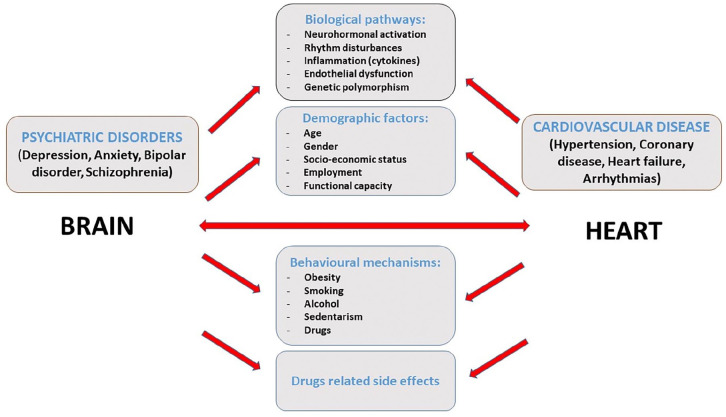
Cardiovascular diseases (CVD) and mental health disorders (MHD) are respectively the first and second most prevalent diseases in high-income countries and the two most relevant causes of disability worldwide. The close association between the two conditions has been known for a long time and research has been able to document how the co-morbidity between cardiovascular disorders and mental health disorders is a negative prognostic factor for both conditions. This strong connection and the relevance of the impact of the association have led to define a new branch of cardiology, known as behavioral cardiology. The aim of the new branch is just to study the nexus CVD-MHD in order to prevent or decrease the burden of MHD on CVD and vice versa. This review describes the epidemiological evidence of the relationship between MHD on CVD at the state of the art among clinical research.
心血管疾病(CVD)和精神健康障碍(MHD)分别是高收入国家中最普遍的第一和第二种疾病,也是全球范围内与残疾最相关的两个主要原因。这两种疾病之间的紧密关联早已为人所知,并且研究已经能够证明心血管疾病与精神健康障碍的共病如何成为这两种疾病的负面预后因素。这种紧密联系以及该关联影响的相关性促使人们定义了心脏病学的一个新分支,即行为心脏病学。这个新分支的目的正是研究心血管疾病与精神健康障碍之间的联系,以预防或减轻精神健康障碍对心血管疾病的负担,反之亦然。这篇综述描述了临床研究领域中精神健康障碍对心血管疾病影响关系的流行病学证据。