Tobías Aurelio, Íñiguez Carmen, Hurtado Díaz Magali, Riojas Horacio, Cifuentes Luis Abdon, Royé Dominic, Abrutzky Rosana, Coelho Micheline de Sousa Zanotti Stagliorio, Saldiva Paulo Hilario Nascimento, Valdés Ortega Nicolás, Matus Correa Patricia, Osorio Samuel, Carrasco Gabriel, Colistro Valentina, Pascal Mathilde, Chanel Olivier, Madaniyazi Lina, Gasparrini Antonio
Institute of Environmental Assessment and Water Research (IDAEA), Spanish Council for Scientific Research (CSIC), Barcelona, Spain.
School of Tropical Medicine and Global Health, Nagasaki University, Nagasaki, Japan.
Environ Epidemiol. 2024 Oct 10;8(6):e335. doi: 10.1097/EE9.0000000000000335. eCollection 2024 Dec.
We quantify the mortality burden and economic loss attributable to nonoptimal temperatures for cold and heat in the Central and South American countries in the Multi-City Multi-Country (MCC) Collaborative Research Network.
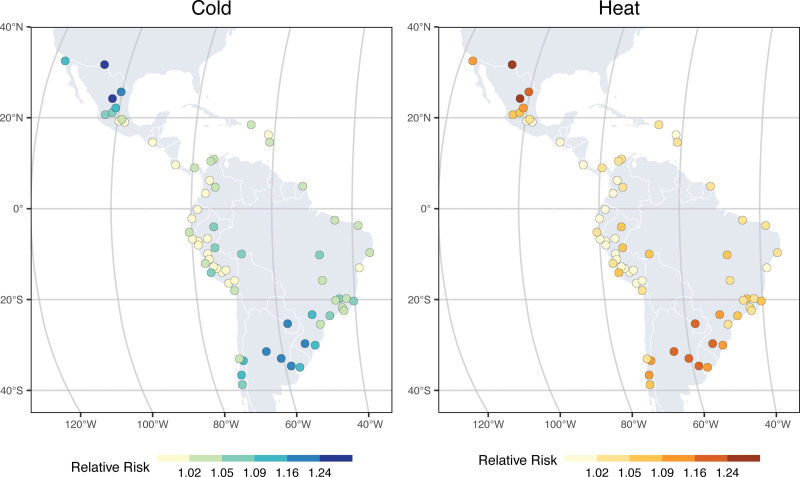
We collected data for 66 locations from 13 countries in Central and South America to estimate location-specific temperature-mortality associations using time-series regression with distributed lag nonlinear models. We calculated the attributable deaths for cold and heat as the 2.5th and 97.5th temperature percentiles, above and below the minimum mortality temperature, and used the value of a life year to estimate the economic loss of delayed deaths.
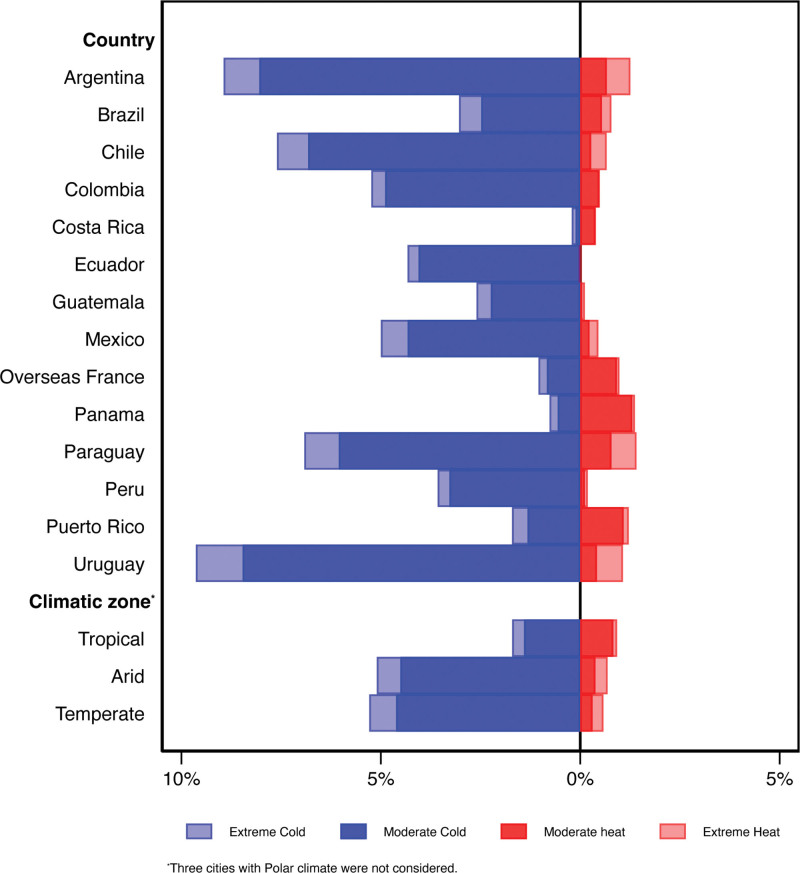
The mortality impact of cold varied widely by country, from 9.64% in Uruguay to 0.22% in Costa Rica. The heat-attributable fraction for mortality ranged from 1.41% in Paraguay to 0.01% in Ecuador. Locations in arid and temperate climatic zones showed higher cold-related mortality (5.10% and 5.29%, respectively) than those in tropical climates (1.71%). Arid and temperate climatic zones saw lower heat-attributable fractions (0.69% and 0.58%) than arid climatic zones (0.92%). Exposure to cold led to an annual economic loss of $0.6 million in Costa Rica to $472.2 million in Argentina. In comparison, heat resulted in economic losses of $0.05 million in Ecuador to $90.6 million in Brazil.
Most of the mortality burden for Central and South American countries is caused by cold compared to heat, generating annual economic losses of $2.1 billion and $290.7 million, respectively. Public health policies and adaptation measures in the region should account for the health effects associated with nonoptimal temperatures.
我们在多城市多国家(MCC)合作研究网络中,对中美洲和南美洲国家因寒冷和炎热天气下非适宜温度所致的死亡负担及经济损失进行量化。
我们收集了中美洲和南美洲13个国家66个地点的数据,采用分布滞后非线性模型的时间序列回归来估计特定地点的温度与死亡率之间的关联。我们将寒冷和炎热天气下的归因死亡数计算为高于和低于最低死亡率温度的第2.5和第97.5温度百分位数,并使用生命年价值来估计延迟死亡的经济损失。
寒冷天气对死亡率的影响因国家而异,从乌拉圭的9.64%到哥斯达黎加的0.22%。炎热天气导致的死亡率归因比例从巴拉圭的1.41%到厄瓜多尔的0.01%不等。干旱和温带气候区的寒冷相关死亡率(分别为5.10%和5.29%)高于热带气候区(1.71%)。干旱和温带气候区的炎热归因比例(分别为0.69%和0.58%)低于干旱气候区(0.92%)。寒冷天气导致的年度经济损失在哥斯达黎加为60万美元,在阿根廷为4.722亿美元。相比之下,炎热天气导致的经济损失在厄瓜多尔为5万美元,在巴西为9060万美元。
与炎热天气相比,中美洲和南美洲国家的大部分死亡负担是由寒冷天气造成的,分别造成年度经济损失21亿美元和2.907亿美元。该地区的公共卫生政策和适应措施应考虑到与非适宜温度相关的健康影响。