Division of Oncology, Department of Medicine, University of North Carolina at Chapel Hill, Chapel Hill, NC, USA.
University of North Carolina at Chapel Hill School of Medicine, Chapel Hill, NC, USA.
JNCI Cancer Spectr. 2024 Sep 2;8(5). doi: 10.1093/jncics/pkae092.
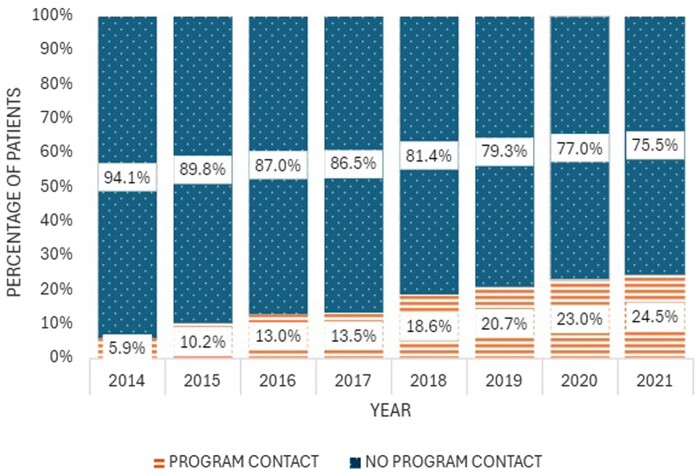
Cancer care organizations often struggle to adequately address the unique needs of adolescent and young adult cancer patients, resulting in poorer outcomes compared with other age groups. Creation of adolescent and young adult cancer programs serves to bridge this gap and improve quality of care for this population. We aimed to describe the evolution and impact of the University of North Carolina at Chapel Hill's Adolescent and Young Adult Cancer Program. To do so, we conducted a retrospective cohort study utilizing electronic health record data matched with North Carolina Cancer Registry data from 2014 to 2022. Between 2014 and 2022, a total of 4016 adolescents and young adults (aged 13-39 years) received cancer care at the University of North Carolina Medical Center, with 670 having contact with the Adolescent and Young Adult Cancer Program. Program-contacted patients were younger, more likely to be non-Hispanic Black race, and more likely to have metastatic disease or hematologic malignancies. We saw a steady increase in patient volume over the study period, corresponding with program growth.
癌症护理组织常常难以充分满足青少年和青年癌症患者的特殊需求,导致其治疗效果比其他年龄组更差。创建青少年和青年癌症项目有助于弥补这一差距,并改善该人群的护理质量。我们旨在描述北卡罗来纳大学教堂山分校青少年和青年癌症项目的发展历程及其影响。为此,我们进行了一项回顾性队列研究,使用电子健康记录数据与 2014 年至 2022 年北卡罗来纳癌症登记处的数据进行匹配。在 2014 年至 2022 年间,共有 4016 名青少年和青年(年龄在 13-39 岁之间)在北卡罗来纳大学医疗中心接受癌症治疗,其中 670 名患者与青少年和青年癌症项目有接触。与项目有接触的患者更年轻,更可能是非西班牙裔黑人,更可能患有转移性疾病或血液系统恶性肿瘤。在研究期间,我们看到患者数量稳步增加,与项目的发展相对应。