Clinical Research Development Center, Imam Reza Hospital, Kermanshah University of Medical Sciences, Kermanshah, Iran.
Chemistry Department, College of Education, University of Garmian, Sulimmania, Iraq.
Sci Rep. 2024 Oct 14;14(1):24021. doi: 10.1038/s41598-024-76153-y.
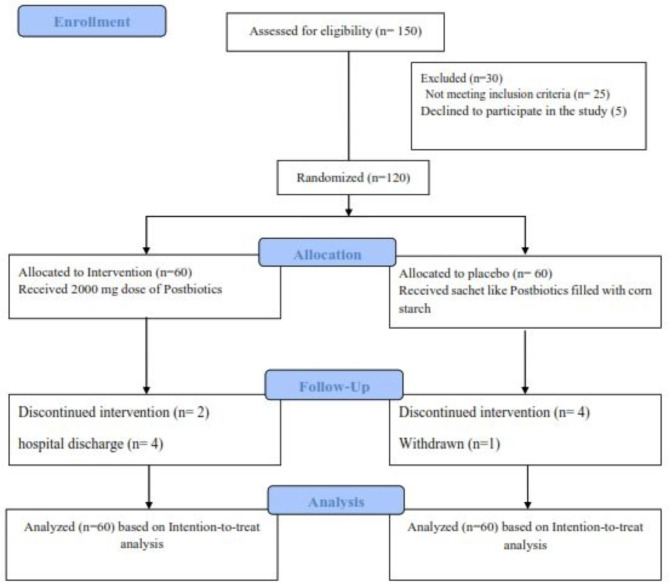
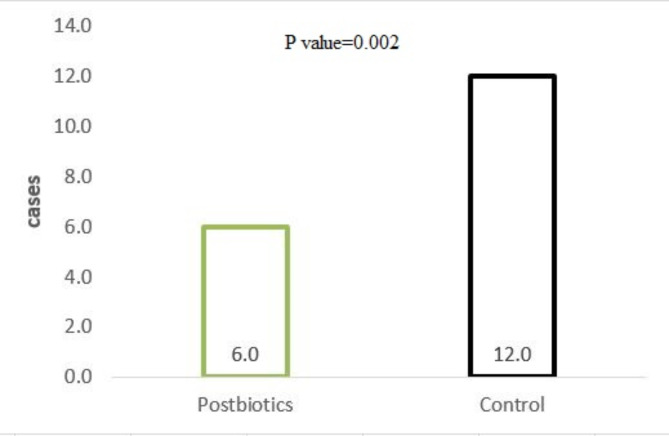
Background Cerebrovascular accidents (CVAs), or strokes, are major global health concerns associated with oxidative stress, inflammation, and gastrointestinal complications. This study aimed to explore the impact of postbiotic supplementation in CVA patients, specifically in terms of oxidative stress, inflammation, and clinical outcomes, as an alternative to probiotics with potential advantages. Method A prospective, single-center, randomized, controlled trial was conducted with 120 CVA patients in Iran. These patients were admitted to the ICU to assess the severity of their strokes. Patients were randomly assigned to receive either postbiotic supplementation (n = 60) or a placebo (n = 60). Various biomarkers related to oxidative stress, inflammation, and clinical outcomes were assessed. Data on demographic characteristics, nosocomial infections, and laboratory measurements were collected. Gut microbiota analysis was also performed on fecal samples. Results After the 7-day intervention, postbiotic supplementation resulted in significant improvements in inflammatory markers, oxidative stress, and a reduced incidence of pneumonia compared with those in the control group, with the postbiotic group demonstrating notable decreases in the serum IL-1β levels (-1.79; 95% CI: = -2.9 to -0.64, p = 0.002 ), MDA levels (-30.5; 95% CI: -54.8 to -6.1, p = 0.015), Hs-CRP levels (-0.67; 95% CI:-1.1 to -0.26 mg/dl, p = 0.001) and TAC levels (62.5; 95%CI: 34.1 to 90.9, p < 0.001) compared with those in the placebo group. However, no significant differences in other clinical outcomes, including the NIHSS score, NUTRIC score, and APACHE II score, or the gut microbiota profile, were observed between the two groups. Conclusion Postbiotic supplementation improved the levels of inflammatory factors and oxidative stress markers and reduced the risk of pneumonia in CVA patients. Trial registration This trial is registered in the Iranian Registry of Clinical Trials (registration code IRCT20180712040438N7), Registration date 06122022.
脑血管意外(CVA)又称中风,是全球范围内主要的健康问题之一,与氧化应激、炎症和胃肠道并发症有关。本研究旨在探讨后生物补充剂对 CVA 患者的影响,特别是在氧化应激、炎症和临床结局方面,作为益生菌的替代物,具有潜在优势。 方法: 这是在伊朗进行的一项前瞻性、单中心、随机、对照试验,纳入了 120 名 CVA 患者。这些患者被收入 ICU 以评估中风的严重程度。患者被随机分配接受后生物补充剂(n=60)或安慰剂(n=60)。评估了与氧化应激、炎症和临床结局相关的各种生物标志物。收集了人口统计学特征、医院感染和实验室测量的数据。还对粪便样本进行了肠道微生物组分析。 结果: 在 7 天的干预后,与对照组相比,后生物补充剂组的炎症标志物、氧化应激显著改善,肺炎发生率降低,后生物补充剂组的血清 IL-1β 水平显著下降(-1.79;95%置信区间:-2.9 至 -0.64,p=0.002),MDA 水平下降(-30.5;95%置信区间:-54.8 至 -6.1,p=0.015),Hs-CRP 水平下降(-0.67;95%置信区间:-1.1 至 -0.26 mg/dl,p=0.001),TAC 水平升高(62.5;95%置信区间:34.1 至 90.9,p<0.001)。然而,两组之间其他临床结局(包括 NIHSS 评分、NUTRIC 评分、APACHE II 评分)或肠道微生物组谱无显著差异。 结论: 后生物补充剂可改善 CVA 患者的炎症因子和氧化应激标志物水平,并降低肺炎风险。 试验注册: 本试验在伊朗临床试验注册中心注册(注册号 IRCT20180712040438N7),注册日期 2022 年 12 月 6 日。