Chen Mengting, Ma Liling, Yu Huiqing, Huang Shaoyi, Zhang Junhui, Gong Juan, Yang Liejun, Chen Lan, Luo Haojun, Tian Ling, Wang Sixiong
Department of Clinical Nutrition, Chongqing University Cancer Hospital, School of Medicine, Chongqing University, Chongqing, China.
Department of Geriatric Oncology and Department of Palliative Care, Chongqing University Cancer Hospital, School of Medicine, Chongqing University, Chongqing, China.
Front Oncol. 2023 Aug 4;13:1155592. doi: 10.3389/fonc.2023.1155592. eCollection 2023.
This study aimed to evaluate the effects of JK5G postbiotics to regulate imbalanced gut microbiota and its impacts on the efficacy and incidence rate of immune-related adverse events (irAEs) in non-small-cell lung cancer (NSCLC) patients treated with immune checkpoint inhibitors (ICIs).
This randomized, double-blind, placebo-controlled trial was conducted in China and included non-squamous or squamous NSCLC patients without EGFR, ROS1, and ALK alteration, treatment-naive, and stage IIIb-IV. Patients were randomly (1:1) divided into two groups to receive four cycles (three weeks for each cycle) of programmed cell death-1 (PD-1) plus chemotherapy plus placebo (control group, n = 30) or to receive PD-1 plus chemotherapy plus JK5G postbiotics (JK5G group, n = 30). The primary endpoint was objective response rate. The secondary endpoints were quality of life (QoL), adverse effects, and the 16S DNA sequencing of gut microbiota, blood inflammatory cytokines, and lymphocyte subsets. This study was registered at www.chictr.org.cn (ChiCTR2200064690).
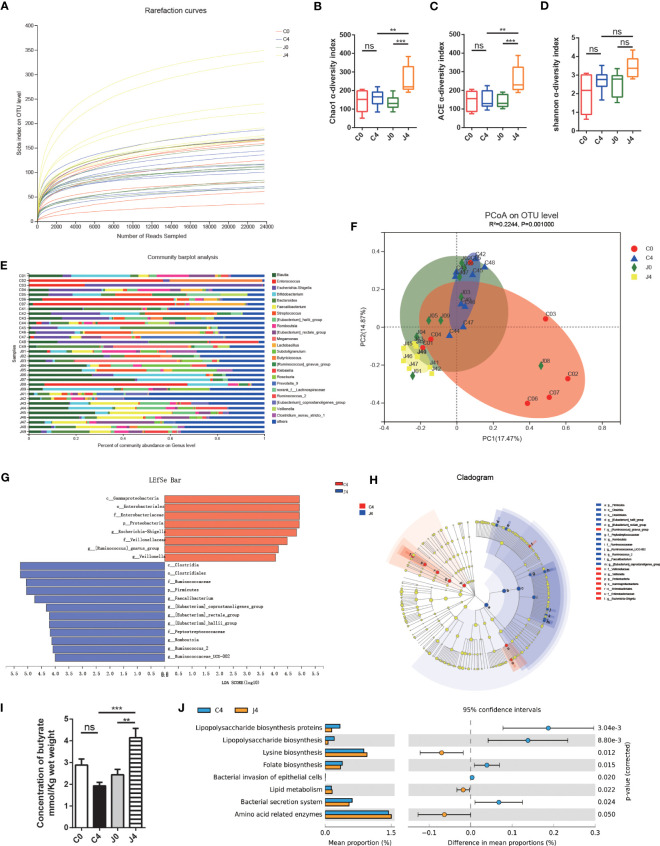
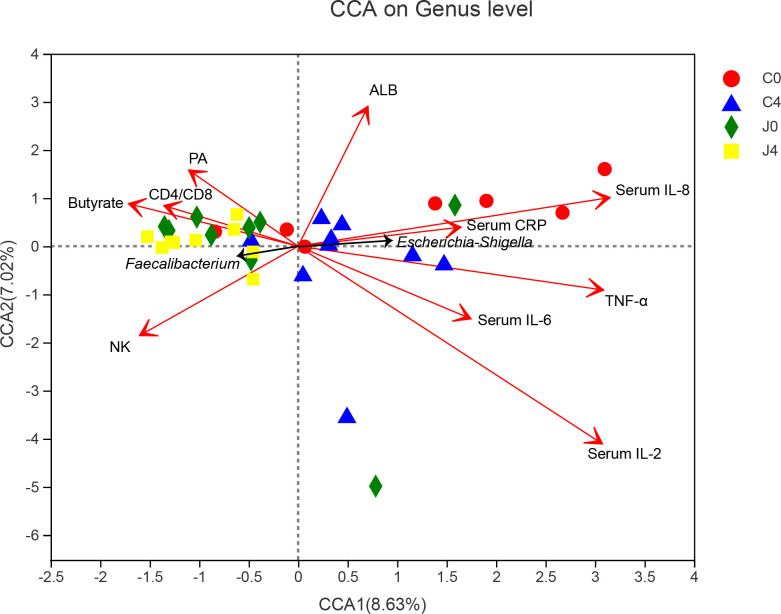
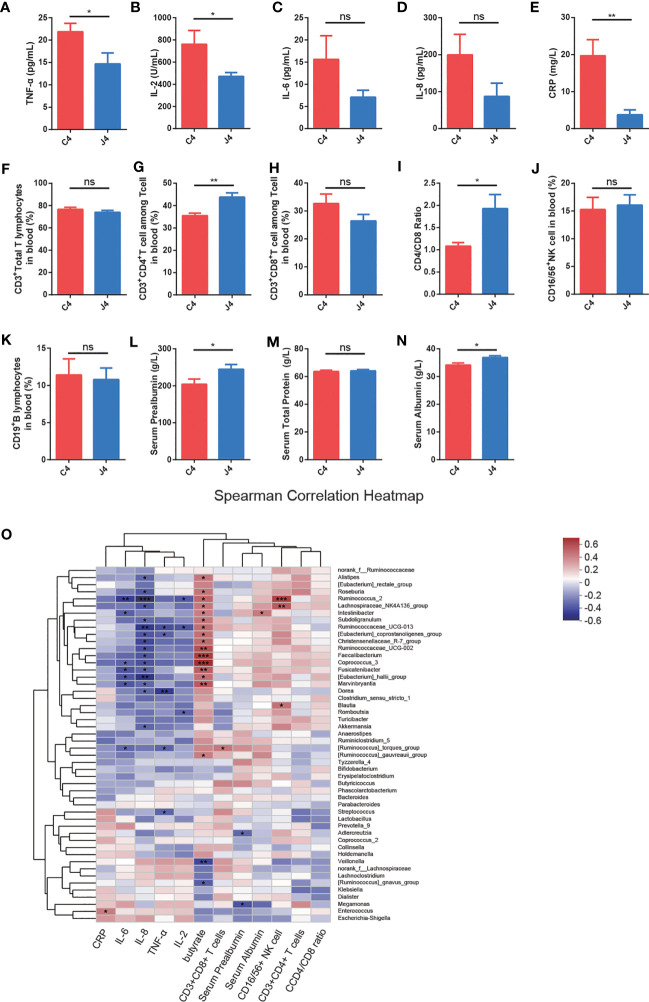
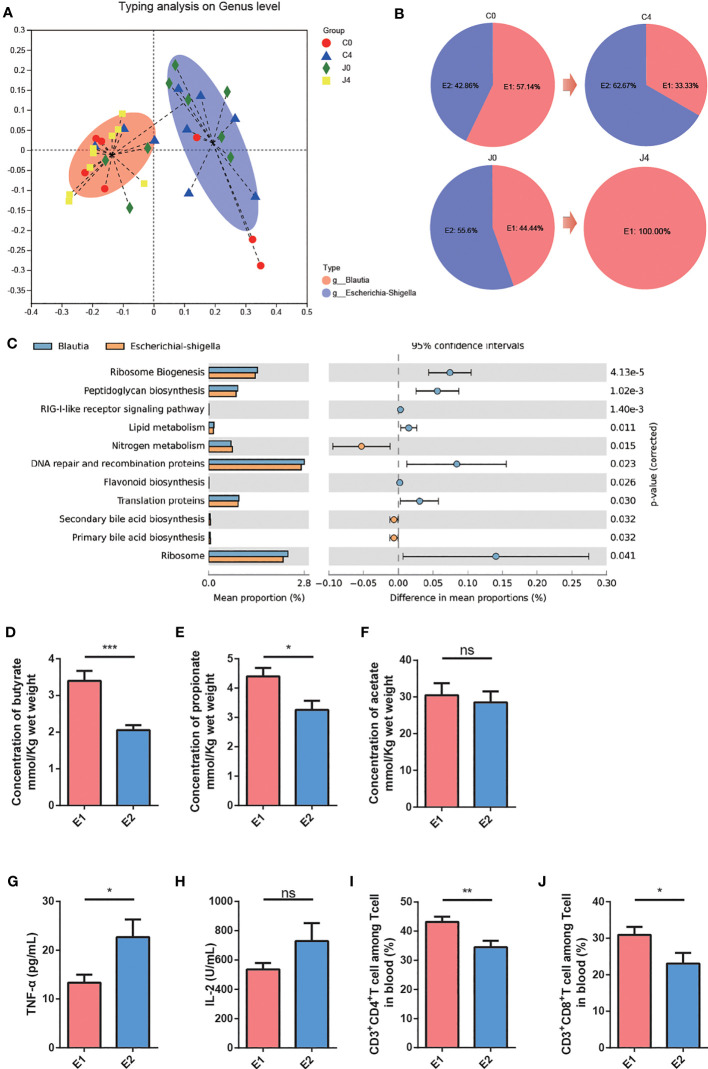
Sixty patients were enrolled. The objective response rate was 36.67% (11/30) in the control group and 50.00% (15/30) in the JK5G group ( = 0.297). The JK5G group had better QoL and nutritional levels, as well as lower depression symptoms than the control group (all < 0.05). Moreover, the JK5G group had a lower incidence of anemia (63.33% vs. 13.33%, < 0.001), decreased lymphocyte count (20.00% vs. 0%, = 0.010), decreased appetite (53.33% vs. 16.67%, = 0.003), nausea (33.33% vs. 6.67%, = 0.010), and asthenia (30.00% vs. 6.67%, = 0.017) than the control group. Moreover, JK5G attenuated gut microbiota imbalance, accompanied by increased , , and fecal butyrate concentration, and diminished . Furthermore, JK5G administration significantly decreased the levels of pro-inflammatory markers, including TNF-α, IL-2, and C-reactive protein (CRP) (all < 0.05). Significant increases in CD3CD4 T cells and CD4/CD8 ratio were observed in the peripheral blood of JK5G group patients (all < 0.05). The enterotype data showed that patients were clustered into (E1) and (E2) enterotypes, and JK5G postbiotics intervention might be related to enterotype modulations.
Our current findings indicated that JK5G postbiotics might attenuate irAEs, and enhance the QoL and nutrition levels of advanced NSCLC patients who received ICIs. JK5G postbiotics could also improve the gut microbiota structures and ameliorate the tumor microenvironment and inflammation.
www.chictr.org.cn, identifier ChiCTR2200064690.
本研究旨在评估JK5G后生元对调节肠道微生物群失衡的作用及其对接受免疫检查点抑制剂(ICI)治疗的非小细胞肺癌(NSCLC)患者免疫相关不良事件(irAE)的疗效和发生率的影响。
本随机、双盲、安慰剂对照试验在中国进行,纳入无EGFR、ROS1和ALK改变、未经治疗且为Ⅲb-Ⅳ期的非鳞状或鳞状NSCLC患者。患者被随机(1:1)分为两组,接受四个周期(每个周期三周)的程序性细胞死亡蛋白1(PD-1)加化疗加安慰剂(对照组,n = 30),或接受PD-1加化疗加JK5G后生元(JK5G组,n = 30)。主要终点是客观缓解率。次要终点是生活质量(QoL)、不良反应以及肠道微生物群的16S DNA测序、血液炎症细胞因子和淋巴细胞亚群。本研究已在www.chictr.org.cn注册(ChiCTR2200064690)。
共纳入60例患者。对照组的客观缓解率为36.67%(11/30),JK5G组为50.00%(15/30)(P = 0.297)。JK5G组的生活质量和营养水平更好,抑郁症状也比对照组轻(均P < 0.05)。此外,JK5G组贫血发生率较低(63.33%对13.33%,P < 0.001),淋巴细胞计数下降较少(20.00%对0%,P = 0.010),食欲下降较少(53.33%对16.67%,P = 0.003),恶心较少(33.33%对6.67%,P = 0.010),乏力较少(30.00%对6.67%,P = 0.017)。此外,JK5G减轻了肠道微生物群失衡,同时伴随着双歧杆菌属、阿克曼菌属增加和粪便丁酸盐浓度升高,以及嗜黏蛋白阿克曼菌减少。此外,给予JK5G显著降低了促炎标志物的水平,包括肿瘤坏死因子-α、白细胞介素-2和C反应蛋白(CRP)(均P < 0.05)。JK5G组患者外周血中CD3CD4 T细胞和CD4/CD8比值显著增加(均P < 0.05)。肠型数据显示患者被聚类为拟杆菌型(E1)和普氏菌型(E2)肠型,JK5G后生元干预可能与肠型调节有关。
我们目前的研究结果表明,JK5G后生元可能减轻irAE,并提高接受ICI治疗的晚期NSCLC患者的生活质量和营养水平。JK5G后生元还可以改善肠道微生物群结构,改善肿瘤微环境和炎症。