Borelli Eleonora, Pesciarelli Francesca
Department of Medical and Surgical Sciences, University of Modena and Reggio Emilia, Modena, Italy.
Department of Biomedical, Metabolic and Neural Sciences, University of Modena and Reggio Emilia, Modena, Italy.
Front Psychol. 2024 Sep 30;15:1474945. doi: 10.3389/fpsyg.2024.1474945. eCollection 2024.
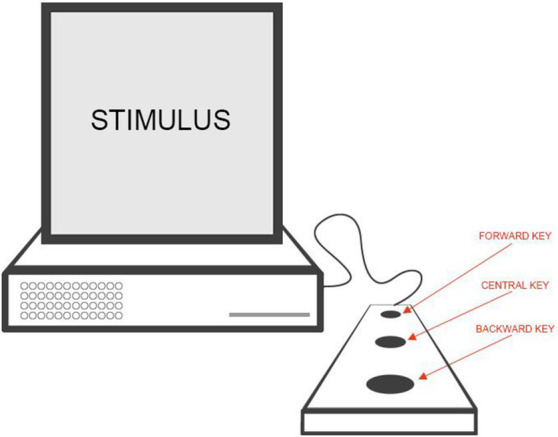
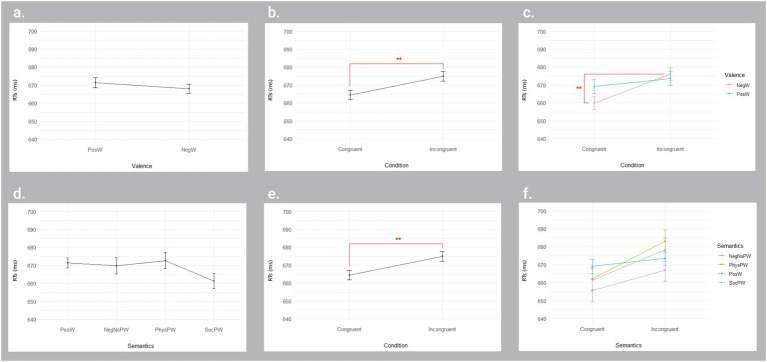
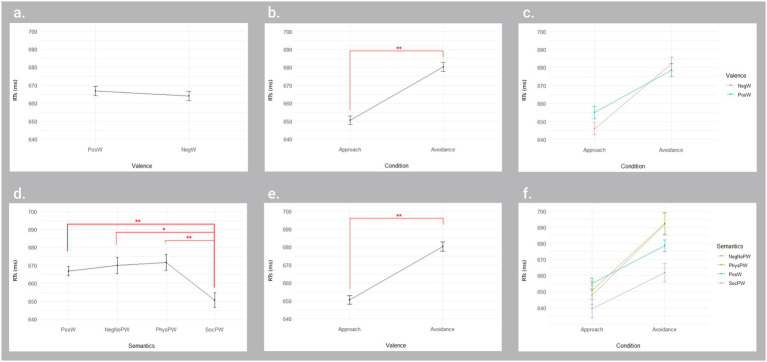
Studies examining whether stimulus valence affects cognitive processing and motor responses yield mixed results, possibly due to treating negative words as a homogeneous category. Words related to pain may hold distinct status because of their relevance to survival. Thus, they offer a unique opportunity to investigate semantic influences on cognitive processing. This study aims to determine if words related to physical and social pain elicit stronger aversion than general negative words by assessing the Affective Compatibility Effect in implicit and explicit tasks. In Experiment 1, 35 participants performed a lexical decision task on 60 positive words and 60 negative words, of which 20 not related to pain, 20 related to physical pain, and 20 related to social pain. Participants held down the central key of a keyboard and released it to press a key far from the screen (avoidance condition) or close to the screen (approach condition) for words. In Experiment 2, 43 participants performed a valence evaluation task on the same words. They held down the central key and released it to press a key close to the screen for positive words and a key far from the screen for negative words (congruent condition), or the opposite (incongruent condition). In Experiment 1, we found faster RTs for social pain-related words compared to other categories. We also found faster RTs in the approach condition than in the avoidance condition, regardless of whether valence or semantics were considered as independent variables. In Experiment 2, we found faster RTs in the congruent condition than in the incongruent condition when semantics was considered as independent variable. We also found an interaction valence*condition, with faster RTs for negative words in the congruent condition than in the incongruent condition when valence was considered as independent variable. Our findings suggest that, notwithstanding pain-related words do not affect aversive behaviors compared to negative, pain-unrelated words, they are processed faster when conveying social pain. This supports the hypothesis that the cognitive system differentiates and responds congruently not only based on general semantic categories, like pain, but also possibly based on nuances within it.
研究刺激效价是否会影响认知加工和运动反应,结果喜忧参半,这可能是因为将负面词汇视为一个同质化的类别。与疼痛相关的词汇可能因其与生存的相关性而具有独特地位。因此,它们为研究语义对认知加工的影响提供了一个独特的机会。本研究旨在通过评估内隐和外显任务中的情感兼容性效应,来确定与身体疼痛和社会疼痛相关的词汇是否比一般负面词汇引发更强烈的厌恶情绪。在实验1中,35名参与者对60个积极词汇和60个负面词汇进行词汇判断任务,其中20个与疼痛无关,20个与身体疼痛相关,20个与社会疼痛相关。参与者按住键盘的中心键,然后松开它以按下远离屏幕的键(回避条件)或靠近屏幕的键(趋近条件)来对词汇做出反应。在实验2中,43名参与者对相同的词汇进行效价评估任务。他们按住中心键,然后松开它以按下靠近屏幕的键来表示积极词汇,按下远离屏幕的键来表示负面词汇(一致条件),或者相反(不一致条件)。在实验1中,我们发现与其他类别相比,与社会疼痛相关的词汇的反应时更快。我们还发现,无论将效价还是语义视为自变量,趋近条件下的反应时都比回避条件下的更快。在实验2中,当将语义视为自变量时,我们发现一致条件下的反应时比不一致条件下的更快。我们还发现了效价*条件的交互作用,当将效价视为自变量时,一致条件下负面词汇的反应时比不一致条件下的更快。我们的研究结果表明,尽管与疼痛相关的词汇与负面的、与疼痛无关的词汇相比,不会影响厌恶行为,但在传达社会疼痛时,它们的加工速度更快。这支持了这样一种假设,即认知系统不仅会根据一般的语义类别(如疼痛)进行区分并做出一致的反应,还可能会根据其中的细微差别进行区分并做出一致的反应。