Kofler Mario, Lindner Anna, Rass Verena, Ianosi Bogdan A, Putnina Lauma, Kindl Philipp, Schiefecker Alois J, Gaasch Maxime, Beer Ronny, Rhomberg Paul, Thomé Claudius, Schmutzhard Erich, Pfausler Bettina, Helbok Raimund
Department of Anaesthesiology and Critical Care Medicine, Medical University of Innsbruck, Innsbruck, Austria.
Department of Neurology, Medical University of Innsbruck, Innsbruck, Austria.
Neurocrit Care. 2025 Apr;42(2):343-350. doi: 10.1007/s12028-024-02126-8. Epub 2024 Oct 15.
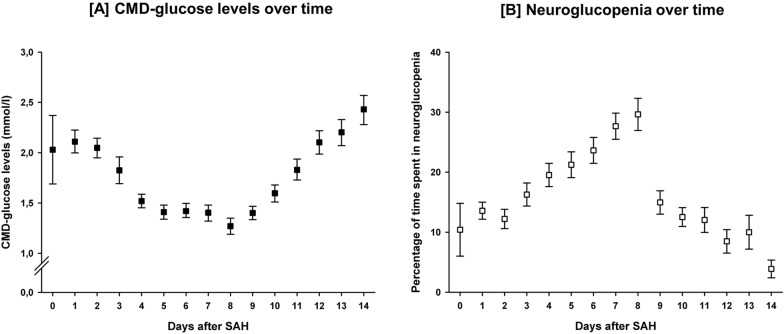
Pathologically low brain glucose levels, referred to as neuroglucopenia, are associated with unfavorable outcomes in neurocritical care patients. We sought to investigate whether an increase in serum glucose levels would be associated with a reduction of neuroglucopenia.
In this retrospective analysis of prospectively collected data, we included 55 consecutive patients with spontaneous subarachnoid hemorrhage who underwent cerebral microdialysis (CMD) monitoring. Neuroglucopenia was defined as CMD-glucose levels < 0.7 mmol/l. We identified systemic glucose liberalization events, defined as a day with median serum glucose levels < 150 mg/dl, followed by a day with median serum glucose levels > 150 mg/dl, and compared concentrations of cerebral metabolites between these days. Unfavorable outcome was defined as modified Rankin Scale score ≥ 3 at 3 months after the bleeding.
Episodes of neuroglucopenia were more frequent in patients with unfavorable outcome (19.8% [19.3-20.3%] vs. 10.9% [10.4-11.5%], p = 0.007). Sixty-nine systemic glucose liberalization events were identified in 40 patients. Blood glucose levels increased from 141.2 (138.7-143.6) mg/dl to 159.5 (157.0-162.2) mg/dl (p < 0.001), CMD-glucose levels increased from 1.44 (1.39-1.50) mmol/l to 1.68 (1.62-1.75) mmol/l (p = 0.001), and the frequency of neuroglucopenia decreased from 24.7% (22.9-26.5%) to 20.2% (18.7-21.8%) (p = 0.002) during these events. Liberalization was not associated with changes in CMD-lactate, CMD-pyruvate, CMD-lactate-to-pyruvate ratio, CMD-glutamate, or CMD-glycerol.
In conclusion, the liberalization of serum glucose concentrations to levels between 150 and 180 mg/dl was associated with a significant reduction of neuroglucopenia.
病理性低脑葡萄糖水平,即所谓的神经低血糖症,与神经重症监护患者的不良预后相关。我们试图研究血清葡萄糖水平升高是否与神经低血糖症的减少有关。
在这项对前瞻性收集数据的回顾性分析中,我们纳入了55例连续接受脑微透析(CMD)监测的自发性蛛网膜下腔出血患者。神经低血糖症定义为CMD葡萄糖水平<0.7 mmol/l。我们确定了全身葡萄糖自由化事件,定义为一天的血清葡萄糖中位数水平<150 mg/dl,随后一天的血清葡萄糖中位数水平>150 mg/dl,并比较了这些天之间脑代谢物的浓度。不良预后定义为出血后3个月改良Rankin量表评分≥3分。
不良预后患者的神经低血糖症发作更频繁(19.8%[19.3 - 20.3%]对10.9%[10.4 - 11.5%],p = 0.007)。在40例患者中确定了69次全身葡萄糖自由化事件。血糖水平从141.2(138.7 - 143.6)mg/dl升高至159.5(157.0 - 162.2)mg/dl(p < 0.001),CMD葡萄糖水平从1.44(1.39 - 1.50)mmol/l升高至1.68(1.62 - 1.75)mmol/l(p = 0.001),在这些事件期间神经低血糖症的频率从24.7%(22.9 - 26.5%)降至20.2%(18.7 - 21.8%)(p = 0.002)。自由化与CMD乳酸、CMD丙酮酸、CMD乳酸与丙酮酸比值、CMD谷氨酸或CMD甘油的变化无关。
总之,将血清葡萄糖浓度放宽至150至180 mg/dl之间与神经低血糖症的显著减少有关。