Lee Bum Ju
Digital Health Research Division, Korea Institute of Oriental Medicine, Daejeon 34054, Republic of Korea.
J Clin Med. 2024 Oct 8;13(19):5988. doi: 10.3390/jcm13195988.
: Metabolic syndrome (MS) is a cluster of cardiometabolic risk factors for future diabetes and cardiovascular diseases, and low grip strength (GS) is associated with an increased risk of MS. However, the index (among absolute GS, relative GS, and anthropometric indices) that is more strongly associated with MS has not been conclusively identified. Therefore, the objective of the present study was to simultaneously examine the associations of MS with relative and absolute GS and anthropometric indices in a Korean population. : In this large-scale cross-sectional study, we used data from the Korean National Health and Nutrition Examination Survey (KNHANES). A total of 20,915 subjects were included in the statistical analyses. Complex sample binary logistic regression models were used to analyze the associations between MS and indices such as the waist-to-height ratio (WHtR), body mass index (BMI), and absolute and relative GS. : The prevalence of MS was 40.48% in men and 34.4% in women. The mean GS values in the healthy group and MS group were 38.06 ± 0.13 and 38.06 ± 0.15 years for men ( = 0.980) and 22.72 ± 0.07 and 21.19 ± 0.11 years for women ( < 0.001), respectively. Among all the indices, the WHtR was the index most strongly associated with MS in men. Among the GS indices, the GS/weight index was closely associated with MS, and the magnitude of this association was stronger than that of the absolute GS index. In women, the WHtR was the most related index to MS among all the indices. Among the GS indices, the GS/weight and GS/BMI indices were strongly associated with MS, and the magnitudes of these associations were much greater than those of the absolute GS index. : Although absolute and relative GS indices are strongly associated with MS in the Korean population, the strongest association was observed for the simple anthropometric index (WHtR).
代谢综合征(MS)是一组未来发生糖尿病和心血管疾病的心血管代谢危险因素,而握力(GS)低下与MS风险增加相关。然而,与MS关联更强的指标(在绝对握力、相对握力和人体测量指标之中)尚未得到最终确定。因此,本研究的目的是在韩国人群中同时检验MS与相对和绝对握力及人体测量指标之间的关联。
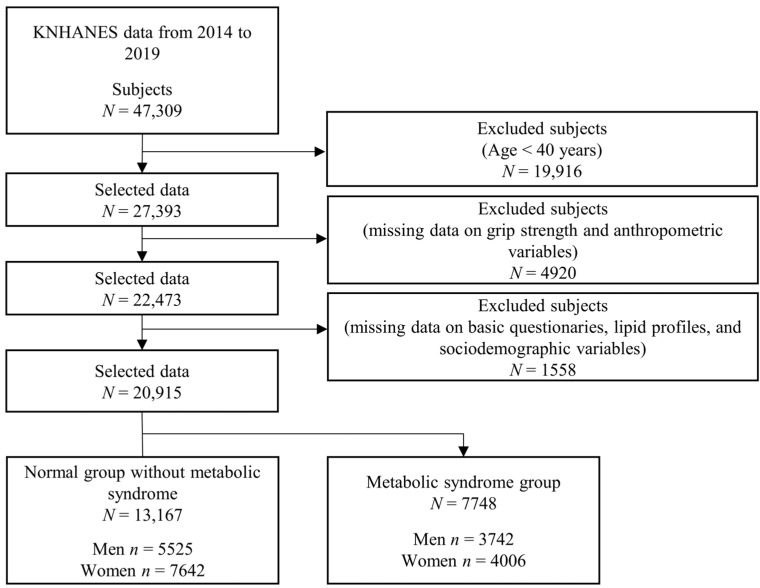
在这项大规模横断面研究中,我们使用了韩国国家健康与营养检查调查(KNHANES)的数据。共有20915名受试者纳入统计分析。采用复杂样本二元逻辑回归模型分析MS与腰高比(WHtR)、体重指数(BMI)以及绝对和相对握力等指标之间的关联。
男性MS患病率为40.48%,女性为34.4%。健康组和MS组男性的平均握力值分别为38.06±0.13和38.06±0.15岁(P = 0.980),女性分别为22.72±0.07和21.19±0.11岁(P < 0.001)。在所有指标中,WHtR是男性中与MS关联最强的指标。在握力指标中,握力/体重指数与MS密切相关,且这种关联的强度大于绝对握力指标。在女性中,WHtR是所有指标中与MS最相关的指标。在握力指标中,握力/体重和握力/BMI指数与MS密切相关,且这些关联的强度远大于绝对握力指标。
虽然绝对和相对握力指标在韩国人群中与MS密切相关,但观察到简单人体测量指标(WHtR)的关联最强。