Park Jongsuk, Kim Sangho
Department of Sport and Health Studies, Konkuk University, Chungju-si 27478, Republic of Korea.
School of Global Sport Studies, Korea University, Sejong-si 30019, Republic of Korea.
Medicina (Kaunas). 2025 Aug 16;61(8):1473. doi: 10.3390/medicina61081473.
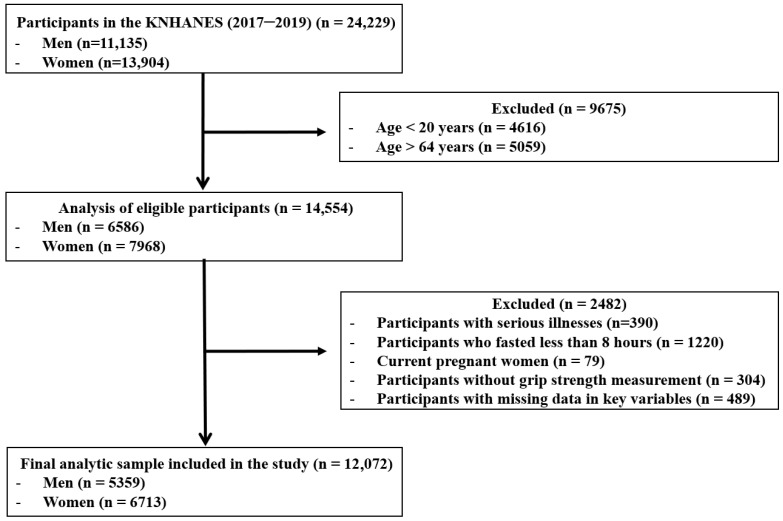
: This study aimed to assess the association between relative grip strength (RGS) and metabolic syndrome (MetS) in Korean adults and to explore sex- and age-specific cutoff values for screening purposes. : This cross-sectional study analyzed data from 12,072 Korean adults (aged 19-64 years) who participated in the 2017-2019 Korea National Health and Nutrition Examination Survey. Receiver operating characteristic (ROC) curve analysis was performed stratified by sex and age group, and participants were categorized into adequate (ARG) and low (LRG) RGS groups. Multivariable logistic regression was used to examine the association between RGS (as both categorical and continuous variables) and MetS, adjusting for lifestyle and behavioral covariates. : The RGS demonstrated moderate discriminatory power for MetS, with area under the curve (AUC) values ranging from 0.601 to 0.742. Age- and sex-specific cutoff values for RGS progressively decreased with age. Individuals in the LRG group had significantly higher odds of MetS across all age and sex groups. The LRG group had significantly greater odds of MetS in nearly all subgroups (e.g., women aged 20-39 years: odds ratio [OR] = 6.846; men: OR = 3.502). As a continuous variable, each 0.1-unit increase in RGS was associated with a 22.1-33.4% reduction in the odds of MetS ( < 0.001). : RGS is inversely associated with MetS, particularly in women and younger adults. Although its discriminatory ability is moderate, the RGS may serve as a simple and accessible screening indicator to help identify individuals with an increased metabolic risk.
本研究旨在评估韩国成年人相对握力(RGS)与代谢综合征(MetS)之间的关联,并探索用于筛查目的的性别和年龄特异性临界值。本横断面研究分析了12072名参与2017 - 2019年韩国国家健康与营养检查调查的韩国成年人(年龄在19 - 64岁之间)的数据。通过性别和年龄组进行分层的受试者工作特征(ROC)曲线分析,并将参与者分为RGS充足(ARG)组和RGS低(LRG)组。使用多变量逻辑回归来检验RGS(作为分类变量和连续变量)与MetS之间的关联,并对生活方式和行为协变量进行调整。RGS对MetS具有中等判别能力,曲线下面积(AUC)值范围为0.601至0.742。RGS的年龄和性别特异性临界值随年龄逐渐降低。在所有年龄和性别组中,LRG组患MetS的几率显著更高。在几乎所有亚组中,LRG组患MetS的几率都显著更高(例如,20 - 39岁女性:比值比[OR] = 6.846;男性:OR = 3.502)。作为连续变量,RGS每增加0.1个单位,患MetS的几率就会降低22.1 - 33.4%(<0.001)。RGS与MetS呈负相关,尤其是在女性和年轻人中。尽管其判别能力中等,但RGS可作为一种简单且易于获取的筛查指标,以帮助识别代谢风险增加的个体。