Paulo Rui, Ramalho André, Scursatone Isabella, Caire Maria, Calle Nicolás Bores, Bores-García Daniel, Espada María, Rebelo Miguel, Duarte-Mendes Pedro
Department of Sports and Well-Being, Polytechnic Institute of Castelo Branco, 6000-084 Castelo Branco, Portugal.
Sport Physical Activity and Health Research & INnovation CenTer, SPRINT, 2001-904 Santarém, Portugal.
Healthcare (Basel). 2024 Sep 26;12(19):1930. doi: 10.3390/healthcare12191930.
The objective of this study is to describe and compare the levels of physical activity, preferences for leisure-time physical activity, and the frequency of non-sedentary behaviors of Portuguese, Italian, and Spanish students attending higher education.
A total of 1354 students (21.2 ± 2.9 years) participated in the study, with data collected through an online questionnaire for 6 months.
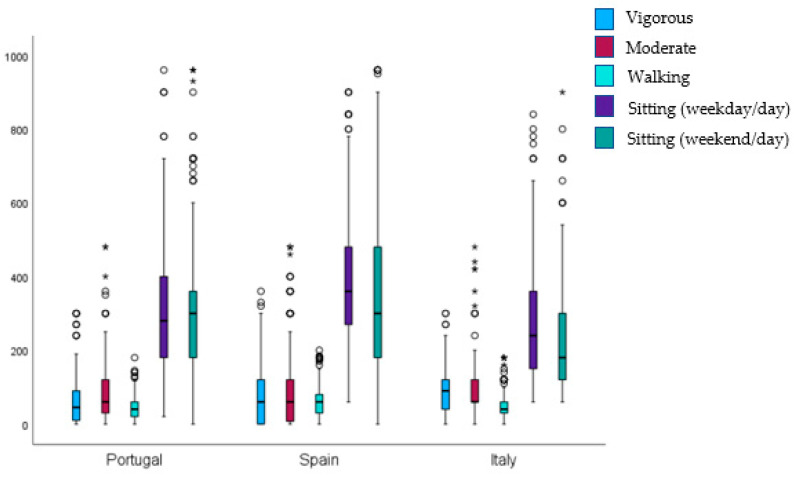
The highest levels of sedentary behavior are found among Spanish students, followed by the Portuguese, and lastly the Italians. In relation to physical activity levels, Spanish students perform more low and moderate physical activity, while Italian students perform more vigorous activities and naturally have a lower level of sedentary behavior.
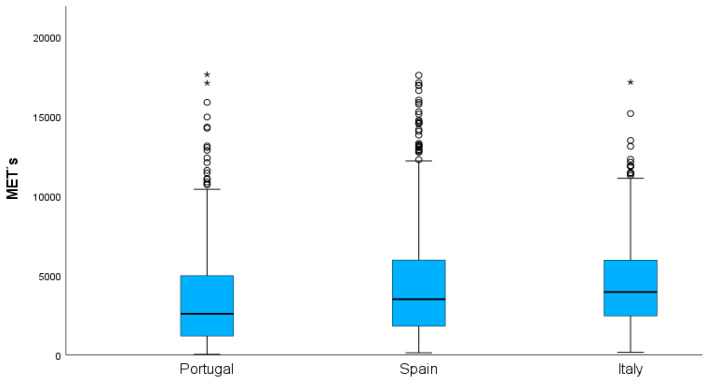
However, it is worth highlighting that students from all three countries reach the minimum levels of physical activity recommended by the WHO.
本研究的目的是描述和比较葡萄牙、意大利和西班牙接受高等教育的学生的身体活动水平、休闲时间身体活动偏好以及非久坐行为的频率。
共有1354名学生(21.2±2.9岁)参与了该研究,数据通过在线问卷收集,为期6个月。
西班牙学生的久坐行为水平最高,其次是葡萄牙学生,最后是意大利学生。在身体活动水平方面,西班牙学生进行更多的低强度和中等强度身体活动,而意大利学生进行更多的剧烈活动,自然久坐行为水平较低。
然而,值得强调的是,来自这三个国家所有的学生都达到了世界卫生组织建议的最低身体活动水平。