Department of Physiology, College of Basic Medicine, Lanzhou University, Lanzhou 730000, China.
School of Pharmacy, Lanzhou University, Lanzhou 730000, China.
Nutrients. 2024 Oct 9;16(19):3417. doi: 10.3390/nu16193417.
This study aimed to compare the effects of the phytoestrogens resveratrol (RES) and genistein (GEN) on the contractility of isolated uterine smooth muscle from rats, focusing on both spontaneous and stimulated contractions, and to investigate the underlying mechanisms.
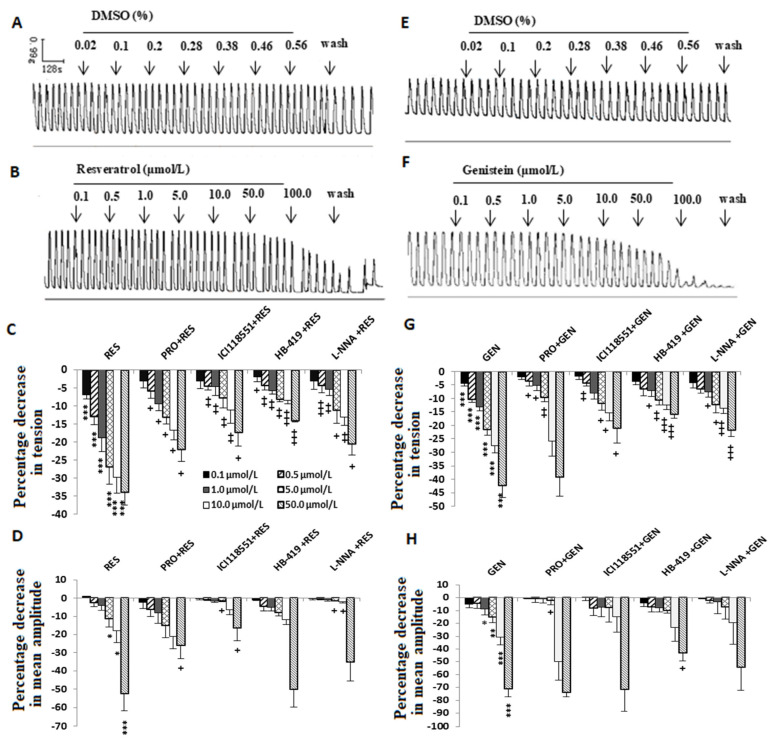
Uterine strips were suspended vertically in perfusion chambers containing Kreb's solution, various concentrations of RES and GEN were added to the ex vivo uterine strips, and contractions were measured before and after incubation with RES or GEN.
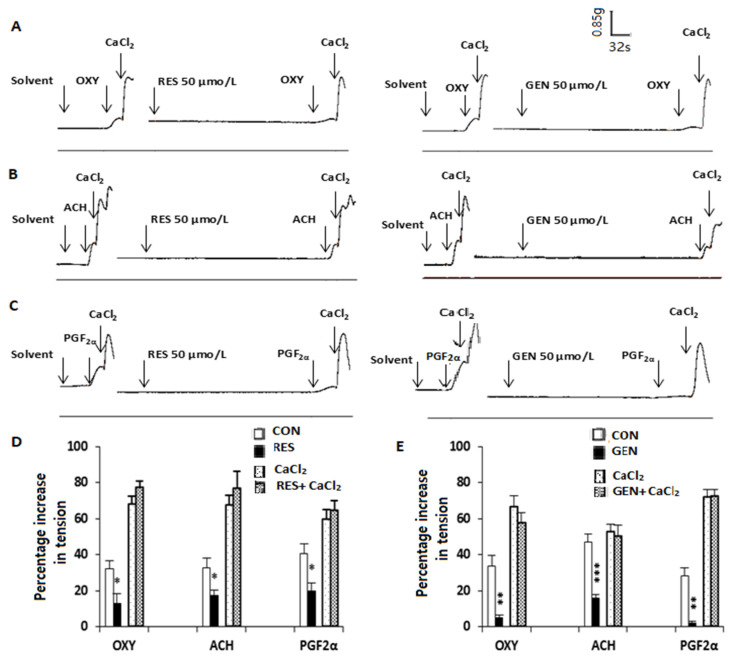
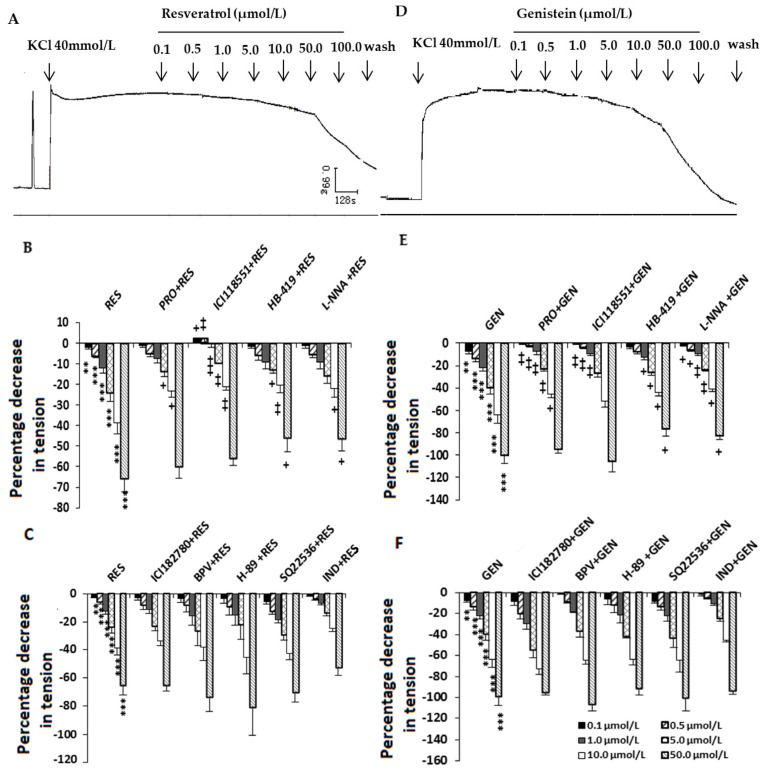
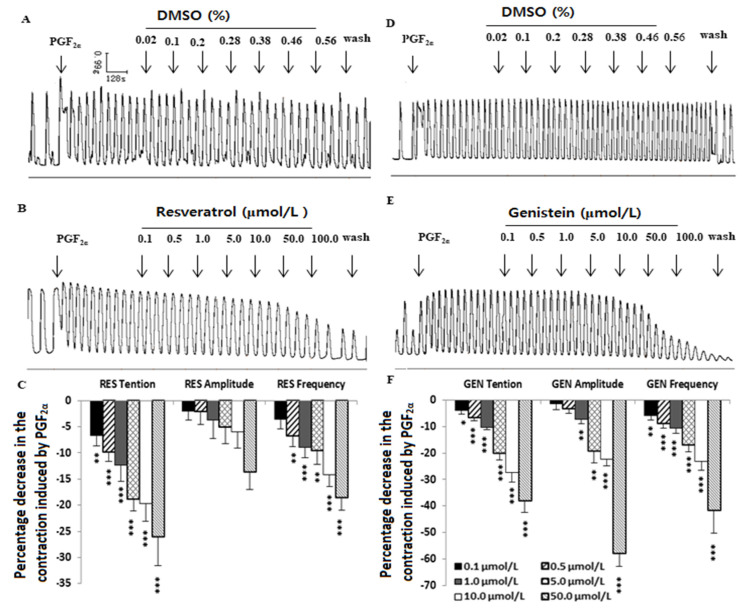
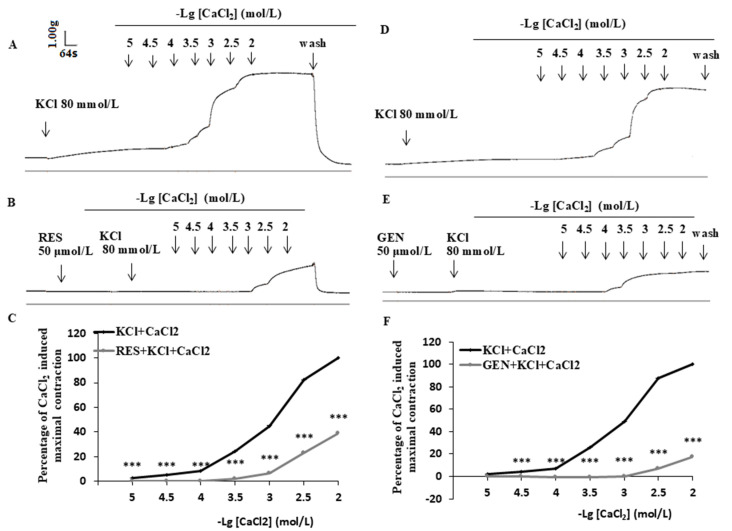
(1) Both RES and GEN inhibited K-induced contractions in a dose-dependent manner; the β/β-adrenoceptor antagonist propranolol (PRO), ICI118551, the ATP-dependent K channel blocker glibenclamide (HB-419) and the NO synthase inhibitor N-nitro-L-arginine (L-NNA) diminished the inhibitory effects of RES and GEN on K-induced contractions. (2) RES and GEN also dose-dependently inhibited PGF-induced uterine contractions. (3) The inhibitory effects of RES and GEN were observed in spontaneous contractile activities as well; PRO, ICI118551, HB-419 and L-NNA attenuated the inhibitory effects of RES and GEN on the spontaneous contractions of isolated uterine muscle strips. (4) RES and GEN significantly decreased the cumulative concentration response of Ca and shifted the Ca cumulative concentration-response curves to the right in high-K Ca-free Kreb's solution. (5) RES and GEN markedly reduced the first phasic contraction induced by oxytocin, acetylcholine, and prostaglandin F but did not alter the second phasic contraction caused by CaCl in Ca-free Kreb's solution.
RES and GEN can directly inhibit both spontaneous and activated contractions of isolated uterine smooth muscle. The mechanisms underlying the inhibitory effects of RES and GEN likely involve β adrenergic receptor activation, reduced Ca influx and release, the activation of ATP-dependent K channels and increased NO production.
本研究旨在比较白藜芦醇(RES)和染料木黄酮(GEN)对大鼠离体子宫平滑肌收缩性的影响,重点关注自发性和刺激性收缩,并探讨其潜在机制。
将子宫条垂直悬挂在含有 Krebs 溶液的灌注室中,向离体子宫条中加入不同浓度的 RES 和 GEN,孵育前后测量收缩情况。
(1)RES 和 GEN 均呈剂量依赖性抑制 K 诱导的收缩;β/β-肾上腺素能受体拮抗剂普萘洛尔(PRO)、ICI118551、ATP 依赖性 K 通道阻滞剂格列本脲(HB-419)和一氧化氮合酶抑制剂 N-硝基-L-精氨酸(L-NNA)减弱了 RES 和 GEN 对 K 诱导收缩的抑制作用。(2)RES 和 GEN 也呈剂量依赖性抑制 PGF 诱导的子宫收缩。(3)RES 和 GEN 对自发性收缩活动也有抑制作用;PRO、ICI118551、HB-419 和 L-NNA 减弱了 RES 和 GEN 对离体子宫肌条自发性收缩的抑制作用。(4)RES 和 GEN 显著降低 Ca 累积浓度反应,并使高 K Ca 缺失 Krebs 溶液中的 Ca 累积浓度反应曲线右移。(5)RES 和 GEN 明显减少了催产素、乙酰胆碱和前列腺素 F 诱导的第一相收缩,但不改变 Ca 缺失 Krebs 溶液中 CaCl 引起的第二相收缩。
RES 和 GEN 可直接抑制离体子宫平滑肌的自发性和激活性收缩。RES 和 GEN 的抑制作用机制可能涉及β肾上腺素能受体激活、减少 Ca 内流和释放、激活 ATP 依赖性 K 通道和增加 NO 产生。