Souza Danivia Endi Santana, Melo Jéssica Jessi Carvalho de, Santos Fernanda Franca Dos, Vasconcelos Ana Luíza Dos Santos, Jesus Adriana Dos Santos de, Freitas Lisiane Dos Santos, Souza Ranyere Lucena de, Soares Cleide Mara Faria
Postgraduate Program Process Engineering, Tiradentes University (UNIT), Campus Farolandia, Aracaju 49032-490, SE, Brazil.
Department of Chemistry, Federal University of Sergipe (UFS), São Cristóvão 49100-000, SE, Brazil.
Foods. 2024 Oct 1;13(19):3141. doi: 10.3390/foods13193141.
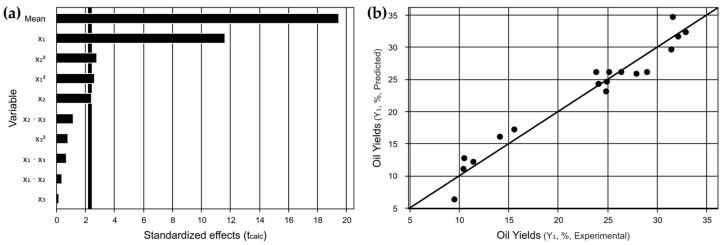
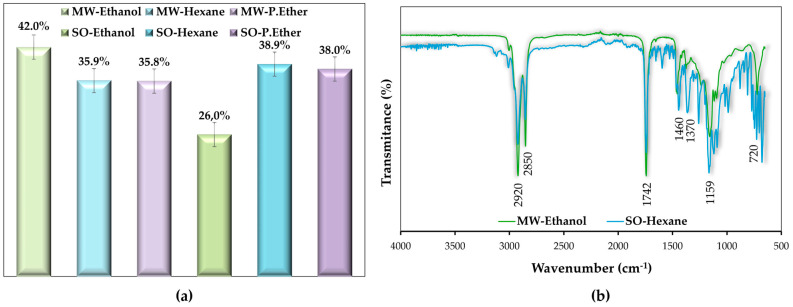
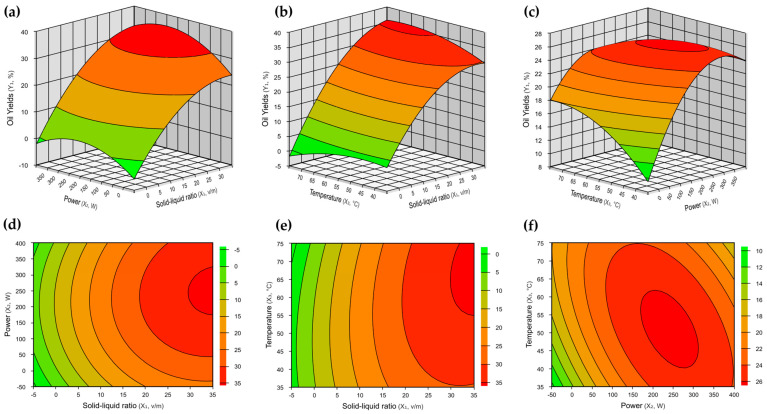
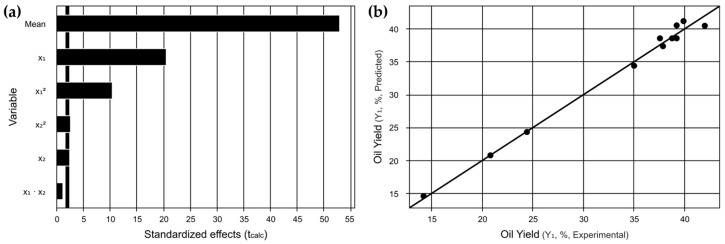
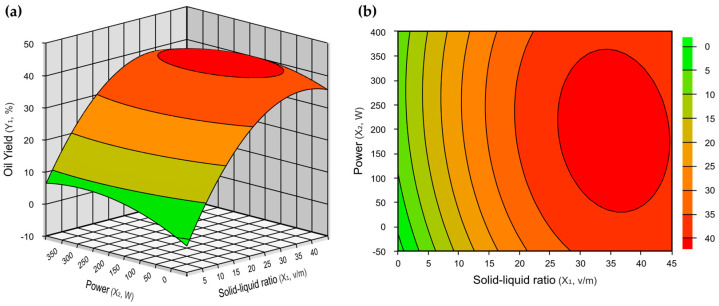
This study aims to evaluate the effectiveness of microwave-assisted and conventional extraction using ethanol, hexane, and petroleum ether as solvents, and to optimize the process for extracting oil from Lam. seeds, with a focus on improving food-grade oil production. Response surface methodology (RSM) was applied to enhance the extraction process of the oil. Central composite rotational design (CCRD) was used to analyze the impact of solid-liquid ratio (x), power (x), and temperature (x) on oil yield. The optimization identified the optimal conditions as a solid/liquid ratio of 1:38, power of 175 W, and temperature of 50 °C, achieving a 42% oil yield. Notably, the microwave-assisted extraction reduced the processing time from 8 h (using conventional Soxhlet extraction) to just 1 h. Conventional extraction with hexane and petroleum ether was also performed for comparison, resulting in similar oil content and fatty acid profiles, predominantly, oleic acid. FTIR analysis confirmed that the microwave-extracted oil contained fatty acids and had similar characteristics to the conventionally extracted oil. Thus, the use of ethanol as a green solvent in the microwave has shown significant improvement in terms of time and energy savings compared to the Soxhlet method with toxic solvents. This study concludes that microwave-assisted extraction with ethanol provides a more energy efficient, environmentally friendly, and time-saving alternative for food-grade oil production, aligning with advancements in food engineering and production.
本研究旨在评估以乙醇、己烷和石油醚为溶剂的微波辅助萃取和传统萃取的效果,并优化从Lam.种子中提取油脂的工艺,重点是提高食品级油脂的产量。应用响应面法(RSM)来强化油脂的萃取过程。采用中心复合旋转设计(CCRD)分析固液比(x1)、功率(x2)和温度(x3)对出油率的影响。优化确定的最佳条件为固液比1:38、功率175 W、温度50℃,出油率达到42%。值得注意的是,微波辅助萃取将处理时间从8小时(使用传统索氏萃取法)缩短至仅1小时。还进行了用己烷和石油醚的传统萃取以作比较,结果显示含油量和脂肪酸谱相似,主要为油酸。傅里叶变换红外光谱(FTIR)分析证实,微波萃取的油脂含有脂肪酸,且与传统萃取的油脂具有相似的特性。因此,与使用有毒溶剂的索氏法相比,在微波中使用乙醇作为绿色溶剂在时间和节能方面有显著改善。本研究得出结论,乙醇微波辅助萃取为食品级油脂生产提供了一种更节能、环保且省时的替代方法,符合食品工程和生产的发展趋势。