Oliveira Maria Cristina O, Alves Artur, Fidalgo Cátia, de Freitas José G R, Pinheiro de Carvalho Miguel A A
ISOPlexis Centre of Sustainable Agriculture and Food Technology, University of Madeira, Campus da Penteada, Funchal, Portugal.
ARDITI, Agência Regional para o Desenvolvimento da Investigação, Tecnologia e Inovação, Caminho da Penteada, Funchal, Portugal.
Front Microbiol. 2024 Oct 1;15:1426957. doi: 10.3389/fmicb.2024.1426957. eCollection 2024.
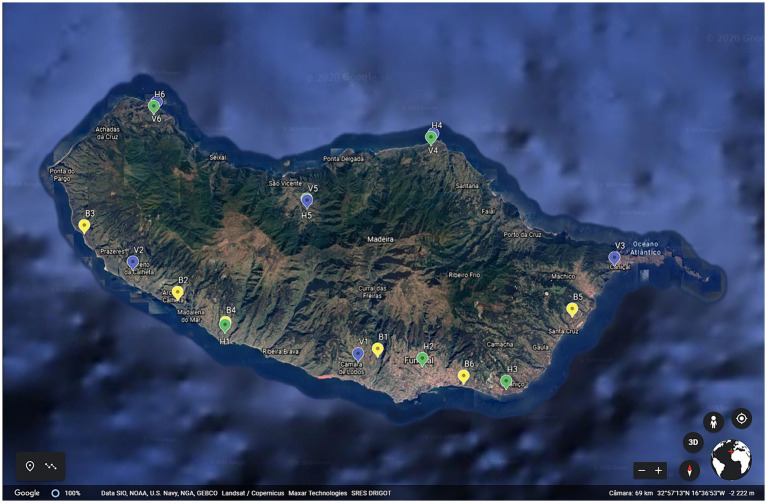
Agricultural soils are responsible for ecological functions and services that include primary production of food, fiber and fuel, nutrient cycling, carbon cycling and storage, water infiltration and purification, among others. Fungi are important drivers of most of those ecosystem services. Given the importance of fungi in agricultural soils, in this study, we aimed to characterize and analyse the changes of the soil fungal communities of three cropping systems from Madeira Island, where family farming is predominant, and investigate the response of fungi and its functional groups to soil physicochemical properties. To achieve that, we sequenced amplicons targeting the internal transcribed spacer 1 (ITS1) of the rRNA region, to analyse soil samples from 18 agrosystems: 6 vineyards (V), 6 banana plantations (B) and 6 vegetable plantations (H). Our results showed that alpha diversity indices of fungal communities are similar in the three cropping systems, but fungal composition and functional aspects varied among them, with more pronounced differences in B. Ascomycota, Basidiomycota, and Mortierellomycota were the main phyla found in the three cropping systems. Agaricomycetes and Sordariomycetes are the predominant classes in B, representing 23.8 and 22.4%, respectively, while Sordariomycetes (27.9%) followed by Eurotiomycetes (12.3%) were the predominant classes in V and Sordariomycetes (39.2%) followed by Tremellomycetes (8.9%) in the H. Saprotrophs are the fungal group showing higher relative abundance in the three cropping systems, followed by plant pathogens. Regarding symbionts, endophytes were highly observed in B, while mycorrhizal fungi was predominant in V and H. The structure of fungal communities was mainly correlated with soil content of P, K, N, Fe, and Cu. In addition, we identified bioindicators for each cropping system, which means that cultivated crops are also drivers of functional groups and the composition of communities. Overall, the three cropping systems favored diversity and growth of taxa that play important roles in soil, which highlights the importance of conservative management practices to maintain a healthy and resilient agrosystem.
农业土壤承担着多种生态功能和服务,包括食物、纤维和燃料的初级生产、养分循环、碳循环与储存、水分渗透与净化等。真菌是这些生态系统服务中大多数功能的重要驱动者。鉴于真菌在农业土壤中的重要性,在本研究中,我们旨在对马德拉岛(以家庭农场为主)三种种植系统的土壤真菌群落变化进行表征和分析,并研究真菌及其功能组对土壤理化性质的响应。为实现这一目标,我们对靶向rRNA区域内部转录间隔区1(ITS1)的扩增子进行测序,以分析来自18个农业系统的土壤样本:6个葡萄园(V)、6个香蕉种植园(B)和6个蔬菜种植园(H)。我们的结果表明,三种种植系统中真菌群落的α多样性指数相似,但真菌组成和功能方面存在差异,其中B的差异更为明显。子囊菌门、担子菌门和被孢霉门是在三种种植系统中发现的主要门类。伞菌纲和粪壳菌纲是B中的优势纲,分别占23.8%和22.4%,而粪壳菌纲(27.9%)其次是散囊菌纲(12.3%)是V中的优势纲,粪壳菌纲(39.2%)其次是银耳纲(8.9%)是H中的优势纲。腐生菌是在三种种植系统中相对丰度较高的真菌类群,其次是植物病原体。关于共生菌,内生菌在B中大量存在,而菌根真菌在V和H中占主导地位。真菌群落结构主要与土壤中P、K、N、Fe和Cu的含量相关。此外,我们确定了每种种植系统的生物指示物,这意味着种植作物也是功能组和群落组成的驱动因素。总体而言,这三种种植系统有利于在土壤中发挥重要作用的分类群的多样性和生长,这凸显了采用保守管理措施以维持健康且有韧性的农业系统的重要性。