Hunan Provincial Key Laboratory of Medical Virology, College of Biology, Hunan University, Changsha, China.
State Key Laboratory of Emerging Infectious Diseases, Carol Yu Centre for Infection, Department of Microbiology, Li Ka Shing Faculty of Medicine, The University of Hong Kong, Hong Kong, Hong Kong SAR, China.
Front Immunol. 2024 Oct 2;15:1450114. doi: 10.3389/fimmu.2024.1450114. eCollection 2024.
The frequent occurrence of mutations in the SARS-CoV-2 Spike (S) protein, with up to dozens of mutations, poses a severe threat to the current efficacy of authorized COVID-19 vaccines. Membrane (M) protein, which is the most abundant viral structural protein, exhibits a high level of amino acid sequence conservation. M protein ectodomain could be recognized by specific antibodies; however, the extent to which it is immunogenic and provides protection remains unclear.
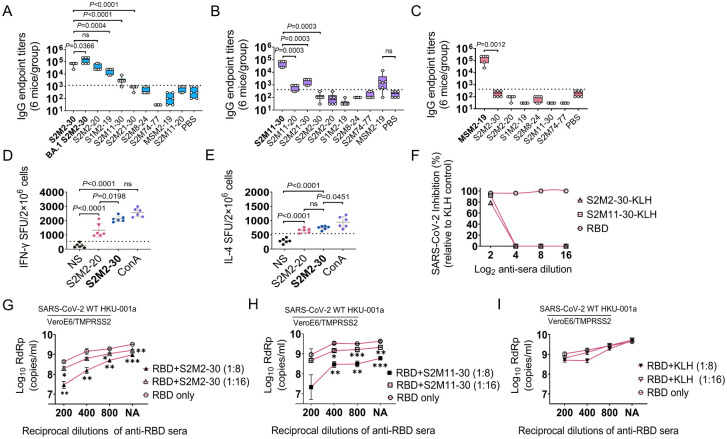
We designed and synthesized multiple peptides derived from coronavirus M protein ectodomains, and determined the secondary structure of specific peptides using circular dichroism (CD) spectroscopy. Enzyme-linked immunosorbent assay (ELISA) was utilized to detect IgG responses against the synthesized peptides in clinical samples. To evaluate the immunogenicity of peptide vaccines, BALB/c mice were intraperitoneally immunized with peptide-keyhole limpet hemocyanin (KLH) conjugates adjuvanted with incomplete Freund's adjuvant (IFA). The humoral and T-cell immune responses induced by peptide-KLH conjugates were assessed using ELISA and ELISpot assays, respectively. The efficacy of the S2M2-30-KLH vaccine against SARS-CoV-2 variants was evaluated in vivo using the K18-hACE2 transgenic mouse model. The inhibitory effect of mouse immune serum on SARS-CoV-2 virus replication in vitro was evaluated using microneutralization assays. The subcellular localization of the M protein was evaluated using an immunofluorescent staining method, and the Fc-mediated antibody-dependent cellular cytotoxicity (ADCC) activity of the S2M2-30-specific monoclonal antibody (mAb) was measured using an ADCC reporter assay.
Seroconversion rates for ectodomain-specific IgG were observed to be high in both SARS-CoV-2 convalescent patients and individuals immunized with inactivated vaccines. To assess the protective efficacy of the M protein ectodomain-based vaccine, we initially identified a highly immunogenic peptide derived from this ectodomain, named S2M2-30. The mouse serum specific to S2M2-30 showed inhibitory effects on the replication of SARS-CoV-2 variants . Immunizations of K18-hACE2-transgenic mice with the S2M2-30-keyhole limpet hemocyanin (KLH) vaccine significantly reduced the lung viral load caused by B.1.1.7/Alpha (UK) infection. Further mechanism investigations reveal that serum neutralizing activity, specific T-cell response and Fc-mediated antibody-dependent cellular cytotoxicity (ADCC) correlate with the specific immuno-protection conferred by S2M2-30.
The findings of this study suggest that the antibody responses against M protein ectodomain in the population most likely exert a beneficial effect on preventing various SARS-CoV-2 infections.
SARS-CoV-2 刺突(S)蛋白频繁发生突变,多达数十种突变,这对当前授权的 COVID-19 疫苗的效果构成了严重威胁。膜(M)蛋白是最丰富的病毒结构蛋白,表现出高度的氨基酸序列保守性。M 蛋白外域可被特定抗体识别;然而,其免疫原性和提供保护的程度尚不清楚。
我们设计并合成了源自冠状病毒 M 蛋白外域的多种肽,并使用圆二色性(CD)光谱确定了特定肽的二级结构。酶联免疫吸附试验(ELISA)用于检测临床样本中针对合成肽的 IgG 反应。为了评估肽疫苗的免疫原性,用不完全弗氏佐剂(IFA)佐剂的肽-钥孔血蓝蛋白(KLH)缀合物对 BALB/c 小鼠进行腹腔内免疫。使用 ELISA 和 ELISpot 测定分别评估肽-KLH 缀合物诱导的体液和 T 细胞免疫应答。使用 K18-hACE2 转基因小鼠模型评估 S2M2-30-KLH 疫苗对 SARS-CoV-2 变体的疗效。使用微量中和测定评估小鼠免疫血清对 SARS-CoV-2 病毒复制的体外抑制作用。使用免疫荧光染色法评估 M 蛋白的亚细胞定位,并使用 ADCC 报告测定测量 S2M2-30 特异性单克隆抗体(mAb)的 Fc 介导的抗体依赖性细胞毒性(ADCC)活性。
在 SARS-CoV-2 恢复期患者和接种灭活疫苗的个体中,观察到针对外域特异性 IgG 的血清转化率很高。为了评估 M 蛋白外域为基础的疫苗的保护效力,我们最初从该外域中鉴定出一种高度免疫原性的肽,命名为 S2M2-30。针对 S2M2-30 的小鼠血清显示出对 SARS-CoV-2 变体复制的抑制作用。用 S2M2-30-钥孔血蓝蛋白(KLH)疫苗免疫 K18-hACE2 转基因小鼠可显著降低 B.1.1.7/Alpha(UK)感染引起的肺部病毒载量。进一步的机制研究表明,血清中和活性、特异性 T 细胞反应和 Fc 介导的抗体依赖性细胞毒性(ADCC)与 S2M2-30 赋予的特异性免疫保护相关。
本研究结果表明,人群中针对 M 蛋白外域的抗体反应很可能对预防各种 SARS-CoV-2 感染产生有益影响。