
从环境、经济和社会影响角度出发,将生命周期评估与多标准决策分析相结合以构建印度尼西亚可持续可可生产系统
Integrating life cycle assessment and multi criteria decision making analysis towards sustainable cocoa production system in Indonesia: An environmental, economic, and social impact perspective.
作者信息
Rahmah Devi Maulida, Nurlilasari Puspita, Mardawati Efri, Kastaman Roni, Agus Kurniawan Koko Iwan, Sofyana Neng Tanty, Noguchi Ryozo
机构信息
Department of Agricultural Industrial Technology, Universitas Padjadjaran, Jatinangor, 45365, Indonesia.
Marine Science Department, Faculty of Fishery and Marine Science, Universitas Padjadjaran, 45363, Indonesia.
出版信息
Heliyon. 2024 Sep 27;10(19):e38630. doi: 10.1016/j.heliyon.2024.e38630. eCollection 2024 Oct 15.
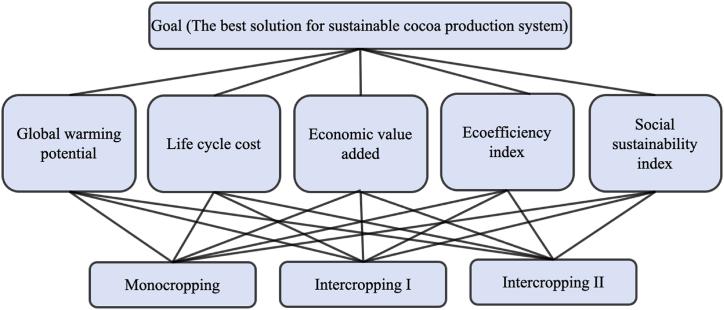
Sustainable Cocoa production practices should be investigated comprehensively to address sustainability requirements and mitigate Cocoa production issues in Indonesia. This study aims to identify the sustainable Cocoa production system considering the environmental, economic, and social impacts. Life cycle framework and multicriteria decision-making (MCDM) were integrated to obtain the study's objectives by comparing Cocoa monocropping system (CM) and Cocoa intercropping systems (IC). The result indicated that in the environmental sustainability aspect, the monocropping system (CM) showed higher performance as indicated by the lower environmental impact in all indicators; for example, CM emitted a lower Global Warming Potential (GWP) that has a lower margin of 34.5-55.9 % compared to the intercropping system (IC-I and IC-II). In the economic aspect, both on the short-term and long-term analysis, the Cocoa intercropping system (IC-II) generated higher value-added and economic feasibility, with a higher profit margin of 150-205 % compared to CM and IC-1. Along with the increase of economic benefits in IC II, this system also significantly provides social benefits, as presented by the higher social index margin of 4.9-23.7 % compared to other systems. Furthermore, by applying decision-making analysis, the result determines the highest index on the Cocoa intercropping system II (IC-II). These findings highlight that applying the intercropping system II is recommended to overcome the cocoa issue at the farmer and decision-maker levels. Additionally, the proposed method that combined LCA-MCDM can be applied to another agricultural commodity to achieve sustainable agriculture production.
应全面研究可持续可可生产实践,以满足可持续性要求并缓解印度尼西亚可可生产问题。本研究旨在确定考虑环境、经济和社会影响的可持续可可生产系统。通过比较可可单作系统(CM)和可可间作系统(IC),整合生命周期框架和多标准决策(MCDM)以实现研究目标。结果表明,在环境可持续性方面,单作系统(CM)表现出更高的性能,所有指标的环境影响较低;例如,CM的全球变暖潜势(GWP)排放较低,与间作系统(IC-I和IC-II)相比,其差距低34.5-55.9%。在经济方面,无论是短期还是长期分析,可可间作系统(IC-II)都产生了更高的附加值和经济可行性,与CM和IC-1相比,利润率高出150-205%。随着IC II经济效益的增加,该系统还显著提供社会效益,与其他系统相比,社会指数高出4.9-23.7%。此外,通过应用决策分析,结果确定可可间作系统II(IC-II)的指数最高。这些发现突出表明,建议采用间作系统II来解决农民和决策者层面的可可问题。此外,所提出的结合LCA-MCDM的方法可应用于其他农产品,以实现可持续农业生产。




 Zotero 插件