Lehne Moritz, Sass Julian, Essenwanger Andrea, Schepers Josef, Thun Sylvia
1Berlin Institute of Health (BIH), Berlin, Germany.
2Charité - Universitätsmedizin Berlin, Berlin, Germany.
NPJ Digit Med. 2019 Aug 20;2:79. doi: 10.1038/s41746-019-0158-1. eCollection 2019.
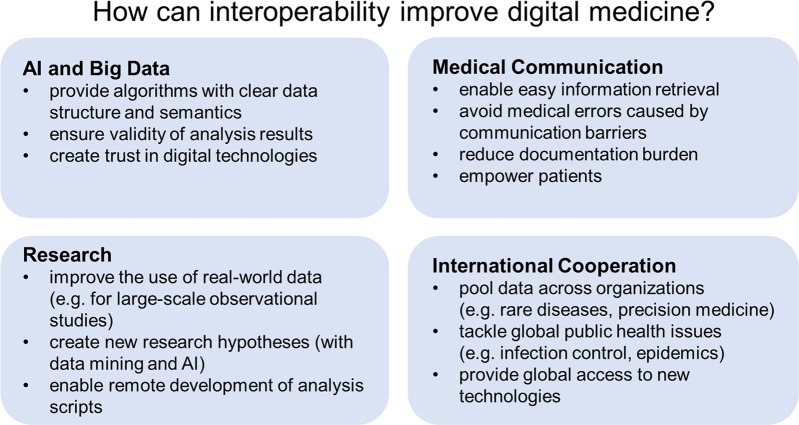
Digital data are anticipated to transform medicine. However, most of today's medical data lack interoperability: hidden in isolated databases, incompatible systems and proprietary software, the data are difficult to exchange, analyze, and interpret. This slows down medical progress, as technologies that rely on these data - artificial intelligence, big data or mobile applications - cannot be used to their full potential. In this article, we argue that interoperability is a prerequisite for the digital innovations envisioned for future medicine. We focus on four areas where interoperable data and IT systems are particularly important: (1) artificial intelligence and big data; (2) medical communication; (3) research; and (4) international cooperation. We discuss how interoperability can facilitate digital transformation in these areas to improve the health and well-being of patients worldwide.
数字数据有望变革医学。然而,当今大多数医学数据缺乏互操作性:这些数据隐藏在孤立的数据库、不兼容的系统和专有软件中,难以进行交换、分析和解读。这减缓了医学进步,因为依赖这些数据的技术——人工智能、大数据或移动应用程序——无法充分发挥其潜力。在本文中,我们认为互操作性是未来医学所设想的数字创新的先决条件。我们重点关注四个领域,在这些领域中,可互操作的数据和信息技术系统尤为重要:(1)人工智能和大数据;(2)医学交流;(3)研究;以及(4)国际合作。我们讨论了互操作性如何促进这些领域的数字转型,以改善全球患者的健康和福祉。