Fawkes Leanne S, Roh Taehyun, McDonald Thomas J, Horney Jennifer A, Chiu Weihsueh A, Sansom Garett T
Department of Environmental and Occupational Health, Texas A&M School of Public Health, 212 Adriance Lab Rd., College Station, TX, 77843, USA.
Department of Environmental and Occupational Health, University of Texas School of Public Health San Antonio at the University of Texas Health Science Center at San Antonio, San Antonio, TX, 78229, USA.
Arch Public Health. 2024 Oct 18;82(1):186. doi: 10.1186/s13690-024-01417-y.
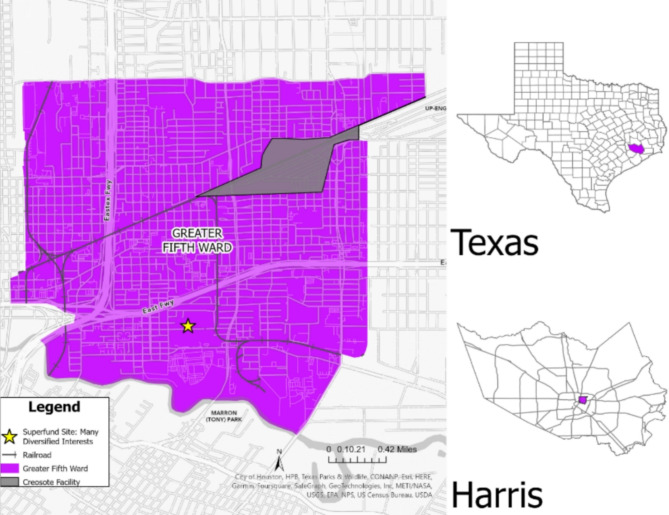
The Greater Fifth Ward (GFW) is a Northeast Houston, Texas, neighborhood with a legacy of industrial contamination and a confirmed cancer cluster. To understand self-rated health in the GFW, community-based participatory research (CBPR), was used to promote the inclusion of all partners. CBPR involves the community during each stage of the research process from design to research dissemination. A complete census was conducted, and 114 surveys were obtained in the environmental justice (EJ) community from July to November 2021. EJ communities shoulder an unfair burden of environmental exposures, pollution, and poor built environments. Mental and physical health were measured using the validated 12-item Short Form Health Survey (SF-12v2). We posited that the Black or African American (Black/AA) community would have lower mental composite scores (MCS) and physical composite scores (PCS) compared to the nation and their White counterparts. The MCS and PCS were calculated and compared against the national mean. Overall, participants had higher MCS and lower PCS than the national mean. Black/AA males and females had lower MCS compared to their White counterparts. White females had the lowest PCS among all respondents, significantly lower than the national average. MCS was lower among those who lived in the neighborhood longer. Burdens from pollution may impact residents' health and perceived health. Targeted interventions or programs that improve mental or physical health would benefit this community and other inequitably burdened neighborhoods.
大第五区(GFW)位于得克萨斯州休斯顿东北部,有着工业污染的历史且已确认存在癌症聚集区。为了解大第五区居民的自评健康状况,采用了基于社区的参与性研究(CBPR)来促进所有合作伙伴的参与。CBPR在研究过程的每个阶段,从设计到研究传播,都让社区参与其中。进行了一次全面普查,并于2021年7月至11月在环境正义(EJ)社区获得了114份调查问卷。EJ社区承担着环境暴露、污染和恶劣建筑环境带来的不公平负担。使用经过验证的12项简短健康调查问卷(SF - 12v2)对心理健康和身体健康进行了测量。我们假设,与全国水平及其白人同龄人相比,黑人或非裔美国人(Black/AA)社区的心理综合得分(MCS)和身体综合得分(PCS)会更低。计算了MCS和PCS,并与全国平均水平进行了比较。总体而言,参与者的MCS高于全国平均水平,而PCS低于全国平均水平。与白人同龄人相比,Black/AA男性和女性的MCS较低。在所有受访者中,白人女性的PCS最低,显著低于全国平均水平。在该社区居住时间较长的居民MCS较低。污染带来的负担可能会影响居民的健康和对健康的认知。旨在改善心理健康或身体健康的针对性干预措施或项目将使这个社区以及其他负担不平等的社区受益。