Department of Physical Performance, Norwegian School of Sport Sciences, Oslo, Norway.
Norwegian Olympic and Paralympic Committee and Confederation of Sports, Oslo, Norway.
Sports Med. 2024 Nov;54(11):2771-2791. doi: 10.1007/s40279-024-02098-x. Epub 2024 Oct 19.
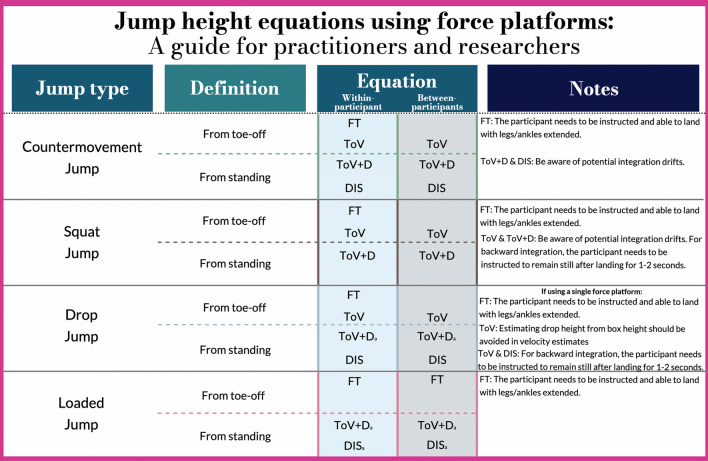
Vertical jump height measures our ability to oppose gravity and lower body neuromuscular function in athletes and various clinical populations. Vertical jump tests are principally simple, time-efficient, and extensively used for assessing athletes and generally in sport science research. Using the force platform for jump height estimates is increasingly popular owing to technological advancements and its relative ease of use in diverse settings. However, ground reaction force data can be analyzed in multiple ways to estimate jump height, leading to distinct outcome values from the same jump. In the literature, four equations have been commonly described for estimating jump height using the force platform, where jump height can vary by up to 15 cm when these equations are used on the same jump. There are advantages and disadvantages to each of the equations according to the intended use. Considerations of (i) the jump type, (ii) the reason for testing, and (iii) the definition of jump height should ideally determine which equation to apply. The different jump height equations can lead to confusion and inappropriate comparisons of jump heights. Considering the popularity of reporting jump height results, both in the literature and in practice, there is a significant need to understand how the different mathematical approaches influence jump height. This review aims to investigate how different equations affect the assessment of jump height using force platforms across various jump types, such as countermovement jumps, squat jumps, drop jumps, and loaded jumps.
垂直跳跃高度衡量我们在运动员和各种临床人群中对抗重力和下肢神经肌肉功能的能力。垂直跳跃测试主要简单、省时,并广泛用于评估运动员,通常也用于运动科学研究。由于技术进步和在不同环境中使用的相对易用性,使用力量台估计跳跃高度越来越受欢迎。然而,地面反作用力数据可以通过多种方式进行分析来估计跳跃高度,从而导致同一跳跃的结果值存在明显差异。在文献中,已经描述了四种常用的使用力量台估计跳跃高度的方程,当在同一跳跃上使用这些方程时,跳跃高度可能会相差多达 15 厘米。根据预期用途,每个方程都有其优点和缺点。应根据(i)跳跃类型、(ii)测试原因和(iii)跳跃高度的定义来考虑使用哪个方程。不同的跳跃高度方程可能会导致混淆和不适当的跳跃高度比较。考虑到报告跳跃高度结果的普及性,无论是在文献中还是在实践中,都需要了解不同的数学方法如何影响跳跃高度。本综述旨在研究不同的方程如何影响使用力量台评估各种跳跃类型(如反向跳跃、深蹲跳跃、跳下跳跃和负重跳跃)的跳跃高度。