Brodie Lara Paige, Caballero Smit Vasquez, Ojea Elena, Taylor Sarah F W, Roberts Michael, Vianello Patrick, Jiddawi Narriman, Aswani Shankar, Bueno Juan
Centro de Investigación Mariña (CIM), Future Oceans Lab, Universidade de Vigo, Campus Lagoas Marcosende, 36310 Vigo, Spain.
Center for Applied Economics and Strategy, RTI International, Research Triangle Park, Durham, NC 27709 USA.
Food Secur. 2024;16(5):1125-1145. doi: 10.1007/s12571-024-01472-x. Epub 2024 Jul 19.
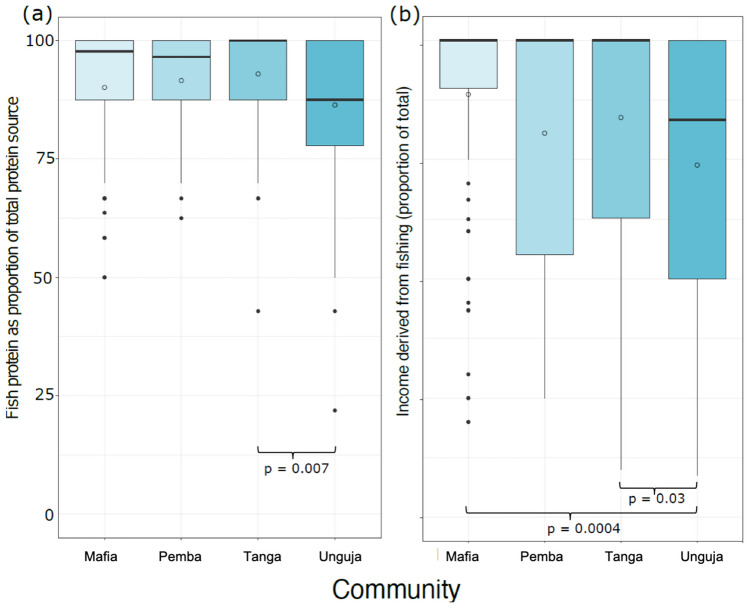
Food insecurity is a pressing issue facing our world, particularly affecting coastal communities who rely on marine resources. The problem is further compounded by the rapidly changing climate, a deteriorating environment and growing human populations. It is essential to evaluate this issue accurately to reduce risk and improve the situation of coastal communities, especially in countries with less socioeconomic development. To this end, we develop a food security social-ecological risk assessment framework for developing communities in coastal areas of the Western Indian Ocean facing a changing environment. The framework integrates local ecological knowledge, expert scientific opinion, survey data, and satellite sea surface temperature (SST) and chlorophyll-a observation. We conducted a local-scale case study in four regions in Tanzania; Mafia, Pemba, Tanga, and Unguja, revealing that they face moderate to high risk levels of food insecurity. The highest risk was observed in the island communities of Pemba and Unguja, while the communities of Mafia and Tanga had the lowest risk due to lower exposure and sensitivity to climate change. Our results show that recognizing the key differences across risk components is crucial in identifying effective intervention strategies for local practitioners. This study highlights the need for detailed assessments to provide accurate information on local-scale food security dynamics, specifically when assessing impacts induced by environmental and climatic changes.
The online version contains supplementary material available at 10.1007/s12571-024-01472-x.
粮食不安全是我们这个世界面临的一个紧迫问题,尤其影响着依赖海洋资源的沿海社区。快速变化的气候、日益恶化的环境和不断增长的人口使这个问题更加复杂。准确评估这个问题对于降低风险和改善沿海社区的状况至关重要,特别是在社会经济发展水平较低的国家。为此,我们为西印度洋沿海地区面临环境变化的发展中社区开发了一个粮食安全社会生态风险评估框架。该框架整合了当地生态知识、专家科学意见、调查数据以及卫星海表温度(SST)和叶绿素a观测数据。我们在坦桑尼亚的四个地区——马菲亚、奔巴、坦噶和桑给巴尔岛进行了一个局部尺度的案例研究,结果显示这些地区面临中度到高度的粮食不安全风险水平。在奔巴和桑给巴尔岛的岛屿社区观察到的风险最高,而马菲亚和坦噶的社区风险最低,因为它们对气候变化的暴露程度和敏感度较低。我们的结果表明,认识到风险构成要素之间的关键差异对于为当地从业者确定有效的干预策略至关重要。这项研究强调了进行详细评估以提供关于局部尺度粮食安全动态的准确信息的必要性,特别是在评估环境和气候变化所带来的影响时。
在线版本包含可在10.1007/s12571 - 024 - 01472 - x获取的补充材料。