National Center for Scientific Research, PSL Université Paris, CRIOBE, USR 3278 CNRS-EPHE-UPVD, Maison des Océans, 195 rue Saint-Jacques, 75005 Paris, France.
Laboratoire d'Excellence CORAIL, Moorea, French Polynesia.
Sci Adv. 2019 Nov 27;5(11):eaaw9976. doi: 10.1126/sciadv.aaw9976. eCollection 2019 Nov.
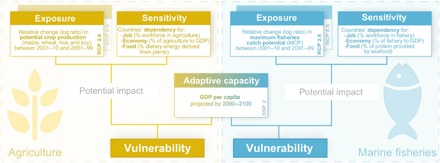
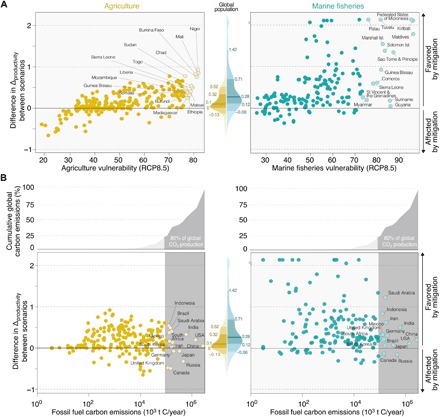
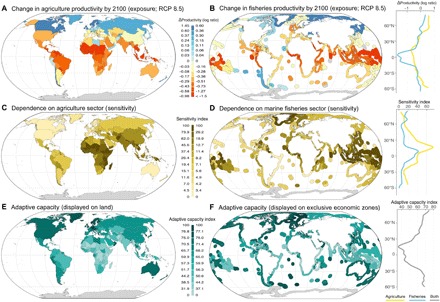
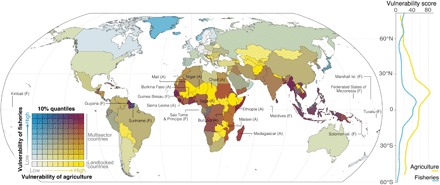
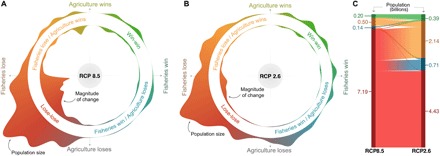
Climate change can alter conditions that sustain food production and availability, with cascading consequences for food security and global economies. Here, we evaluate the vulnerability of societies to the simultaneous impacts of climate change on agriculture and marine fisheries at a global scale. Under a "business-as-usual" emission scenario, ~90% of the world's population-most of whom live in the most sensitive and least developed countries-are projected to be exposed to losses of food production in both sectors, while less than 3% would live in regions experiencing simultaneous productivity gains by 2100. Under a strong mitigation scenario comparable to achieving the Paris Agreement, most countries-including the most vulnerable and many of the largest CO producers-would experience concomitant net gains in agriculture and fisheries production. Reducing societies' vulnerability to future climate impacts requires prompt mitigation actions led by major CO emitters coupled with strategic adaptation within and across sectors.
气候变化可能改变维持粮食生产和供应的条件,对粮食安全和全球经济产生连锁反应。在这里,我们在全球范围内评估了社会对气候变化同时影响农业和海洋渔业的脆弱性。在“按部就班”的排放情景下,约 90%的世界人口——其中大多数生活在最敏感和最不发达的国家——预计将面临这两个部门粮食生产损失的风险,而到 2100 年,只有不到 3%的地区将经历同时生产力提高的情况。在类似于实现《巴黎协定》的强有力缓解情景下,包括最脆弱和许多最大的 CO 排放国在内的大多数国家,农业和渔业生产都将出现净收益。减少社会对未来气候影响的脆弱性需要主要 CO 排放国牵头采取迅速缓解行动,并在部门内和跨部门进行战略适应。