Pi Zheshun, Liu Weici, Song Chenghu, Zhu Chuandong, Liu Jiwei, Wang Lu, He Zhao, Yang Chengliang, Wu Lei, Liu Tianshuo, Geng Zijie, Tebbutt Scott J, Liu Ningning, Wan Yuan, Zhang Faming, Mao Wenjun
Department of Thoracic Surgery The Affiliated Wuxi People's Hospital of Nanjing Medical University, Wuxi People's Hospital, Wuxi Medical Center, Nanjing Medical University Wuxi China.
Department of Microbiota Medicine Medical Center for Digestive Diseases, The Second Affiliated Hospital of Nanjing Medical University Nanjing China.
Imeta. 2024 Sep 7;3(5):e240. doi: 10.1002/imt2.240. eCollection 2024 Oct.
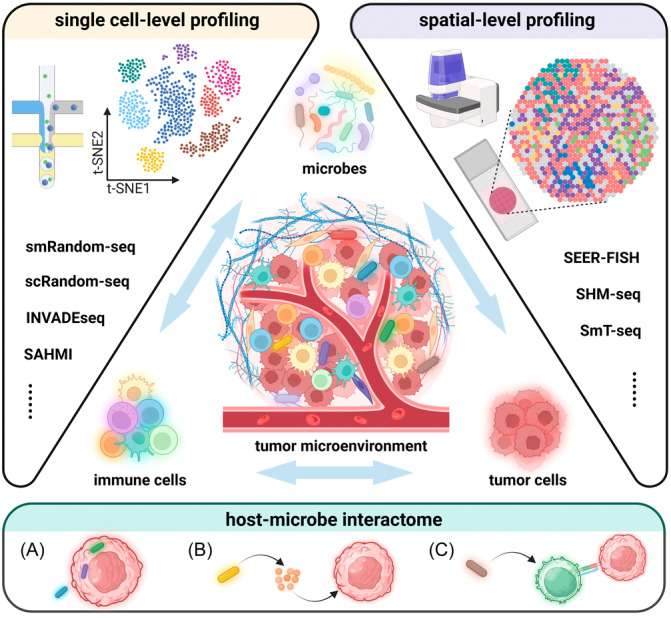
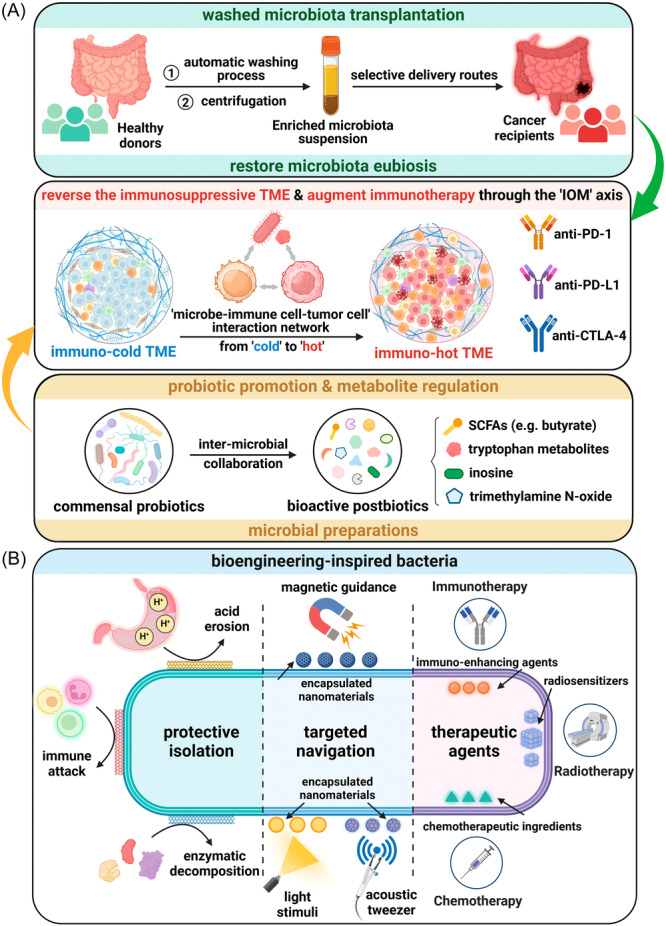
The multifaceted interactions among the immune system, cancer cells and microbial components have established a novel concept of the immuno-oncology-microbiome (IOM) axis. Microbiome sequencing technologies have played a pivotal role in not only analyzing how gut microbiota affect local and distant tumors, but also providing unprecedented insights into the intratumor host-microbe interactions. Herein, we discuss the emerging trends of transiting from bulk-level to single cell- and spatial-level analyses. Moving forward with advances in biotechnology, microbial therapies, including microbiota-based therapies and bioengineering-inspired microbes, will add diversity to the current oncotherapy paradigm.
免疫系统、癌细胞和微生物成分之间的多方面相互作用建立了免疫肿瘤学-微生物群(IOM)轴的新概念。微生物群测序技术不仅在分析肠道微生物群如何影响局部和远处肿瘤方面发挥了关键作用,而且还为肿瘤内宿主-微生物相互作用提供了前所未有的见解。在此,我们讨论了从整体水平分析向单细胞和空间水平分析转变的新趋势。随着生物技术的进步,微生物疗法,包括基于微生物群的疗法和受生物工程启发的微生物,将为当前的肿瘤治疗模式增添多样性。