Zaigham Mehreen, Linden Karolina, Elden Helen, Delle Vedove Stefano, Mariani Ilaria, Kongslien Sigrun, Drandić Daniela, Pumpure Elizabete, Drglin Zalka, Costa Raquel, Sarantaki Antigoni, de Labrusse Claire, Miani Céline, Oțelea Marina Ruxandra, Liepinaitienė Alina, Baranowska Barbara, Rozée Virginie, Valente Emanuelle Pessa, Vik Eline Skirnisdottir, Kurbanović Magdalena, Jakovicka Dārta, Bohinec Anja, Dias Heloísa, Metallinou Dimitra, Mueller Antonia N, Batram-Zantvoort Stephanie, Handra Claudia Mariana, Mizgaitienė Marija, Tataj-Puzyna Urszula, Bomben Arianna, Nedberg Ingvild Hersoug, Voitehoviča Elīna, Pinto Tiago Miguel, Lykeridou Aikaterini, Grylka-Baeschlin Susanne, Jazdauskienė Simona, Szlendak Beata, Sacks Emma, Lazzerini Marzia
Obstetrics and Gynecology, Institution of Clinical Sciences Lund, Lund University, Lund, Sweden.
Department of Obstetrics and Gynecology, Skåne University Hospital, Malmö, Sweden.
Acta Obstet Gynecol Scand. 2024 Dec;103(12):2485-2498. doi: 10.1111/aogs.14994. Epub 2024 Oct 21.
Maternal-neonatal healthcare services were severely disrupted during the COVID-19 pandemic in even high-income countries within the World Health Organization (WHO) European Region. The objective of this study was to compare trends in the quality of maternal and neonatal care (QMNC) in Sweden and Norway to 12 other countries from the WHO European Region during the COVID-19 pandemic, and to identify domains for improvement.
This cross-sectional study included women giving birth in Europe from March 1, 2020 to December 31, 2022. Women answered an online, anonymous questionnaire which included 40 WHO Standard-based Quality Measures collectively scored as the total QMNC index (0-400) and separately in four subdomains (0-100): provision of care, experience of care, availability of human and physical resources, and reorganizational changes due to COVID-19. To assess reported QMNC changes over time, we used adjusted quantile regression models.
gov Identifier: NCT04847336.
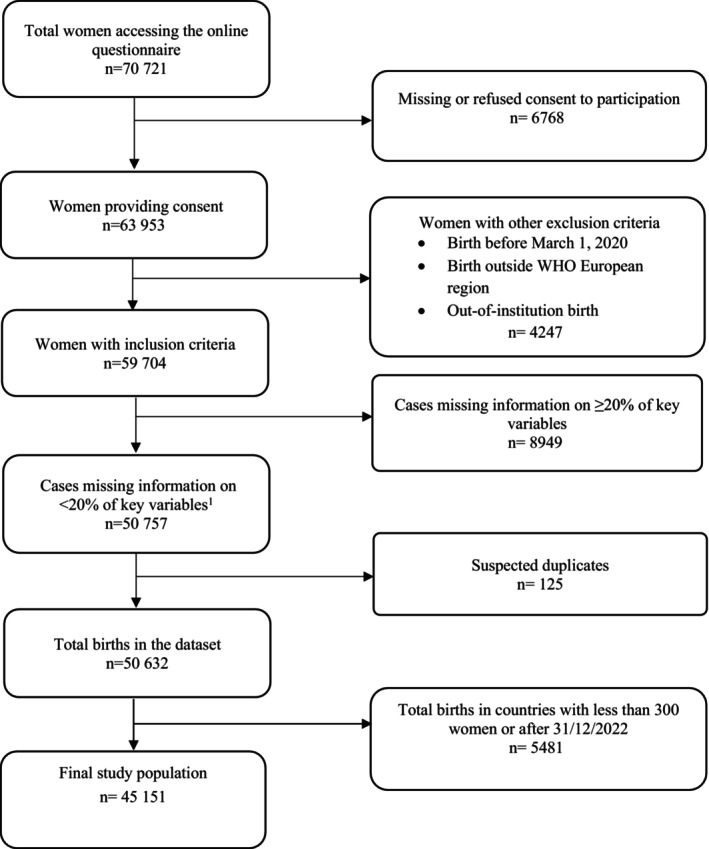
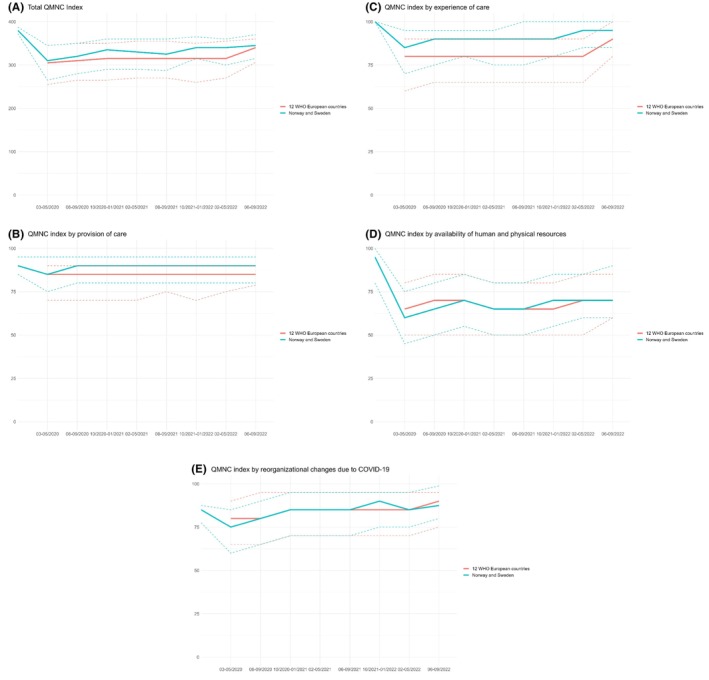
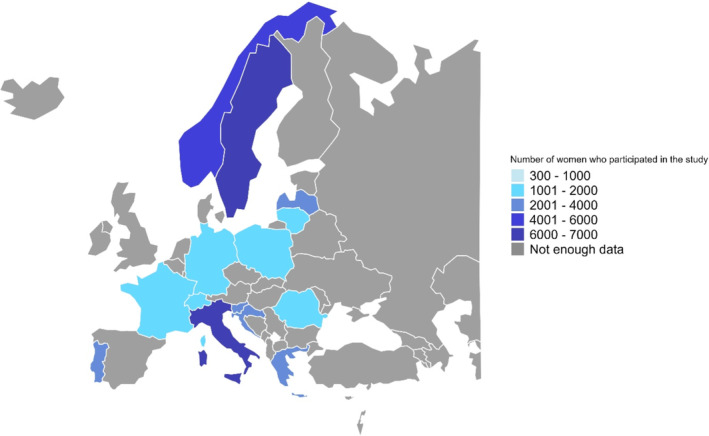
Of the 45151 women included in the study, 13 117 (29.1%) were from Sweden and Norway and 32034 (70.9%) from the 12 WHO European countries. The total QMNC index for Sweden and Norway (median: 325, IQR: 285-355) was higher than the 12 WHO European countries (median: 315, IQR: 265-350, p < 0.001) as were trends in QMNC index over time (Sweden and Norway median: 310-345; 12 WHO European countries median: 305-340). Sweden and Norway also had higher scores in three-of-four QMNC subdomains, with the 12 WHO European countries scoring higher only for reorganizational changes due to COVID-19. In adjusted quantile models of the total QMNC index, Sweden and Norway had higher scores, with largest differences in the lower quantiles (p < 0.001 in all percentiles).
Across Europe, there are significant gaps in the quality of maternal-neonatal healthcare services. Although women giving birth in Sweden and Norway reported higher QMNC scores in all subdomains except for "reorganizational changes due to COVID-19," there is room for improvement and shared learning across Europe. Policymakers should prioritize long-term investments in maternal and neonatal healthcare, ensuring that facilities are adequately equipped during public health crises and that all women have access to high-quality, evidence-based, equitable, and respectful care.
在世界卫生组织(WHO)欧洲区域,即使是高收入国家,孕产妇和新生儿医疗服务在新冠疫情期间也受到了严重干扰。本研究的目的是比较瑞典和挪威与世界卫生组织欧洲区域其他12个国家在新冠疫情期间孕产妇和新生儿护理质量(QMNC)的趋势,并确定需要改进的领域。
这项横断面研究纳入了2020年3月1日至2022年12月31日在欧洲分娩的妇女。妇女们回答了一份在线匿名问卷,其中包括40项基于世界卫生组织标准的质量指标,这些指标被综合计为总QMNC指数(0 - 400),并分别在四个子领域(0 - 100)进行计分:护理提供、护理体验、人力和物力资源可用性以及因新冠疫情导致的组织变革。为了评估报告的QMNC随时间的变化,我们使用了调整后的分位数回归模型。
gov标识符:NCT04847336。
在纳入研究的45151名妇女中,13117名(29.1%)来自瑞典和挪威,32034名(70.9%)来自世界卫生组织欧洲的12个国家。瑞典和挪威的总QMNC指数(中位数:325,四分位间距:285 - 355)高于世界卫生组织欧洲的12个国家(中位数:315,四分位间距:265 - 350,p < 0.001),QMNC指数随时间的趋势也是如此(瑞典和挪威中位数:310 - 345;世界卫生组织欧洲12个国家中位数:305 - 340)。瑞典和挪威在四个QMNC子领域中的三个也得分更高,世界卫生组织欧洲的12个国家仅在因新冠疫情导致的组织变革方面得分更高。在总QMNC指数的调整分位数模型中,瑞典和挪威得分更高,在较低分位数上差异最大(所有百分位数中p < 0.001)。
在整个欧洲,孕产妇和新生儿医疗服务质量存在显著差距。尽管在瑞典和挪威分娩的妇女在除“因新冠疫情导致的组织变革”之外的所有子领域报告的QMNC得分更高,但整个欧洲仍有改进和共同学习的空间。政策制定者应优先对孕产妇和新生儿医疗保健进行长期投资,确保在公共卫生危机期间设施配备充足,并确保所有妇女都能获得高质量、基于证据、公平且尊重人的护理。