School of Mathematical Sciences, Zhejiang University of Technology, Hangzhou, 310023, China.
School of Mathematics and Statistics, and Hubei Key Lab-Math. Sci., Central China Normal University, Wuhan, 430079, China.
Commun Biol. 2024 Oct 21;7(1):1358. doi: 10.1038/s42003-024-07001-y.
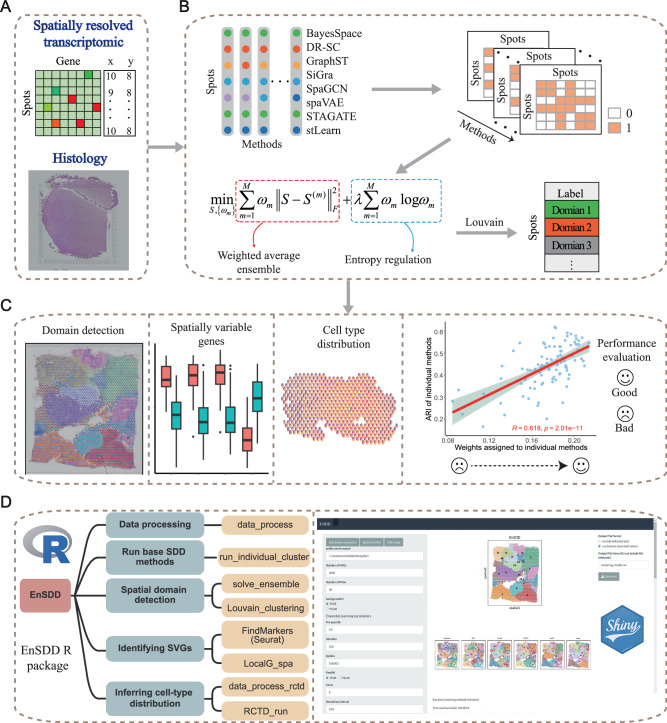
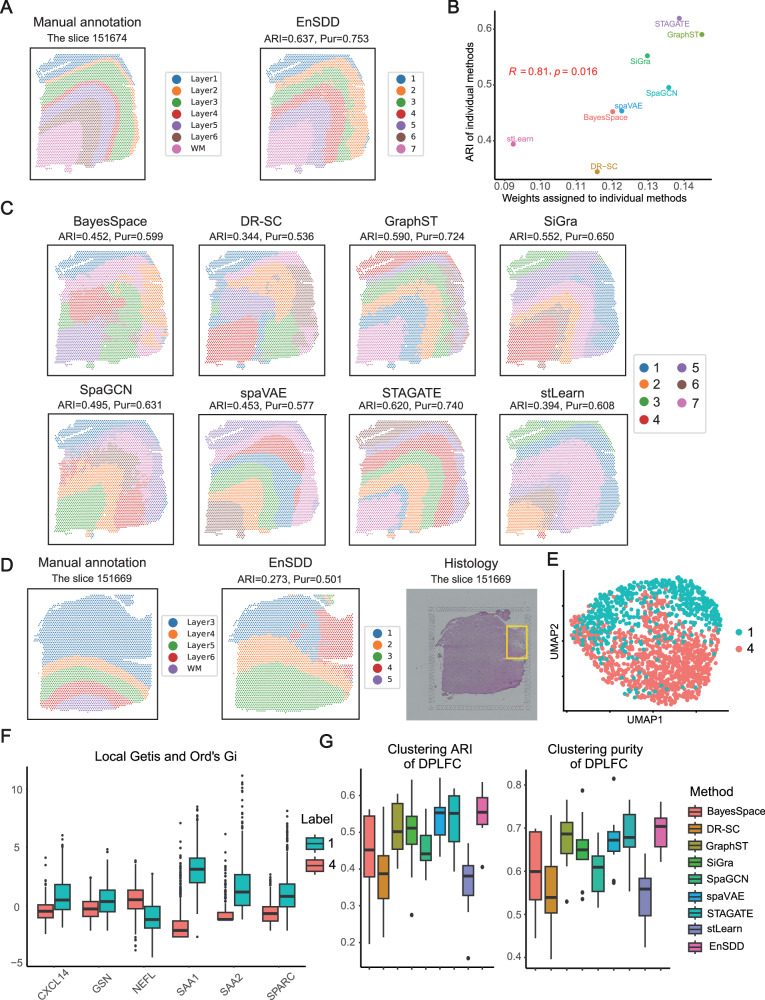
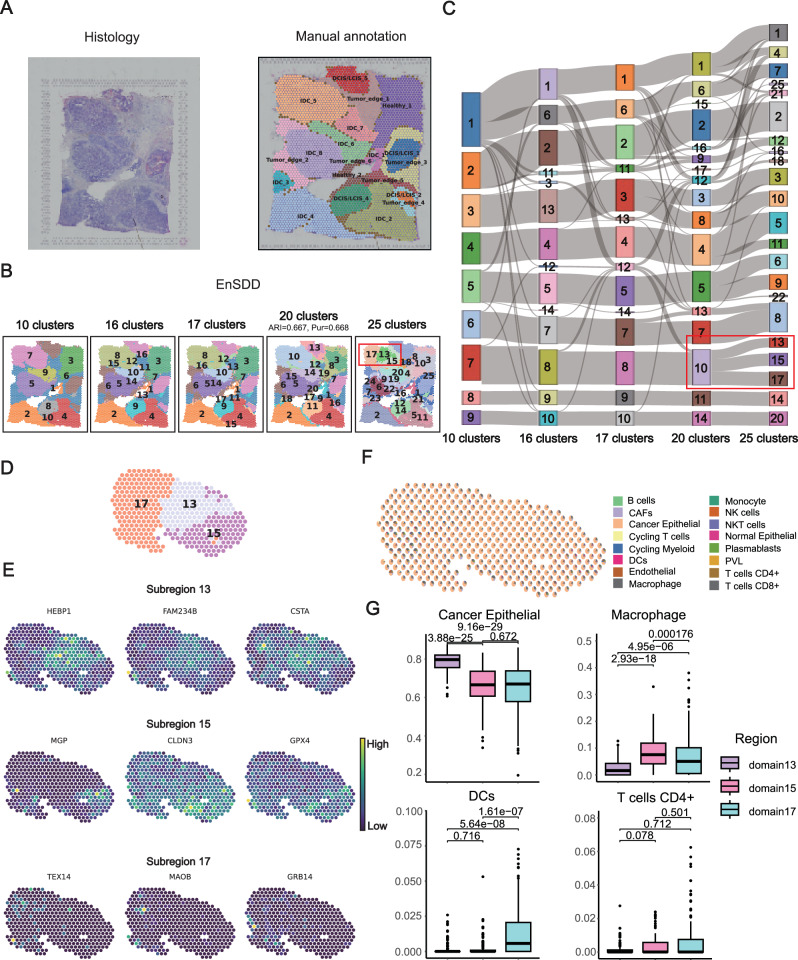
Advancements in spatial transcriptomics have transformed our understanding of organ function and tissue microenvironment. However, accurately identifying spatial domains to depict genome heterogeneity and cellular interactions remains a challenge. In this study, we propose EnSDD (Ensemble-learning for Spatial Domain Detection), a method that ingeniously integrates eight state-of-the-art spatial domain detection methods to automatically identify spatial domains. A key innovation of EnSDD is its dynamic weighting mechanism within the ensemble learning process, which optimizes the contribution of each base model and provides a performance evaluation metric without the need for ground truth data. By leveraging the spatial domains identified through EnSDD, we incorporate the detection of domain-specific spatially variable genes and the spatial distribution of cell types, thereby providing deeper insights into tissue heterogeneity. We validate EnSDD across diverse spatial transcriptomics datasets from various tissue organizational structures. Our results demonstrate that EnSDD significantly enhances spatial domain identification accuracy, identifies genes with spatial expression patterns, and reveals domain-specific cell type enrichment patterns, offering invaluable insights into tissue spatial heterogeneity and regionalization.
空间转录组学的进展改变了我们对器官功能和组织微环境的理解。然而,准确识别空间域以描绘基因组异质性和细胞相互作用仍然是一个挑战。在这项研究中,我们提出了 EnSDD(用于空间域检测的集成学习),这是一种巧妙地集成了八种最先进的空间域检测方法的方法,可自动识别空间域。EnSDD 的一个关键创新是其在集成学习过程中的动态加权机制,该机制优化了每个基础模型的贡献,并提供了一种无需真实数据的性能评估指标。通过利用 EnSDD 识别的空间域,我们结合了特定空间域的基因检测和细胞类型的空间分布,从而更深入地了解组织异质性。我们在来自不同组织结构的各种空间转录组学数据集上验证了 EnSDD。我们的结果表明,EnSDD 显著提高了空间域识别的准确性,识别了具有空间表达模式的基因,并揭示了特定空间域的细胞类型富集模式,为组织空间异质性和区域化提供了宝贵的见解。