Flinders University, GPO Box 2100, Adelaide, South Australia, 5001, Australia.
Southern Adelaide Local Health Network, Adelaide, South Australia, Australia.
Support Care Cancer. 2024 Oct 22;32(11):744. doi: 10.1007/s00520-024-08924-2.
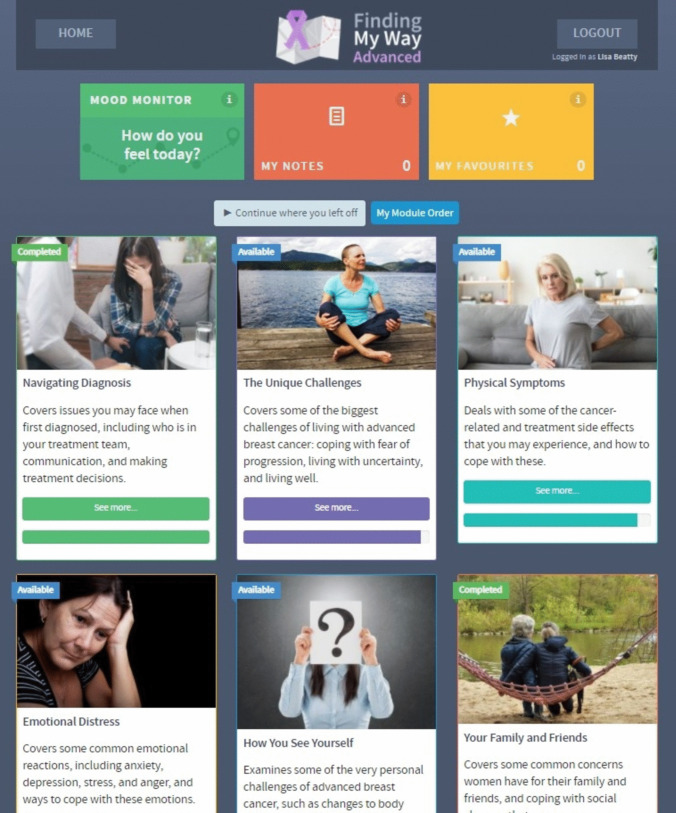
Few digital interventions target patients with advanced cancer. Hence, we feasibility-tested Finding My Way-Advanced (FMW-A), a self-guided program for women with metastatic breast cancer.
A single-site randomised controlled pilot trial was conducted. Participants were recruited through clinicians, professional networks, and social media and randomised to intervention or usual-care control. Participants were randomly allocated to either the intervention (FMW-A; a 6-week, 6-module CBT-based online self-directed psychosocial program for women with MBC + usual care resources) or control (usual care resources: BCNA's Hope and Hurdles kit). Feasibility outcomes included rates of recruitment, uptake, engagement, and attrition. Distress, QOL, and unmet needs were evaluated for signals of efficacy, and qualitative feedback was collected to assess acceptability.
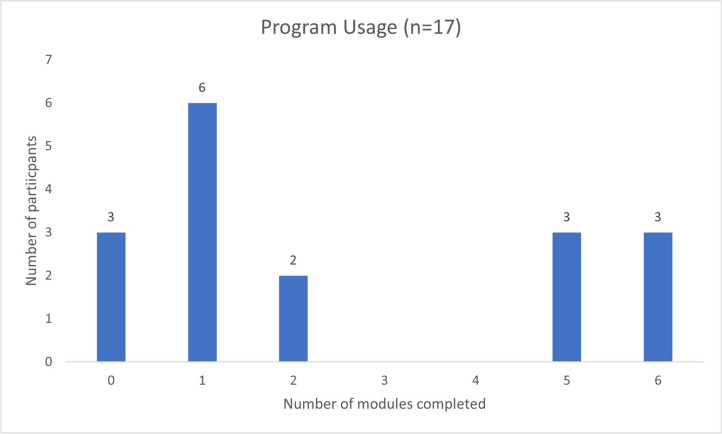
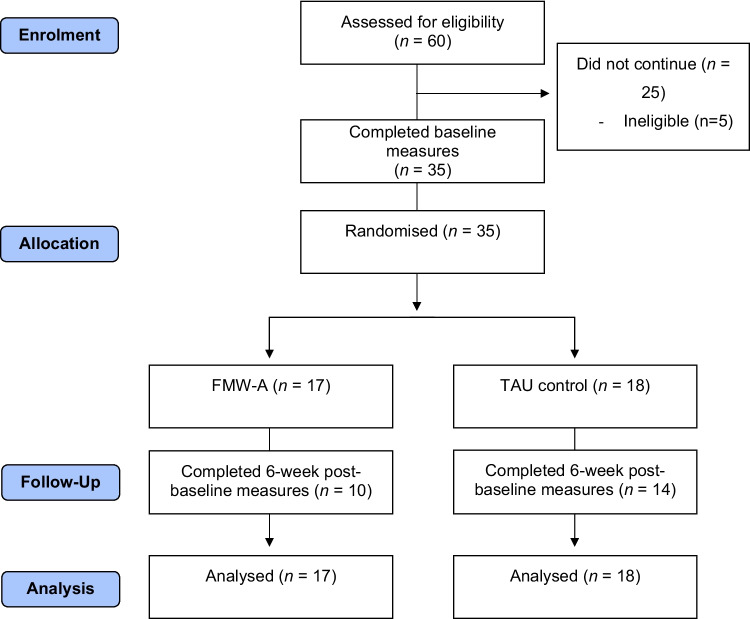
Due to COVID-19 and funding constraints, the target recruitment of 40 was not reached (n = 60 approached; n = 55 eligible; n = 35 consented). Uptake was high (n = 35/55; 63.6%), engagement modest (median 3/6 modules per user), and attrition acceptable (66% completed post-treatment). Efficacy signals were mixed: compared to controls, FMW-A participants experienced small improvements in fear of progression (d = 0.21) and global QOL (d = 0.22) and demonstrated a trend towards improvements in cancer-specific distress (d = 0.13) and role functioning (d = 0.18). However, FMW-A participants experienced small-to-moderate deteriorations in general distress (d = 0.23), mental QOL (d = 0.51), and social functioning (d = 0.27), whereas controls improved. Qualitatively, participants (n = 4) were satisfied with the program, perceived it as appropriate, but noted some sections could evoke transient distress.
The study demonstrated feasibility (high uptake and acceptable retention) and generated realistic recruitment estimates. While FMW-A appears promising for targeting cancer-specific distress and fear of progression, the mixed findings in quality of life and general distress warrant further revisions and testing.
针对晚期癌症患者的数字干预措施较少。因此,我们对“寻找我的方式-晚期(FMW-A)”进行了可行性测试,这是一个针对转移性乳腺癌女性的自我指导计划。
进行了一项单站点随机对照试验。通过临床医生、专业网络和社交媒体招募参与者,并将其随机分配至干预组或常规护理对照组。参与者被随机分配至干预组(FMW-A;一种基于认知行为疗法的 6 周 6 模块在线自我指导心理社会计划,适用于 MBC 患者+常规护理资源)或对照组(常规护理资源:BCNA 的希望与障碍工具包)。可行性结果包括招募率、参与率、参与度和失访率。评估了困扰、生活质量和未满足的需求,以寻找疗效信号,并收集定性反馈以评估可接受性。
由于 COVID-19 和资金限制,未达到 40 人的目标招募人数(n=60 人被邀请;n=55 人符合条件;n=35 人同意)。参与率很高(n=35/55;63.6%),参与度适中(每位用户中位数完成 6 个模块中的 3 个),失访率可接受(66%完成治疗后评估)。疗效信号混杂:与对照组相比,FMW-A 参与者在进展恐惧(d=0.21)和总体生活质量(d=0.22)方面略有改善,并表现出癌症特异性困扰(d=0.13)和角色功能(d=0.18)改善的趋势。然而,FMW-A 参与者在一般困扰(d=0.23)、心理生活质量(d=0.51)和社会功能(d=0.27)方面经历了轻微至中度恶化,而对照组则有所改善。定性研究中,4 名参与者(n=4)对该计划感到满意,认为该计划合适,但指出一些部分可能会引起短暂的困扰。
该研究证明了可行性(高参与率和可接受的保留率),并提供了现实的招募估计。虽然 FMW-A 似乎对靶向癌症特异性困扰和进展恐惧有希望,但生活质量和一般困扰的混合结果需要进一步修订和测试。