Leslie Monica, Beatty Lisa, Hulbert-Williams Lee, Pendrous Rosina, Cartwright Tim, Jackson Richard, Hulbert-Williams Nicholas J
Department of Psychology, Edge Hill University, Ormskirk, United Kingdom.
College of Education, Psychology & Social Work, Flinders University, Adelaide, Australia.
JMIR Cancer. 2022 Jul 8;8(3):e36255. doi: 10.2196/36255.
Despite high levels of psychological distress experienced by many patients with cancer, previous research has identified several barriers to accessing traditional face-to-face psychological support. Web-based psychosocial interventions have emerged as a promising alternative.
This meta-review aimed to synthesize evidence on recruitment challenges and enablers, factors that promote engagement and adherence to web-based intervention content, and factors that promote the efficacy of web-based psychosocial interventions for patients with cancer and cancer survivors.
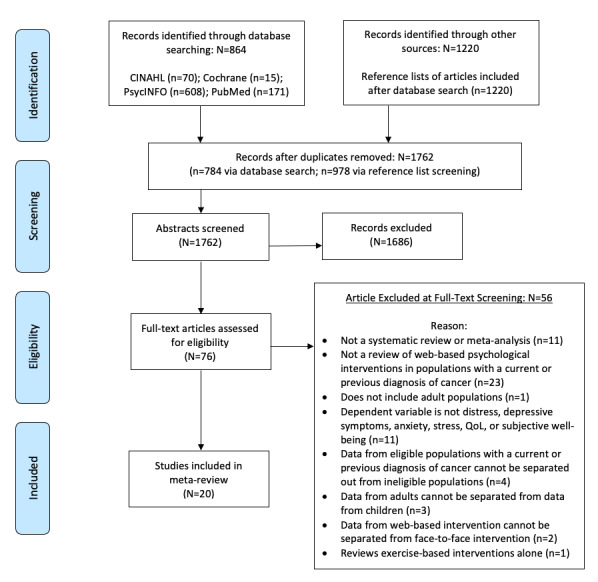
We conducted a systematic search of previous reviews that investigated the recruitment, engagement, and efficacy of web-based and app-based psychosocial interventions in adult patients with cancer and cancer survivors. We searched PubMed, CINAHL, PsycINFO, and the Cochrane Library database for relevant literature. The search terms focused on a combination of topics pertaining to neoplasms and telemedicine. Two independent authors conducted abstract screening, full text screening, and data extraction for each identified article.
A total of 20 articles met eligibility criteria. There was inconsistency in the reporting of uptake and engagement data; however, anxiety about technology and perceived time burden were identified as 2 key barriers. Web-based psychosocial oncology interventions demonstrated efficacy in reducing depression and stress but reported weak to mixed findings for distress, anxiety, quality of life, and well-being. Although no factors consistently moderated intervention efficacy, preliminary evidence indicated that multicomponent interventions and greater communication with a health care professional were preferred by participants and were associated with superior effects.
Several consistently cited barriers to intervention uptake and recruitment have emerged, which we recommend future intervention studies address. Preliminary evidence also supports the superior efficacy of multicomponent interventions and interventions that facilitate communication with a health care professional. However, a greater number of appropriately powered clinical trials, including randomized trials with head-to-head comparisons, are needed to enable more confident conclusions regarding which web-based psychosocial oncology interventions work best and for whom.
PROSPERO CRD42020202633; https://www.crd.york.ac.uk/prospero/display_record.php?RecordID=202633.
尽管许多癌症患者经历了高度的心理困扰,但先前的研究已经确定了获得传统面对面心理支持的几个障碍。基于网络的心理社会干预已成为一种有前途的替代方案。
本荟萃综述旨在综合关于招募挑战与促进因素、促进对基于网络干预内容的参与和坚持的因素,以及促进基于网络的心理社会干预对癌症患者和癌症幸存者疗效的因素的证据。
我们对先前的综述进行了系统检索,这些综述调查了基于网络和应用程序的心理社会干预在成年癌症患者和癌症幸存者中的招募、参与情况及疗效。我们在PubMed、CINAHL、PsycINFO和Cochrane图书馆数据库中搜索相关文献。检索词聚焦于与肿瘤和远程医疗相关的主题组合。两位独立作者对每篇已识别文章进行摘要筛选、全文筛选和数据提取。
共有20篇文章符合纳入标准。在摄取和参与数据的报告方面存在不一致;然而,对技术的焦虑和感知到的时间负担被确定为两个关键障碍。基于网络的心理肿瘤学干预在减轻抑郁和压力方面显示出疗效,但在困扰、焦虑、生活质量和幸福感方面的结果较弱或不一。尽管没有因素始终调节干预效果,但初步证据表明,多成分干预以及与医疗保健专业人员更多的沟通受到参与者的青睐,并且与更好的效果相关。
已经出现了几个一直被提及的干预采用和招募障碍,我们建议未来的干预研究加以解决。初步证据还支持多成分干预以及促进与医疗保健专业人员沟通的干预具有更好的疗效。然而,需要更多样本量合适的临床试验,包括进行直接比较的随机试验,以便就哪些基于网络的心理肿瘤学干预效果最佳以及适用于哪些人群得出更有把握的结论。
PROSPERO CRD42020202633;https://www.crd.york.ac.uk/prospero/display_record.php?RecordID=202633 。