Di Filippo Massimiliano, Gaetani Lorenzo, Centonze Diego, Hegen Harald, Kuhle Jens, Teunissen Charlotte E, Tintoré Mar, Villar Luisa M, Willemse Eline A J, Zetterberg Henrik, Parnetti Lucilla
Section of Neurology, Department of Medicine and Surgery, University of Perugia, Perugia, Italy.
IRCCS Neuromed, Pozzilli, IS, Italy.
Lancet Reg Health Eur. 2024 Aug 22;44:101009. doi: 10.1016/j.lanepe.2024.101009. eCollection 2024 Sep.
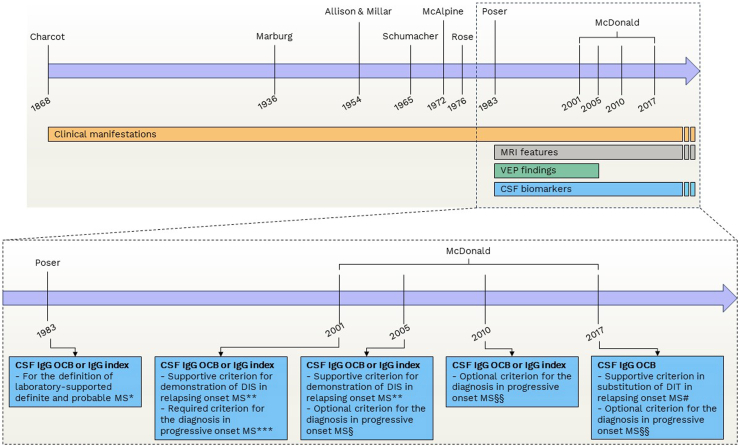
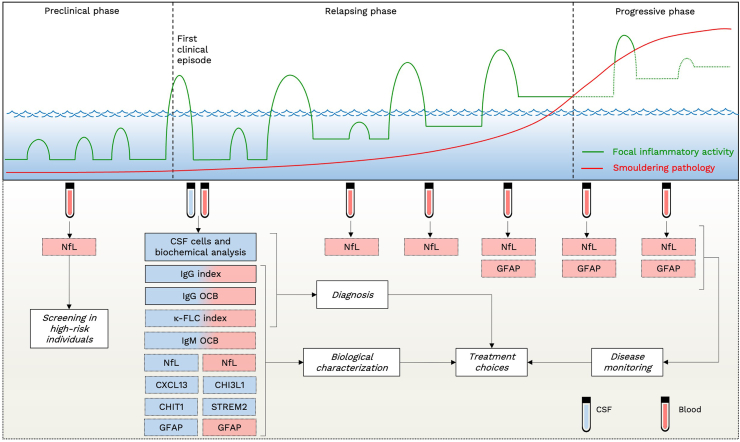
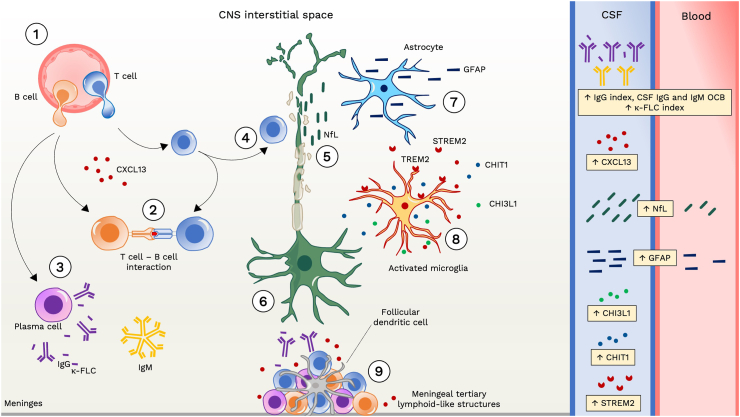
Multiple sclerosis (MS) is an immune-mediated inflammatory and degenerative disorder of the central nervous system (CNS) with heterogeneous clinical manifestations. In the last decade, the landscape of cerebrospinal fluid (CSF) and blood biomarkers as potential key tools for MS diagnosis, prognosis and treatment monitoring has evolved considerably, alongside magnetic resonance imaging (MRI). CSF analysis has the potential not only to provide information on the underlying immunopathology of the disease and exclude differential diagnoses, but also to predict the risk of future relapses and disability accrual, guide therapeutic decisions and thus improve patient outcomes. This Series article overviews the biological framework and current applicability of fluid biomarkers for MS, exploring their potential role in the molecular characterisation of the disease. We discuss recent advances in the field of neurochemistry that enabled the detection of brain-derived proteins in blood, opening the door to much more efficient longitudinal disease monitoring. Furthermore, we identify the current challenges in the application of fluid biomarkers for MS in a real-world setting, while offering recommendations for harnessing their full potential as key paraclinical tools to improve patient management and personalise treatment.
多发性硬化症(MS)是一种由免疫介导的中枢神经系统(CNS)炎症性和退行性疾病,临床表现具有异质性。在过去十年中,脑脊液(CSF)和血液生物标志物作为MS诊断、预后和治疗监测的潜在关键工具,与磁共振成像(MRI)一起有了很大的发展。脑脊液分析不仅有可能提供有关疾病潜在免疫病理学的信息并排除鉴别诊断,还能预测未来复发和残疾累积的风险,指导治疗决策,从而改善患者预后。本系列文章概述了用于MS的液体生物标志物的生物学框架和当前适用性,探讨了它们在疾病分子特征描述中的潜在作用。我们讨论了神经化学领域的最新进展,这些进展使得能够在血液中检测到脑源性蛋白质,为更有效的纵向疾病监测打开了大门。此外,我们确定了在现实环境中应用MS液体生物标志物目前面临的挑战,同时为充分发挥其作为关键辅助临床工具的潜力以改善患者管理和个性化治疗提供了建议。