Yang Haitang, Gu Xiaoran, Wang Zhexin, Liu Gang, Niu Yongliang, Pan Xufeng, Yao Feng
Department of Thoracic Surgery, Shanghai Chest Hospital, Shanghai Jiao Tong University School of Medicine, Shanghai, China.
Department of Respiratory and Critical Care Medicine, No.2 People's Hospital of Fuyang City, Infectious Disease Clinical College of Anhui Medical University, Fuyang, China.
J Thorac Dis. 2024 Sep 30;16(9):6272-6285. doi: 10.21037/jtd-24-1033. Epub 2024 Sep 26.
Non-small cell lung cancer (NSCLC) accounts for approximately 85% of lung cancer cases and remains a leading cause of cancer-related death. Lymph node metastasis (LNM) significantly affects recurrence, survival rates, and treatment options. While lymph node sampling is standard for surgically removing operable NSCLC, it can lead to complications. Positron emission tomography-computed tomography (PET-CT) helps assess preoperative LNM despite false positive or negative rates. Additionally, circulating tumor DNA (ctDNA) detects minimal residual disease with high sensitivity and specificity. Whether ctDNA can predict LNM in operable NSCLC remains uncertain. Our goal is to develop a precise model for predicting NSCLC LNM using non-invasive ctDNA/methylation profiling combined with PET-CT imaging.
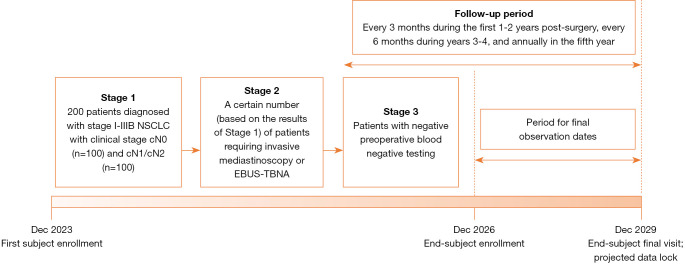
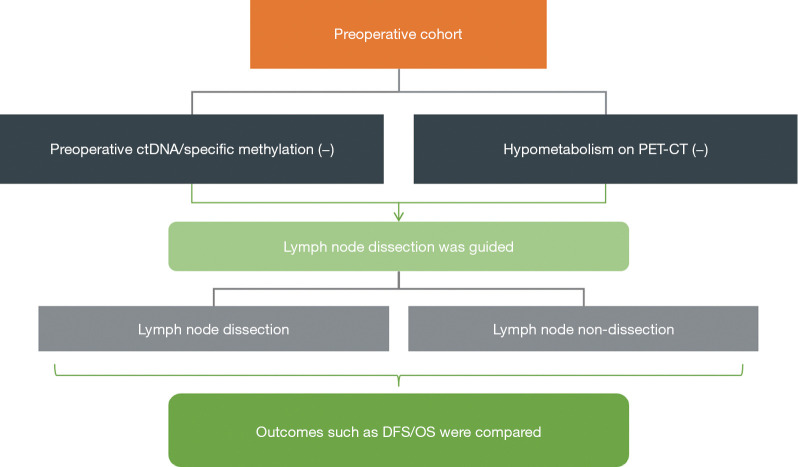
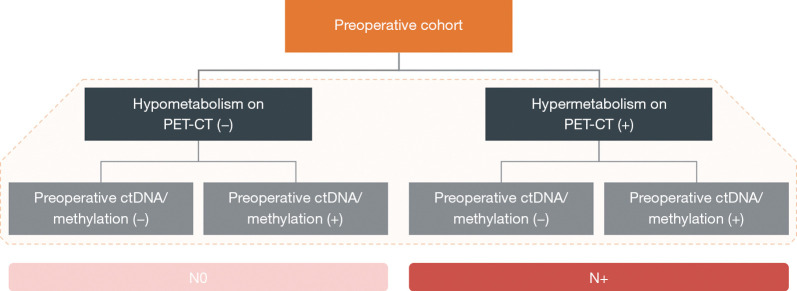
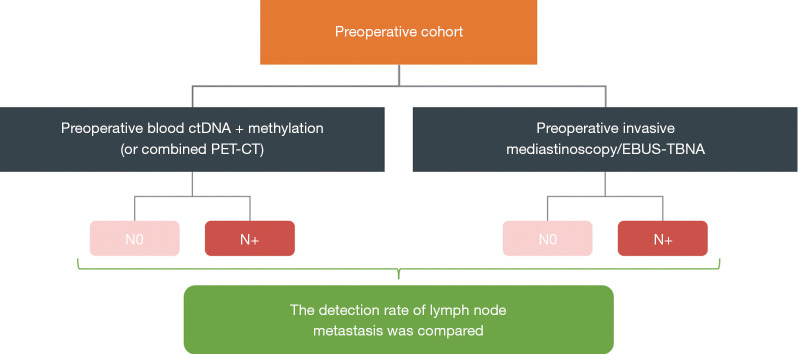
This is a prospective study conducted in three stages. We will enroll patients with clinical stage I-IIIB [8th tumor, node, metastasis (TNM) staging] NSCLC requiring lobectomy plus lymph node sampling/dissection. The distribution of clinical stages in the enrolled population is as follows: clinical stage cN0 (n=100) and cN1/cN2 (n=100). During Stage 1, we will establish LNMs-specific ctDNA methylation signatures and compare negative predictive value (NPV) rates of LNMs using preoperative blood ctDNA somatic mutation/methylation alone or combined with PET-CT across different groups. For Stage 2, we will compare detection rates between ctDNA somatic mutation/methylation profiles alone or combined with PET-CT and traditional mediastinoscopy/endobronchial ultrasound-guided transbronchial needle aspiration (EBUS-TBNA). As for Stage 3, ctDNA-free interval (CFI) and disease-free survival between systematic lymph node presence and absence in patients will be compared with preoperative negative ctDNA profiling and/or PET-CT. In Stage 3, patients will be followed up for 5 years to collect recurrence and survival data. Post-surgery follow-up ctDNA tests will be conducted every 3 months for the first 2 years, every 6 months for years 3-4, and annually in year five. Demographics and baseline data will be summarized with mean, standard deviation, median, max, and min values. Tests will include -tests, Welch/Behren-Fisher test, and Wilcoxon rank-sum test for continuous variables. Categorical data will be presented as counts/percentages and compared using χ test or Fisher's exact test.
By utilizing preoperative ctDNA/methylation profiling in conjunction with PET-CT, this study is expected to yield substantial evidence for accurately predicting LNM before surgery. This will help inform surgeons in selecting the appropriate intraoperative lymph node dissection strategy for operable NSCLC patients.
This study is registered on www.clinicaltrials.gov (NCT06358222).
非小细胞肺癌(NSCLC)约占肺癌病例的85%,仍是癌症相关死亡的主要原因。淋巴结转移(LNM)显著影响复发、生存率和治疗选择。虽然淋巴结采样是手术切除可切除NSCLC的标准方法,但可能会导致并发症。正电子发射断层扫描-计算机断层扫描(PET-CT)有助于评估术前LNM,尽管存在假阳性或假阴性率。此外,循环肿瘤DNA(ctDNA)能以高灵敏度和特异性检测微小残留病灶。ctDNA能否预测可切除NSCLC中的LNM仍不确定。我们的目标是开发一种精确模型,使用非侵入性ctDNA/甲基化分析结合PET-CT成像来预测NSCLC的LNM。
这是一项分三个阶段进行的前瞻性研究。我们将招募临床分期为I-IIIB期[第8版肿瘤、淋巴结、转移(TNM)分期]需要肺叶切除加淋巴结采样/清扫的NSCLC患者。入组人群的临床分期分布如下:临床分期cN0(n = 100)和cN1/cN2(n = 100)。在第一阶段,我们将建立LNM特异性ctDNA甲基化特征,并比较术前单独使用血液ctDNA体细胞突变/甲基化或结合PET-CT在不同组中LNM的阴性预测值(NPV)率。对于第二阶段,我们将比较单独的ctDNA体细胞突变/甲基化谱或结合PET-CT与传统纵隔镜检查/支气管内超声引导经支气管针吸活检(EBUS-TBNA)的检测率。至于第三阶段,将比较患者系统性淋巴结存在与否时的ctDNA无间期(CFI)和无病生存期与术前阴性ctDNA分析和/或PET-CT的情况。在第三阶段,将对患者进行5年随访以收集复发和生存数据。术后前两年每3个月进行一次随访ctDNA检测,第3 - 4年每6个月进行一次,第5年每年进行一次。人口统计学和基线数据将用均值、标准差、中位数、最大值和最小值进行总结。对于连续变量,测试将包括t检验、Welch/Behren-Fisher检验和Wilcoxon秩和检验。分类数据将以计数/百分比形式呈现,并使用χ检验或Fisher精确检验进行比较。
通过结合术前ctDNA/甲基化分析与PET-CT,本研究有望为术前准确预测LNM提供大量证据。这将有助于指导外科医生为可切除NSCLC患者选择合适的术中淋巴结清扫策略。