Boerner Katelynn E, Dudarev Veronica, Pearl-Dowler Leora, Wharton Marie-Noelle, Siden Harold, Holsti Liisa, Oberlander Tim F
Faculty of Medicine, University of British Columbia, Vancouver, BC, Canada.
BC Children's Hospital Research Institute, Vancouver, BC, Canada.
J Dev Behav Pediatr. 2024;45(6):e522-e530. doi: 10.1097/DBP.0000000000001319. Epub 2024 Oct 23.
Dynamic, real-time, in-home methods of data collection are increasingly common in child health research. However, these methods are rarely cocreated or used with families of youth with developmental disabilities. We aimed to determine the feasibility of codesigned methods for in-home data collection for youth across the developmental spectrum.
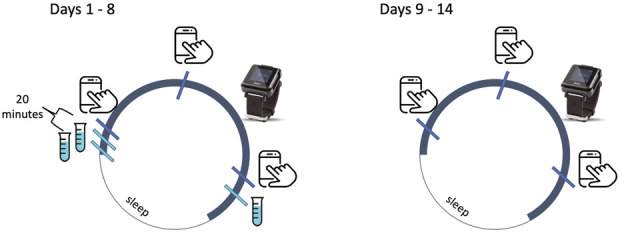
Sixteen youth (14-18 years) with autism spectrum disorder, cerebral palsy, and/or chronic pain completed 14 days of data collection, wearing an accelerometer, answering Ecological Momentary Assessment (EMA) questionnaires, and collecting salivary cortisol samples. Participants completed a poststudy interview regarding their experiences. Data were analyzed for feasibility, quantity, and quality.
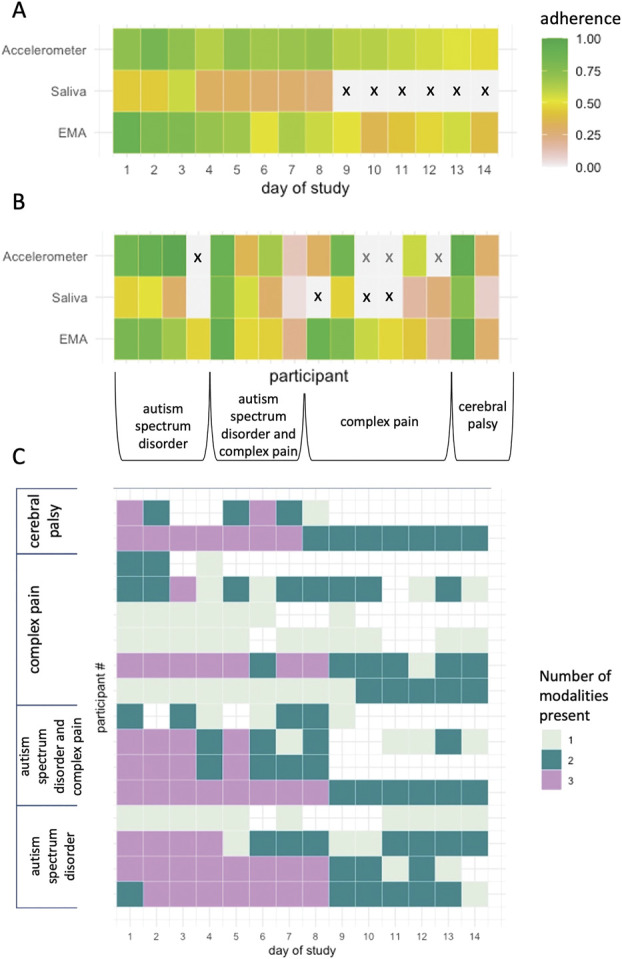
At least 1 EMA response was provided on 73% of days, with 54% of the total number of administered prompts answered before the next prompt arrived. In total, 77% of participants wore the accelerometer ≥10 hours for at least 7 days. Adherence to 8-day saliva sampling after accounting for protocol violations and dry samples was 28%. No significant adverse events were reported aside from mild emotional distress (25%). Families reported generally high satisfaction, willingness to participate again, and acceptability, with moderate burden and interference. Qualitative interviews described: (1) the research question's value to the family as a motivator of engagement; (2) in-home data collection is not a passive or neutral experience; (3) personalized approaches and context are important to families; and (4) a clear need for continued iteration and engagement.
In-home multimodal data collection is potentially feasible for families across the developmental spectrum but requires iteration based on family feedback to increase adherence.
动态、实时、居家的数据收集方法在儿童健康研究中越来越普遍。然而,这些方法很少与发育障碍青少年的家庭共同设计或由其使用。我们旨在确定为不同发育阶段的青少年进行居家数据收集的联合设计方法的可行性。
16名患有自闭症谱系障碍、脑瘫和/或慢性疼痛的青少年(14 - 18岁)完成了14天的数据收集,佩戴加速度计、回答生态瞬时评估(EMA)问卷并采集唾液皮质醇样本。参与者完成了关于他们经历的研究后访谈。对数据进行了可行性、数量和质量分析。
在73%的日子里至少提供了1次EMA回复,在下一个提示到来之前,已给出的提示总数中有54%得到了回答。总体而言,77%的参与者佩戴加速度计≥10小时至少达7天。在考虑方案违规和干燥样本后,8天唾液采样的依从率为28%。除了轻度情绪困扰(25%)外,未报告重大不良事件。家庭报告总体满意度较高、愿意再次参与且接受度较高,负担和干扰程度适中。定性访谈描述了:(1)研究问题对家庭的价值是参与的动力;(2)居家数据收集不是一种被动或中立的体验;(3)个性化方法和背景对家庭很重要;(4)明显需要持续迭代和参与。
居家多模态数据收集对不同发育阶段的家庭来说可能是可行的,但需要根据家庭反馈进行迭代以提高依从性。