Department of Clinical Pharmacology and Therapeutics, Oita University, Yufu, Japan.
Department of Medical Ethics, Faculty of Medicine, Oita University, Yufu, Japan.
JMIR Form Res. 2024 Oct 24;8:e56376. doi: 10.2196/56376.
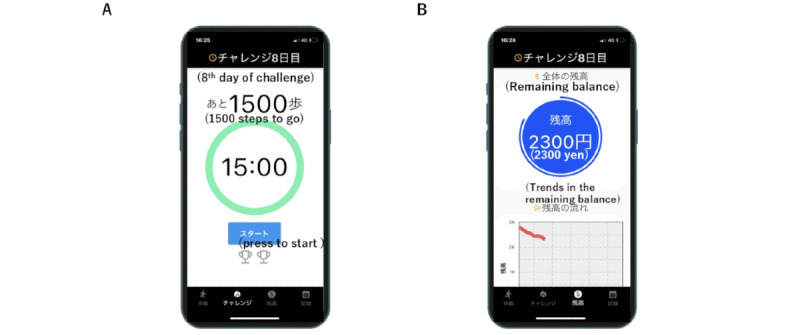
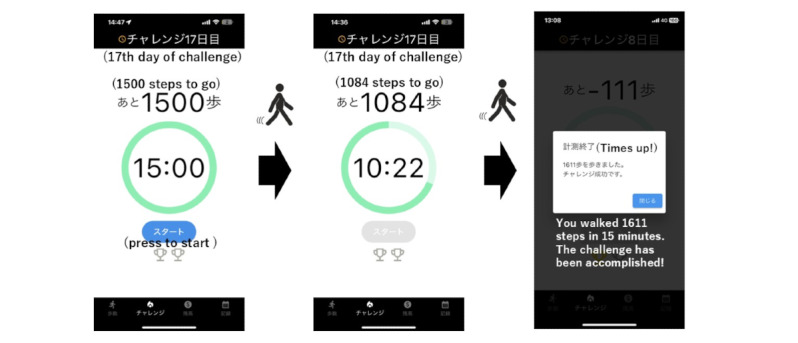
High levels of physical activity are key to improving health outcomes, yet many people fail to take action. Using pedometers to target steps per day and providing financial incentives is a simple and scalable approach to promoting public health. However, conventional pedometers do not account for "intensity" and "duration," making it challenging to efficiently increase people's moderate-to-vigorous physical activity (MVPA), which is expected to improve health outcomes. Based on these rationales, we developed a smartphone app that sets step cadence as a goal (defined as a daily challenge of walking more than 1500 steps in 15 minutes twice a day, which is a heuristic threshold for moderate physical activity) and provides financial incentive when the challenge is met.
This study aimed to evaluate the feasibility of our novel app and explore whether its use can increase users' daily MVPA.
A single-arm pre-post study evaluated the feasibility and efficacy of the app. A total of 15 participants used app 1 (an app without financial incentives) for the first period (4 weeks) and then switched to app 2 (an app with financial incentives) for the second period (4 weeks). The primary outcome was the difference between the first and second periods in the number of successful challenge attempts per week. Secondary outcomes were differences between the first and second periods in daily steps and distance walked. Exploratory outcomes included the difference between the first and second periods in daily "heart points" as measured by Google Fit, a publicly available app that measures users' daily MVPA.
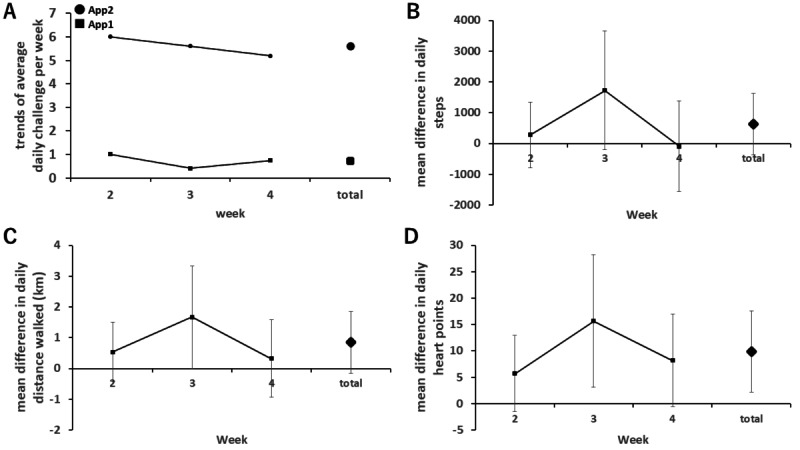
The number of successful challenge attempts per week increased significantly compared to the first period (5.6 times per week vs 0.7 times per week; P<.001). Although not statistically significant, there was a trend toward an increase in the mean steps per day and distance walked per day (6586 steps per day vs 5950 steps per day; P=.19; and 4.69 km per day vs 3.85 km per day; P=.09, respectively). An exploratory end point examining daily MVPA by "heart points" collected from Google Fit also showed a significant increase compared to the first period (22.7 points per day vs 12.8 points per day; P=.02).
Our app using step cadence as a goal and providing financial incentives seemed feasible and could be an effective app to increase users' daily MVPA. Based on the results of this study, we are motivated to conduct a confirmatory study with a broader and larger number of participants.
UMIN 000050518; https://center6.umin.ac.jp/cgi-open-bin/ctr/ctr_view.cgi?recptno=R000057420.
高水平的身体活动是改善健康结果的关键,但许多人未能采取行动。使用计步器来设定每天的步数目标,并提供经济激励是一种简单且可扩展的促进公众健康的方法。然而,传统的计步器没有考虑到“强度”和“时长”,这使得人们难以有效地增加适度到剧烈的身体活动(MVPA),而这预计会改善健康结果。基于这些原理,我们开发了一款智能手机应用程序,将步频设定为目标(每天挑战在 15 分钟内走超过 1500 步两次,这是中等身体活动的启发式阈值),并在达到挑战时提供经济奖励。
本研究旨在评估我们的新型应用程序的可行性,并探讨其使用是否可以增加用户的日常 MVPA。
一项单臂前后研究评估了该应用程序的可行性和效果。共有 15 名参与者在第一阶段(4 周)使用应用程序 1(无经济激励的应用程序),然后在第二阶段(4 周)切换到应用程序 2(有经济激励的应用程序)。主要结果是每周成功挑战次数在第一和第二阶段之间的差异。次要结果是在第一和第二阶段之间每天的步数和行走距离的差异。探索性结果包括第一和第二阶段之间由 Google Fit 测量的日常“心点数”的差异,Google Fit 是一款可测量用户日常 MVPA 的公开可用应用程序。
与第一阶段相比,每周成功挑战的次数显著增加(每周 5.6 次 vs 每周 0.7 次;P<.001)。虽然没有统计学意义,但每天的步数和行走距离都有增加的趋势(每天 6586 步 vs 每天 5950 步;P=.19;每天 4.69 公里 vs 每天 3.85 公里;P=.09,分别)。一个探索性的终点,从 Google Fit 收集的日常 MVPA 的“心点数”,与第一阶段相比也显示出显著增加(每天 22.7 分 vs 每天 12.8 分;P=.02)。
我们的应用程序使用步频作为目标并提供经济激励,似乎是可行的,并且可以成为一种有效的应用程序,以增加用户的日常 MVPA。基于这项研究的结果,我们有动力进行一项有更多参与者的确认性研究。
UMIN 000050518;https://center6.umin.ac.jp/cgi-open-bin/ctr/ctr_view.cgi?recptno=R000057420。