Edmealem Afework, Fentaw Nurye, Bekele Abebe, Tegegne Belachew, Mohammed Jemal, Liknaw Tiliksew
Department of Nursing, Debre Markos University, Debre Markos, Ethiopia.
Tropical College of Medicine Dessie Campus and Dessie Comprehensive Specialized Hospital, Dessie, Ethiopia.
BMC Nurs. 2024 Oct 24;23(1):782. doi: 10.1186/s12912-024-02444-4.
Evidence-based practice is clinical decision-making using the best evidence available in the context of individual patients' preferences and clinical expertise. It is serving as a crucial instrument for the health science disciplines to minimize the theory-practice gap although the level of practice is unknown. Thus, this study aimed to assess nurses' implementation of evidence-based practice in nursing process and its associated factors in South Wollo Zone Public Hospitals.
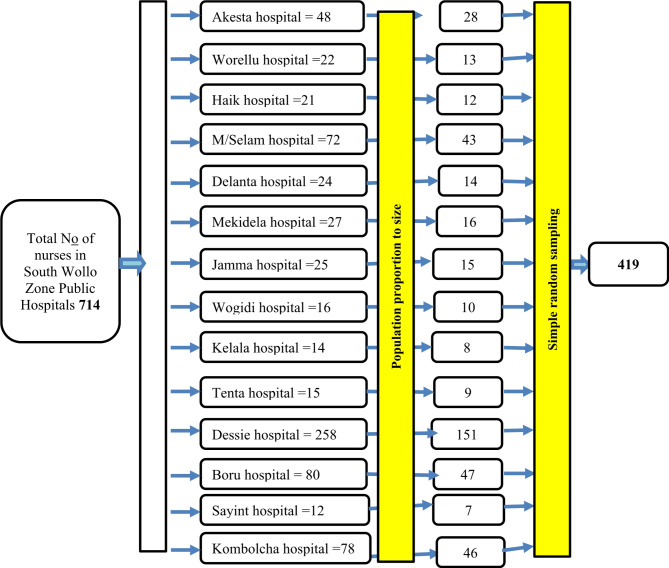
An explanatory sequential mixed method was employed from April 1 to May 29, 2023, among 419 nurses for the quantitative part and 15 others for the qualitative part. The data were collected using structured, pretested, self-administered questionnaires. Simple random and purposive sampling techniques were used to select participants for the quantitative and qualitative studies, respectively. The bivariable analysis was done primarily, and variables with a p-value < 0.25 were further examined using a multivariable logistic regression model to control con-founders. Then, variables having a p-value less than 0.05 with a 95% CI were used to declare significantly associated factors. The key informants were interviewed using pre-made interview guidelines, and then open code software was utilized to conduct a thematic analysis.
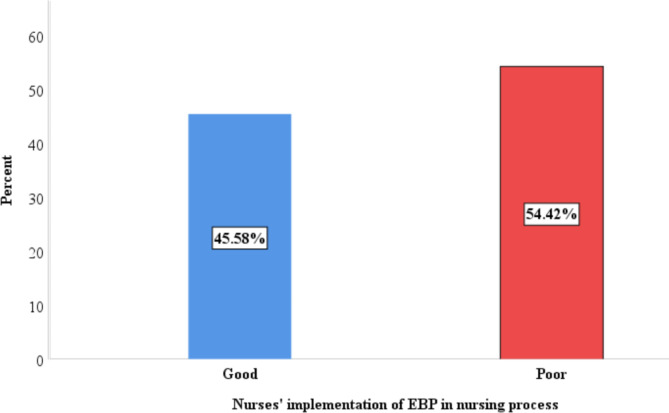
Nurses who had poor implementation of evidence-based practice in the nursing process were 228 [54.42%; 95% CI: (49.8-59.3)]. Similarly, the key informants concluded that the implementation of evidence-based practice in the nursing process was low. Participants who were 31- 40 years old [AOR = 0.61, 95% CI: (0.38-0.99)], 41-50 years [AOR = 0.32, 95% CI: (0.15-0.65)], working at general hospitals [AOR = 3.37, 95% CI: (1.39-8.18)] and comprehensive specialized hospitals [AOR = 7.29, 95% CI: (3.06 - 17.31)], lack of training about evidence-based practice (AOR = 2.50, 95% CI: (1.36-4.56)], and lack of internet access [AOR = 2.46, 95% CI: (1.43-4.23)] were factors associated with poor levels of nurses' implementation of evidence-based practice in the nursing process. The absence of computers, libraries, and updated guidelines were other factors identified on the quality analysis.
Nurses' implementation of evidence-based practice in the nursing process was low. Age, working in general hospitals, and comprehensive and specialized hospitals, lack of training, and internet access were factors that had significant associations. Hence, hospital managers should give an attention to internet access and training about utilization of evidence-based practice in nursing process, particularly for those aged above thirty years old.
循证实践是在考虑个体患者偏好和临床专业知识的背景下,利用现有最佳证据进行临床决策。尽管实践水平尚不清楚,但它正成为健康科学学科缩小理论与实践差距的关键工具。因此,本研究旨在评估南沃洛地区公立医院护士在护理过程中循证实践的实施情况及其相关因素。
2023年4月1日至5月29日采用解释性序贯混合方法,定量部分选取419名护士,定性部分选取另外15名护士。数据通过结构化、预测试、自填式问卷收集。分别采用简单随机抽样和目的抽样技术选取定量和定性研究的参与者。首先进行双变量分析,p值<0.25的变量使用多变量逻辑回归模型进一步检验以控制混杂因素。然后,p值小于0.05且95%置信区间的变量用于确定显著相关因素。使用预先制定的访谈指南对关键信息提供者进行访谈,然后利用开放式编码软件进行主题分析。
在护理过程中循证实践实施不佳的护士有228名[54.42%;95%置信区间:(49.8 - 59.3)]。同样,关键信息提供者得出结论,护理过程中循证实践的实施水平较低。年龄在31 - 40岁的参与者[AOR = 0.61,95%置信区间:(0.38 - 0.99)]、41 - 50岁的参与者[AOR = 0.32,95%置信区间:(0.15 - 0.65)]、在综合医院工作的参与者[AOR = 3.37,95%置信区间:(1.39 - 8.18)]和综合专科医院工作的参与者[AOR = 7.29,95%置信区间:(3.06 - 17.31)]、缺乏循证实践培训(AOR = 2.50,95%置信区间:(1.36 - 4.56)]以及缺乏互联网接入[AOR = 2.46,95%置信区间:(1.43 - 4.23)]是与护士在护理过程中循证实践实施水平不佳相关的因素。质量分析中确定的其他因素包括没有计算机、图书馆和更新的指南。
护士在护理过程中循证实践的实施水平较低。年龄、在综合医院和综合专科医院工作、缺乏培训以及互联网接入是具有显著关联的因素。因此,医院管理者应关注互联网接入以及护理过程中循证实践应用的培训,特别是对于30岁以上的人员。