Ambushe Selamawit Ataro, Awoke Nefsu, Demissie Birhanu Wondimeneh, Tekalign Tiwabwork
School of Nursing, College of Health Science and Medicine, Wolaita Sodo University, Wolaita Sodo, Ethiopia.
School of Nursing and Midwifery, College of Health Science, Addis Ababa University, Addis Ababa, Ethiopia.
BMC Nurs. 2023 Oct 18;22(1):390. doi: 10.1186/s12912-023-01517-0.
Holistic nursing care is an approach to patient care that takes into account the physical, social, spiritual, and psychological needs of the patient. Providing holistic care has been found to be an effective way to prevent diseases and death, as well as improve the quality of healthcare provided to patients. However, despite its perceived benefits, many nurses lack experience with holistic care and only focus on patients' physical needs, treating them as biological machines while ignoring their spiritual, mental, and social needs. Therefore, this study aimed to assess the practice of holistic nursing care and its associated factors among nurses.
A hospital-based cross-sectional study was conducted among 422 sampled Nurses working in public hospitals in Wolaita Zone. Systematic random sampling was applied to select the study participants. A self-administered, pretested questionnaire was used to collect the data. The collected data were entered into Epi Data version 4.6 and analyzed using SPSS version 25. Binary and multivariable logistic regression analyses were used to identify factors associated with holistic nursing care practice. Statistical significance was declared at a p-value less than 0.05. The strength of the association was indicated by the AOR and 95% CI.
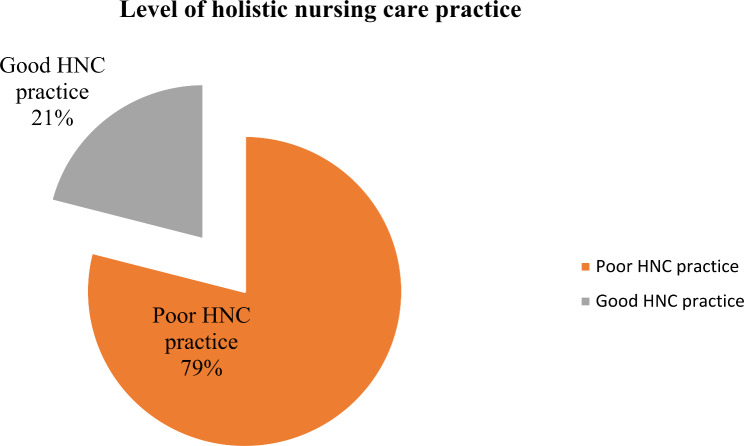
The study found that the overall practice of holistic nursing care was 21%. Nurses with a diploma in nursing (AOR: 0.28; 95% CI: 0.11, 0.71), nurses working in a hospital with no continuous in-service learning (AOR: 0.39; 95% CI: 0.20, 0.76), nurses with a poor relationship with patients (AOR: 0.31; 95% CI: 0.16, 0.58), and nurses with poor knowledge of holistic nursing care practice (AOR: 0.41; 95% CI: 0.21, 0.7) were factors associated with a lower likelihood of practicing holistic nursing care.
This study found that the practice of holistic nursing care among nurses working in public hospitals in the Wolaita Zone was low. Level of education, the unit of work, continuous in-service learning, the nurse-patient relationship, and the knowledge of nurses were factors associated with holistic nursing care. The provision of in-service training and the creation of trusting, positive relationships were suggested to improve the practice of holistic nursing care.
整体护理是一种考虑患者身体、社会、精神和心理需求的患者护理方法。已发现提供整体护理是预防疾病和死亡以及提高提供给患者的医疗保健质量的有效方法。然而,尽管其有明显益处,但许多护士缺乏整体护理经验,仅关注患者的身体需求,将他们当作生物机器对待,而忽视其精神、心理和社会需求。因此,本研究旨在评估护士中整体护理的实践情况及其相关因素。
在沃莱塔地区公立医院工作的422名抽样护士中开展了一项基于医院的横断面研究。采用系统随机抽样来选择研究参与者。使用一份自填式、经过预测试的问卷收集数据。收集到的数据录入Epi Data 4.6版本,并使用SPSS 25版本进行分析。采用二元和多变量逻辑回归分析来确定与整体护理实践相关的因素。当p值小于0.05时宣布具有统计学意义。关联强度由调整后的比值比(AOR)和95%置信区间(CI)表示。
研究发现整体护理的总体实践率为21%。拥有护理文凭的护士(AOR:0.28;95%CI:0.11,0.71)、在没有持续在职学习的医院工作的护士(AOR:0.39;95%CI:0.20,0.76)、与患者关系不佳的护士(AOR:而0.31;95%CI:0.16,0.58)以及对整体护理实践知识掌握较差的护士(AOR:0.41;95%CI:0.21,0.7)是与整体护理实践可能性较低相关的因素。
本研究发现沃莱塔地区公立医院护士中整体护理的实践情况较差。教育水平、工作单位、持续在职学习、护患关系以及护士的知识是与整体护理相关的因素。建议提供在职培训并建立信任、积极的关系以改善整体护理实践。