Wei Chi-Chuan, Hsieh Min-Jia, Chuang Yi-Fang
Institute of Public Health, School of Medicine, National Yang Ming Chiao Tung University, Taipei, Taiwan.
Department of Family Medicine, Taipei Veterans General Hospital, Taipei, Taiwan.
Innov Aging. 2024 Oct 3;8(10):igae084. doi: 10.1093/geroni/igae084. eCollection 2024.
Previous systemic reviews, predominantly including observational studies, have shown that participation in social activities is a protective factor against cognitive decline. However, this association is subject to potential reverse causality, creating a knowledge gap in our understanding of the effect of social interaction interventions on cognitive function. Therefore, this study aims to conduct a systematic review and meta-analysis of randomized controlled trials to examine the effects of social interaction interventions on cognitive decline among older adults without dementia.
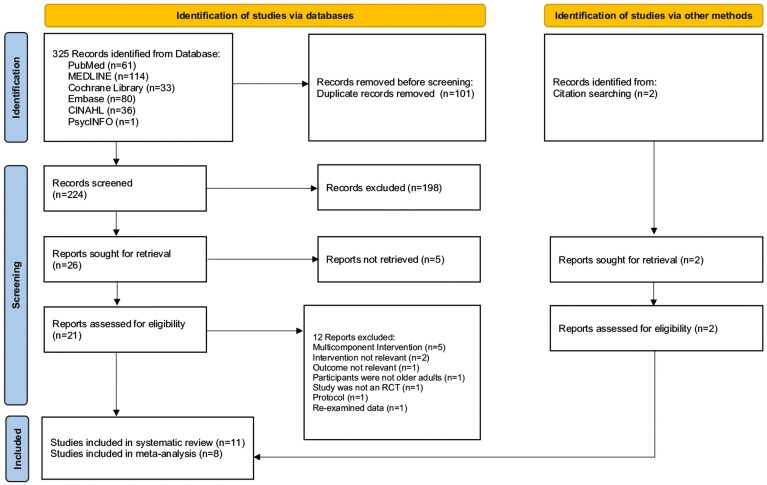
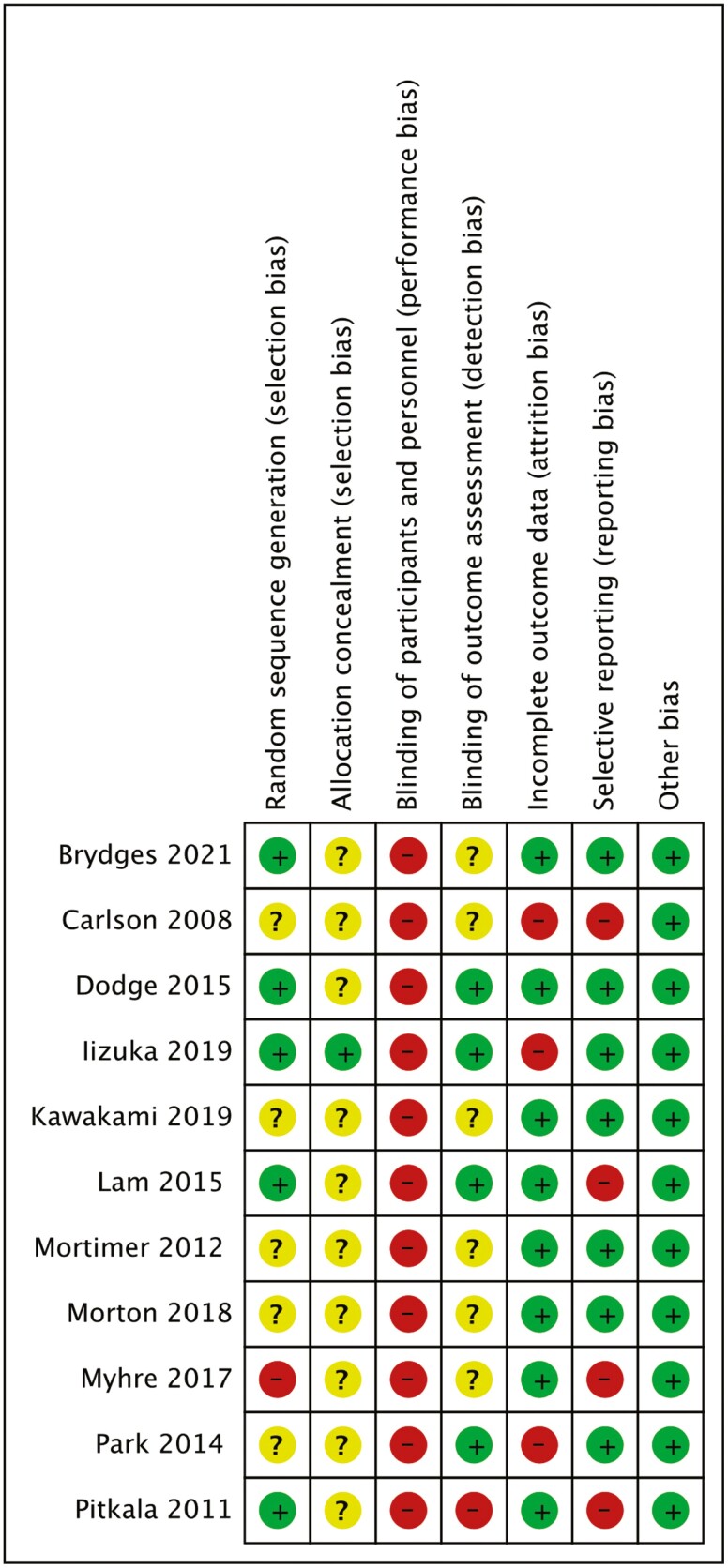
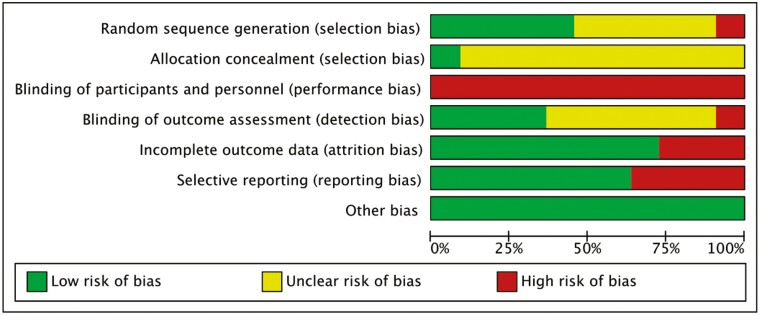
This systematic review, registered in PROSPERO (CRD42022367828), systematically searched 6 databases from inception to May 6, 2022, to identify relevant articles on the effects of activities with social interaction components on cognitive function in community-dwelling older adults without dementia aged above 60. Two independent reviewers conducted study selection, data extraction, and bias assessment, with RevMan5.3 used for meta-analysis. Subgroup analysis was conducted to assess variation in intervention effects among subgroups.
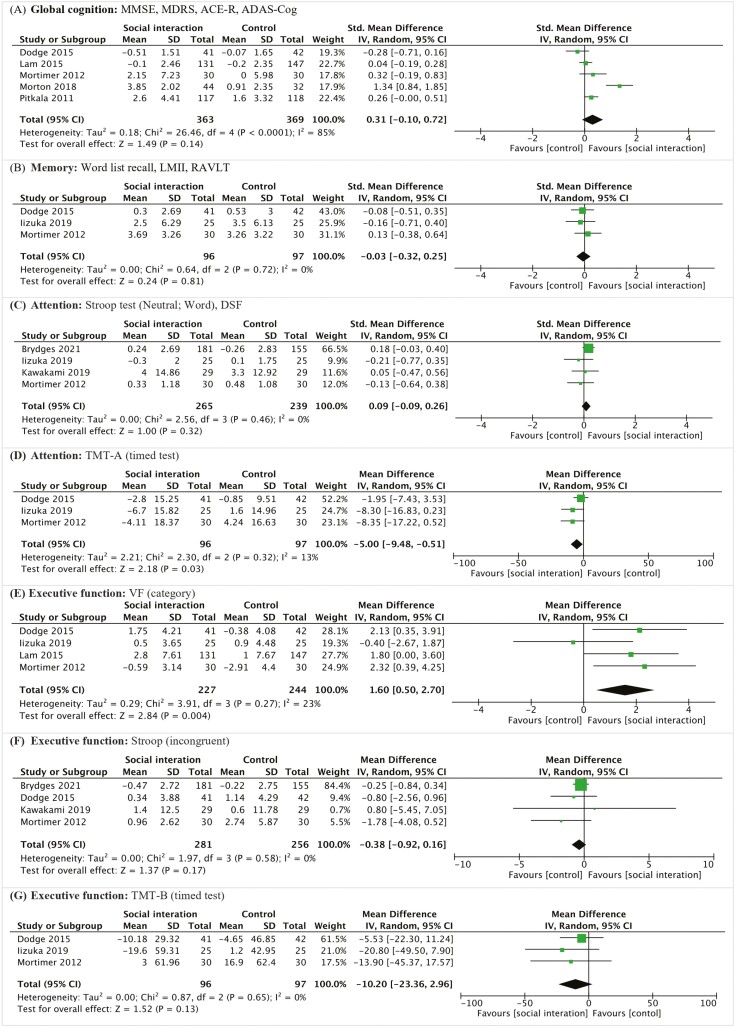
We included 11 studies for qualitative analysis and 8 studies for the meta-analysis. The results showed that social interaction intervention had a significant effect on executive function (standardized mean difference [SMD] = 1.60; 95% CI, 0.50 to 2.70; = .004), but not attention and memory. The subgroup analysis showed a greater cognitive benefit for healthy older adults, but not those with mild cognitive impairment. Moreover, in-person social interaction positively affected global cognition, whereas online interaction did not.
Social interaction interventions have a limited impact on cognitive function in older adults without dementia but showed potential effects on executive function. This finding offers insights for implementing social intervention in the community.
以往的系统评价主要纳入观察性研究,结果显示参与社交活动是预防认知衰退的保护因素。然而,这种关联可能存在潜在的反向因果关系,导致我们在理解社交互动干预对认知功能的影响方面存在知识空白。因此,本研究旨在对随机对照试验进行系统评价和荟萃分析,以检验社交互动干预对无痴呆症老年人认知衰退的影响。
本系统评价已在PROSPERO(CRD42022367828)注册,系统检索了6个数据库,时间跨度从建库至2022年5月6日,以确定关于具有社交互动成分的活动对60岁以上社区居住无痴呆症老年人认知功能影响的相关文章。两名独立评审员进行研究筛选、数据提取和偏倚评估,使用RevMan5.3进行荟萃分析。进行亚组分析以评估亚组间干预效果的差异。
我们纳入11项研究进行定性分析,8项研究进行荟萃分析。结果表明,社交互动干预对执行功能有显著影响(标准化均数差[SMD]=1.60;95%CI,0.50至2.70;P=.004),但对注意力和记忆力无显著影响。亚组分析显示,健康老年人从社交互动干预中获得的认知益处更大,而轻度认知障碍患者则不然。此外,面对面社交互动对整体认知有积极影响,而在线互动则没有。
社交互动干预对无痴呆症老年人的认知功能影响有限,但对执行功能显示出潜在影响。这一发现为在社区实施社交干预提供了见解。