Sabalic Angela, Mei Veronica, Solinas Giuliana, Madeddu Roberto
Department of Biomedical Sciences-Histology, University of Sassari, 07100 Sassari, Italy.
Division of Thoracic Surgery, European Institute of Oncology (IEO), Scientific Institute for Research, Hospitalization and Healthcare (IRCCS), 20141 Milan, Italy.
Toxics. 2024 Oct 17;12(10):755. doi: 10.3390/toxics12100755.
Alzheimer's disease (AD) is the most common cause of dementia and cognitive decline in the elderly. Although the etiology of AD is unknow, an increase in amyloid precursor protein (APP) leads to the toxic aggregation of Aβ plaques. Several factors, such as hypertension, diabetes, dyslipidemia, smoking, hormonal changes, and metal exposure, could increase the risk of developing AD. In this review, we will examine the role of copper (Cu) in the pathophysiology of AD, as well as the mechanisms involved in neurotoxicity and cognitive decline.
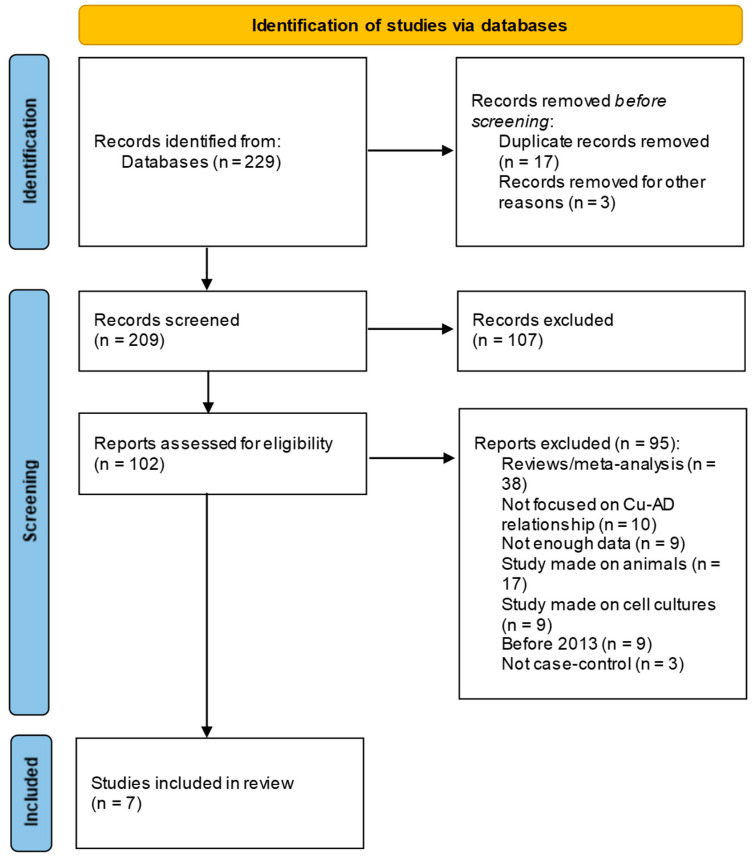
This review was conducted in accordance with PRISMA guidelines. We performed a comprehensive literature analysis over the last ten years on AD and Cu. Only late-onset Alzheimer's disease was considered; only studies on elderly people of both sexes were included.
A total of seven articles were picked for this review, three studies focused on non-ceruloplasmin-bound Copper (non-Cp-Cu) and four on ceruloplasmin-bound Copper (Cp-Cu). The results showed higher Cu concentrations in patients compared to healthy controls.
Elevated concentrations of Cu may contribute to the progression of AD, potentially interacting with ATP7B mutations, oxidative stress (OS), and amyloid-β plaques. Future research is needed to provide more robust evidence and better characterize the relationship between AD and Cu.
阿尔茨海默病(AD)是老年人痴呆和认知功能下降的最常见原因。尽管AD的病因尚不清楚,但淀粉样前体蛋白(APP)增加会导致Aβ斑块的毒性聚集。高血压、糖尿病、血脂异常、吸烟、激素变化和金属暴露等多种因素会增加患AD的风险。在本综述中,我们将研究铜(Cu)在AD病理生理学中的作用,以及神经毒性和认知功能下降所涉及的机制。
本综述按照PRISMA指南进行。我们对过去十年中关于AD和Cu的文献进行了全面分析。仅考虑晚发型阿尔茨海默病;仅纳入对两性老年人的研究。
本综述共挑选了7篇文章,3项研究聚焦于非铜蓝蛋白结合铜(非Cp-Cu),4项研究聚焦于铜蓝蛋白结合铜(Cp-Cu)。结果显示,与健康对照相比,患者体内的铜浓度更高。
铜浓度升高可能会促进AD的进展,可能与ATP7B突变、氧化应激(OS)和淀粉样β斑块相互作用。未来需要开展更多研究以提供更有力的证据,并更好地描述AD与铜之间的关系。