Department of Internal Medicine, National Medical Center, Seoul, Republic of Korea.
School of Biomedical Convergence Engineering, Pusan National University, Yangsan, Republic of Korea.
PLoS One. 2024 Oct 25;19(10):e0309476. doi: 10.1371/journal.pone.0309476. eCollection 2024.
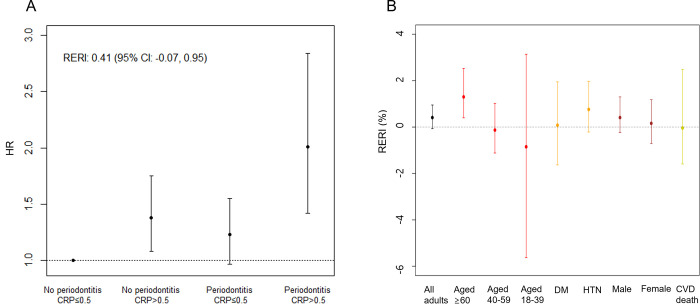
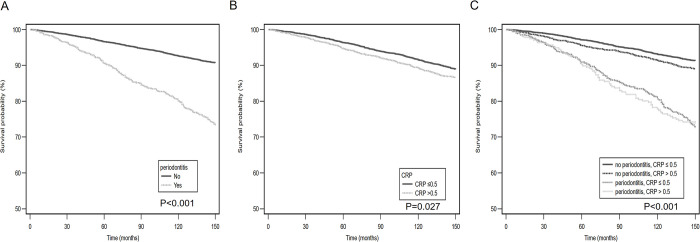
Periodontitis is associated with elevated C-reactive protein (CRP) levels. Although the coexistence of periodontitis and elevated CRP levels may heighten the risk of mortality, previous studies have not confirmed their synergistic effect. Understanding this interaction is crucial for identifying potential interventions to reduce mortality risk in individuals with periodontitis. This study aimed to assess the synergistic effects of periodontitis and elevated CRP levels on mortality in 7,938 adult individuals who participated in the National Health and Nutrition Examination Study 2001-2004. The association of periodontitis status and CRP levels with mortality was assessed using a survey-weighted Cox model. The interactive effect was estimated; the synergistic effect of CRP levels and periodontitis status on mortality was assessed using the relative excess risk due to interaction (RERI). Periodontitis was diagnosed in 1,065 (13.4%) participants. Compared with the participants without periodontitis and possessing CRP levels of ≤ 0.5 mg/dL, those with periodontitis (hazard ratio [HR], 1.38) or CRP levels of > 0.5 mg/dL (HR 1.23) had higher HRs. The participants with both periodontitis and CRP levels of > 0.5 mg/dL had the highest HR of 2.01. The additive scale interactive effect of the periodontal status and CRP levels, measured using RERI 0.41 (-0.07, 0.95), was positive and nearly significant in the total population. The synergy between the periodontal status and CRP levels was more prominent in the participants aged ≥60 years than that in younger individuals. Periodontitis with high CRP levels may indicate a high mortality rate, indicating the importance of active monitoring and intensive management of periodontitis and inflammatory markers.
牙周炎与 C 反应蛋白(CRP)水平升高有关。尽管牙周炎和 CRP 水平升高并存可能会增加死亡率,但以前的研究并未证实它们的协同作用。了解这种相互作用对于确定潜在的干预措施以降低牙周炎患者的死亡风险至关重要。本研究旨在评估牙周炎和 CRP 水平升高对 7938 名参加 2001-2004 年全国健康和营养检查调查的成年人死亡率的协同作用。使用调查加权 Cox 模型评估牙周炎状况和 CRP 水平与死亡率的关系。估计了交互作用;使用交互作用归因的超额相对风险(RERI)评估 CRP 水平和牙周炎状况对死亡率的协同作用。在 1065 名(13.4%)参与者中诊断出牙周炎。与没有牙周炎且 CRP 水平≤0.5mg/dL 的参与者相比,患有牙周炎(危险比[HR],1.38)或 CRP 水平>0.5mg/dL(HR 1.23)的参与者具有更高的 HR。同时患有牙周炎和 CRP 水平>0.5mg/dL 的参与者的 HR 最高,为 2.01。使用 RERI(0.41,-0.07,0.95)测量牙周炎状态和 CRP 水平的加性尺度交互效应为正值,在总人口中接近显著。牙周炎状态和 CRP 水平之间的协同作用在年龄≥60 岁的参与者中比年轻参与者更为明显。CRP 水平升高的牙周炎可能表明死亡率较高,表明需要积极监测和强化管理牙周炎和炎症标志物。