Division of Epidemiology, Department of Internal Medicine, University of Texas Southwestern Medical Center, Dallas, Texas, USA.
RTI International, Washington, District of Columbia, USA.
Environ Health Perspect. 2022 May;130(5):57001. doi: 10.1289/EHP9009. Epub 2022 May 11.
Consensus on the etiology of 1991 Gulf War illness (GWI) has been limited by lack of objective individual-level environmental exposure information and assumed recall bias.
We investigated a prestated hypothesis of the association of GWI with a gene-environment (GxE) interaction of the () Q192R polymorphism and low-level nerve agent exposure.
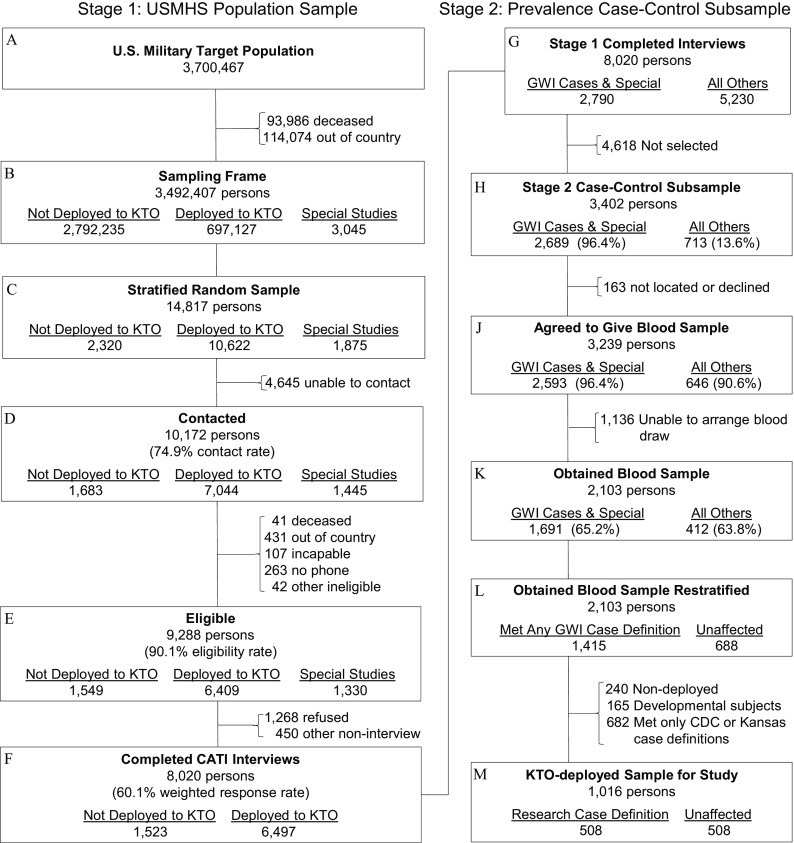
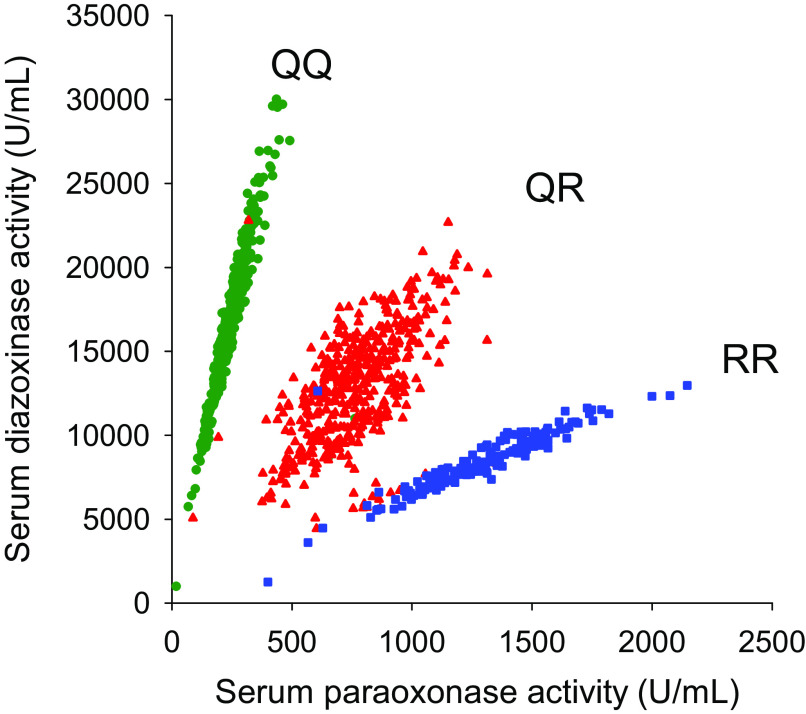
A prevalence sample of 508 GWI cases and 508 nonpaired controls was drawn from the 8,020 participants in the U.S. Military Health Survey, a representative sample survey of military veterans who served during the Gulf War. The Q192R genotype was measured by real-time polymerase chain reaction (RT-PCR), and the serum Q and R isoenzyme activity levels were measured with PON1-specific substrates. Low-level nerve agent exposure was estimated by survey questions on having heard nerve agent alarms during deployment.
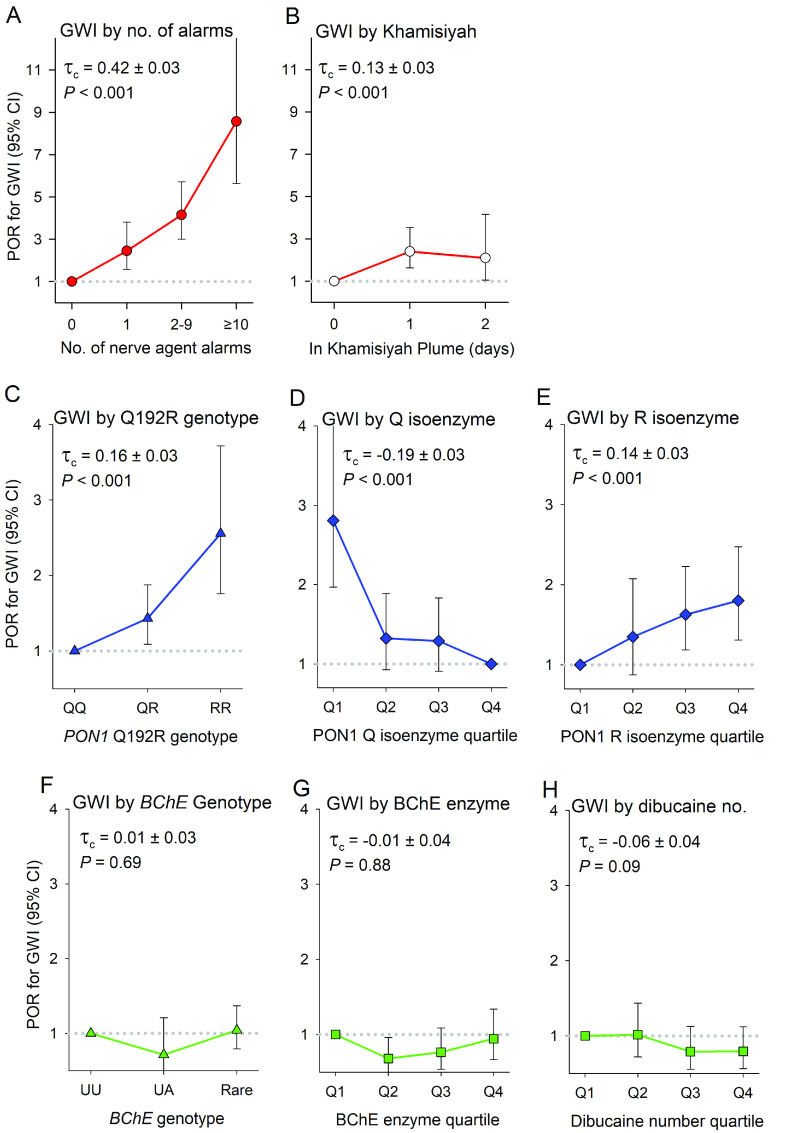
The GxE interaction of the Q192R genotype and hearing alarms was strongly associated with GWI on both the multiplicative [prevalence odds ratio (POR) of the ; 95% confidence interval (CI): 1.20, 9.72] and additive (synergy ; 95% CI: 1.82, 12.19) scales, adjusted for measured confounders. The Q192R genotype and the alarms variable were independent (adjusted POR in the ; 95% CI: 0.81, 1.73; ), and the associations of GWI with the number of R alleles and quartiles of Q isoenzyme were monotonic. The adjusted relative excess risk due to interaction (aRERI) was 7.69 (95% CI: 2.71, 19.13). Substituting Q isoenzyme activity for the genotype in the analyses corroborated the findings. Sensitivity analyses suggested that recall bias had forced the estimate of the GxE interaction toward the null and that unmeasured confounding is unlikely to account for the findings. We found a GxE interaction involving the Q-correlated PON1 diazoxonase activity and a weak possible GxE involving the Khamisiyah plume model, but none involving the PON1 R isoenzyme activity, arylesterase activity, paraoxonase activity, butyrylcholinesterase genotypes or enzyme activity, or pyridostigmine.
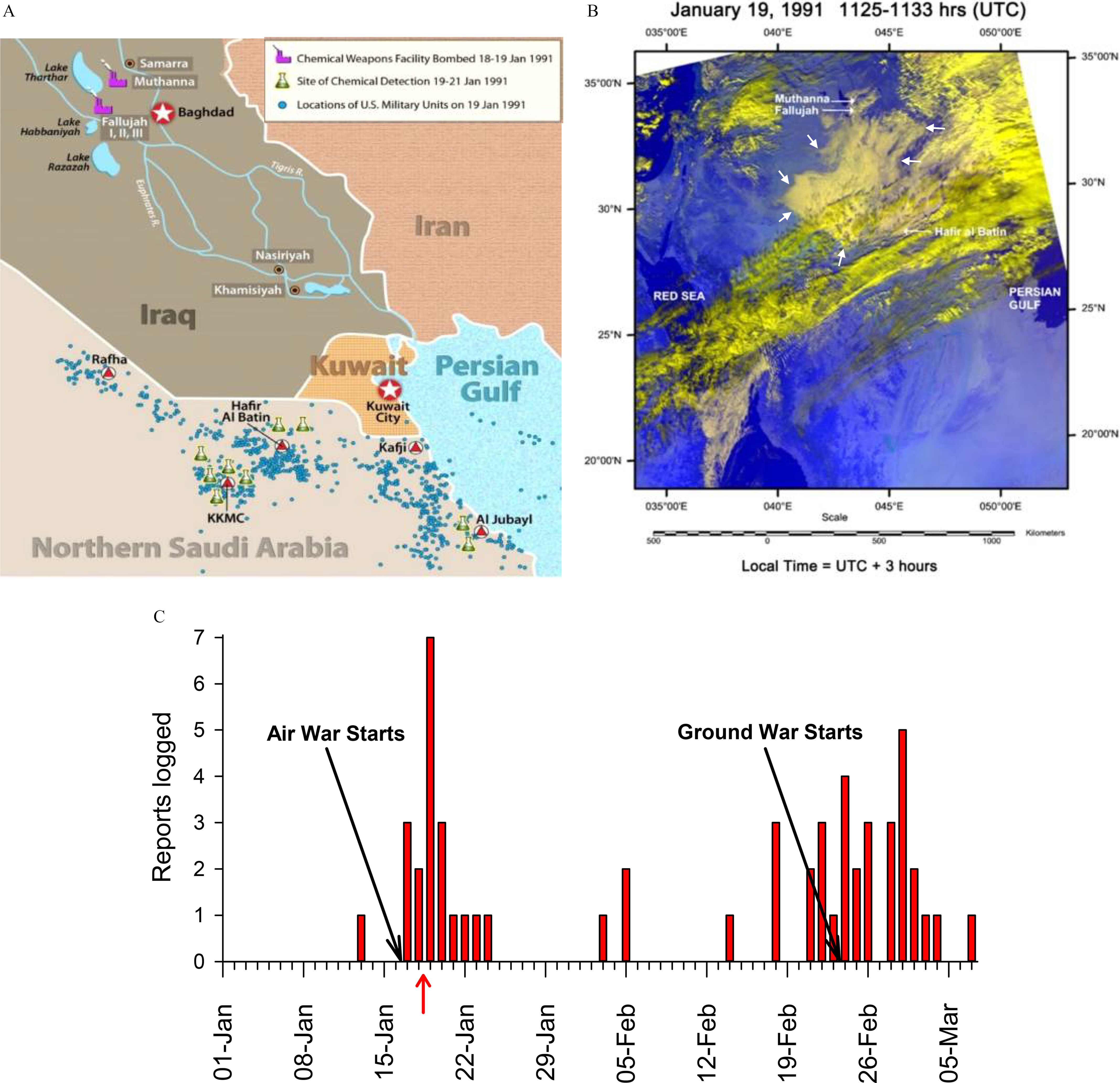
Given gene-environment independence and monotonicity, the unconfounded supports a mechanistic interaction. Together with the direct evidence of exposure to fallout from bombing of chemical weapon storage facilities and the extensive toxicologic evidence of biochemical protection from organophosphates by the Q isoenzyme, the findings provide strong evidence for an etiologic role of low-level nerve agent in GWI. https://doi.org/10.1289/EHP9009.
由于缺乏客观的个体水平环境暴露信息和假设的回忆偏差,1991 年海湾战争疾病(GWI)病因的共识受到限制。
我们调查了 GWI 与基因-环境(GxE)相互作用的假设,该相互作用涉及()Q192R 多态性和低水平神经毒剂暴露。
从海湾战争期间参加美国军事健康调查的 8020 名退伍军人的代表性样本调查中抽取了 508 名 GWI 病例和 508 名非配对对照。通过实时聚合酶链反应(RT-PCR)测量 Q192R 基因型,并用 PON1 特异性底物测量血清 Q 和 R 同工酶活性水平。通过调查问题估计低水平神经毒剂暴露,询问在部署期间是否听到过神经毒剂警报。
Q192R 基因型与听到警报之间的 GxE 相互作用与 GWI 强烈相关,无论是在乘法(;95%置信区间[CI]:1.20,9.72)还是在加性(协同;95%CI:1.82,12.19)尺度上,均经过测量混杂因素调整。Q192R 基因型和警报变量是独立的(调整后;95%CI:0.81,1.73;),并且 GWI 与 R 等位基因数量和 Q 同工酶四分位区间的关联是单调的。交互作用的相对超额风险(aRERI)为 7.69(95%CI:2.71,19.13)。在分析中用 Q 同工酶活性代替基因型,结果得到了证实。敏感性分析表明,回忆偏差迫使 GxE 相互作用的估计值接近零,并且不太可能存在未测量的混杂因素。我们发现了与 Q 相关的 PON1 二嗪酮酶活性有关的 GxE 相互作用,以及与 Khamisiyah 羽流模型有关的可能较弱的 GxE 相互作用,但与 PON1 R 同工酶活性、芳基酯酶活性、对氧磷酶活性、丁酰胆碱酯酶基因型或酶活性或吡啶斯的明无关。
鉴于基因-环境独立性和单调性,未混杂的支持了一种机制性相互作用。结合对爆炸化学武器储存设施造成的散落物的直接暴露证据,以及生物化学对有机磷的 Q 同工酶的保护的广泛毒理学证据,这些发现为低水平神经毒剂在 GWI 中的病因作用提供了强有力的证据。