Cuffaro Doretta, Bertolini Andrea, Silva Ana Margarida, Rodrigues Francisca, Gabbia Daniela, De Martin Sara, Saba Alessandro, Bertini Simone, Digiacomo Maria, Macchia Marco
Department of Pharmacy, University of Pisa, 56126 Pisa, Italy.
Interdepartmental Research Center "Nutraceuticals and Food for Health", University of Pisa, 56100 Pisa, Italy.
Foods. 2024 Oct 18;13(20):3312. doi: 10.3390/foods13203312.
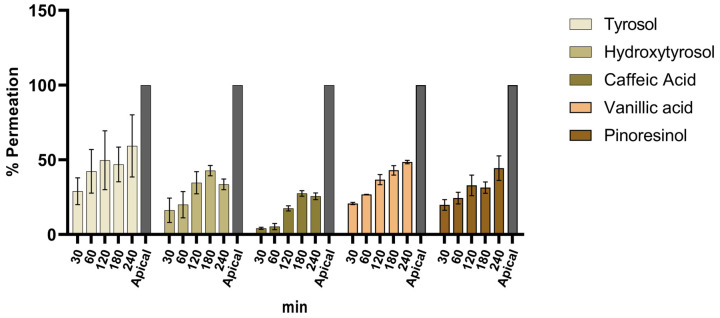
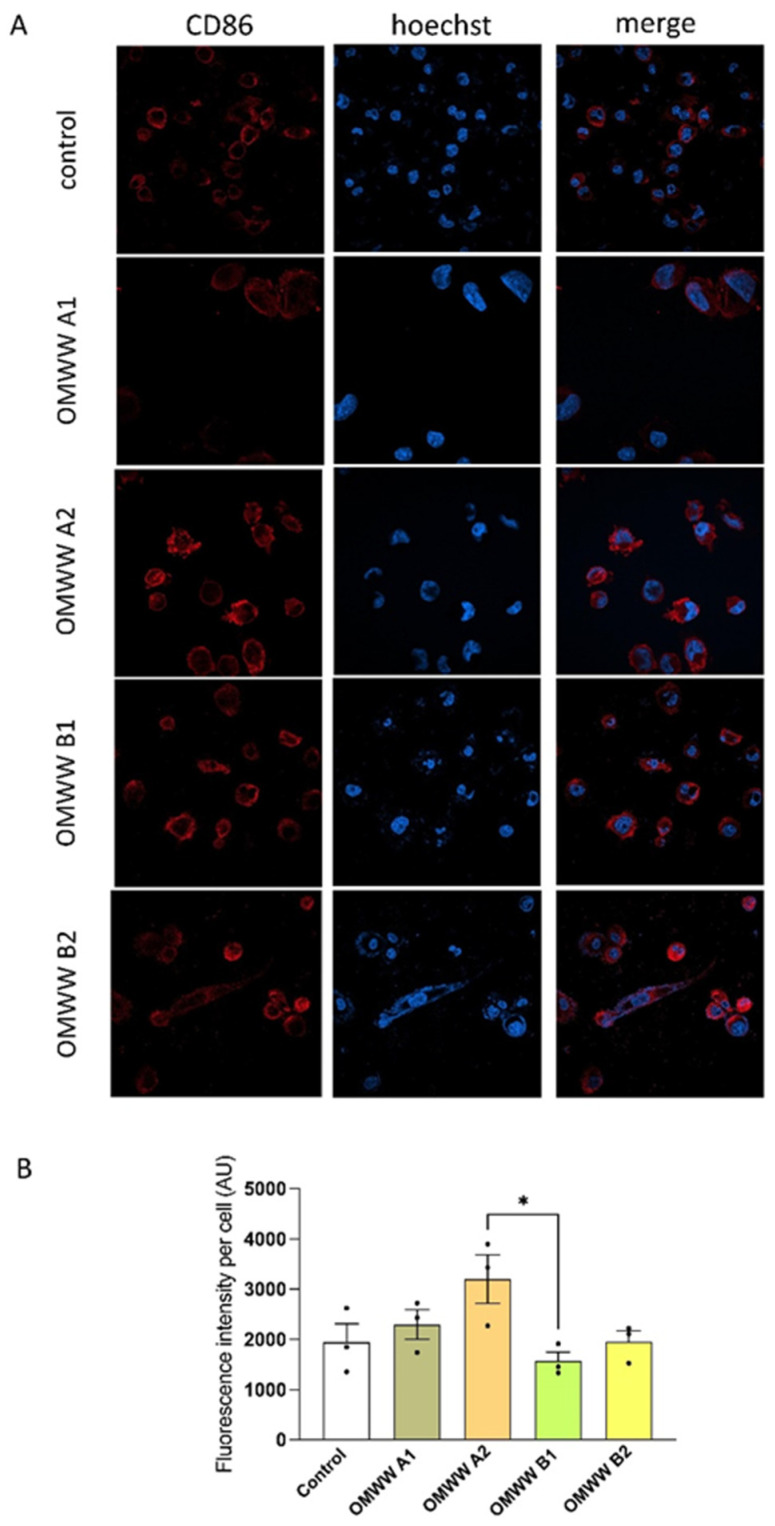
This study reports a comparative analysis of the polyphenolic composition and nutraceutical properties of different olive mill wastewater (OMWW) and corresponding extra virgin olive oil (EVOO) extracts. Specifically, four OMWWs and corresponding EVOOs from cultivars Frantoio (A) and Leccino (B) obtained from different crushing seasons (early-stage (A1 and B1) and later-stage (A2 and B2)) were analyzed. Employing HPLC-DAD and LC-MS methods, the primary polyphenol content was identified and quantified. Overall, OMWW extracts showed a greater polyphenolic content compared to corresponding EVOO extracts, with OMWW B1 displaying the highest levels of polyphenols. The antiradical properties of extracts towards radical species (DPPH, ABTS, O, and HOCl) were demonstrated in vitro, revealing a correlation with polyphenolic content. In fact, OMWW B1 and B2 demonstrated the strongest antiradical activity. Exploring nutraceutical properties of OMWWs, the intestinal permeation of the main polyphenols in a co-culture model (Caco-2 and HT29-MTX cell lines) was assessed, with tyrosol achieving a permeation of almost 60%. Furthermore, the involvement in the inflammation process has been evaluated in cell studies on THP1-derived macrophages by immunocytochemistry, demonstrating that OMWW B1 may exert an anti-inflammatory effect by modulating specific phenotype expression on macrophages. In conclusion, this study provides evidence supporting the reuse of OMWWs as a source of polyphenols with nutraceutical properties.
本研究报告了对不同橄榄果渣废水(OMWW)和相应特级初榨橄榄油(EVOO)提取物的多酚成分及营养特性的比较分析。具体而言,分析了来自品种弗拉托io(A)和莱基诺(B)的四种OMWW及其相应的EVOO,这些样本来自不同的压榨季节(早期(A1和B1)和后期(A2和B2))。采用高效液相色谱 - 二极管阵列检测法(HPLC - DAD)和液相色谱 - 质谱联用法(LC - MS),对主要多酚含量进行了鉴定和定量。总体而言,与相应的EVOO提取物相比,OMWW提取物显示出更高的多酚含量,其中OMWW B1的多酚含量最高。体外实验证明了提取物对自由基(DPPH、ABTS、O和HOCl)的抗自由基特性,揭示了其与多酚含量的相关性。事实上,OMWW B1和B2表现出最强的抗自由基活性。在探索OMWW的营养特性时,评估了共培养模型(Caco - 2和HT29 - MTX细胞系)中主要多酚的肠道渗透性,酪醇的渗透率达到近60%。此外,通过免疫细胞化学在THP1衍生的巨噬细胞的细胞研究中评估了其在炎症过程中的作用,证明OMWW B1可能通过调节巨噬细胞上的特定表型表达发挥抗炎作用。总之,本研究提供了证据支持将OMWW作为具有营养特性的多酚来源进行再利用。